


ML2011 Semiconductor
#MP3 decoder
#stereo DAC
#speaker amplifier
#audio playback
#LSI
#semiconductor
#ML2011GD
#ML2011HB
#decoder
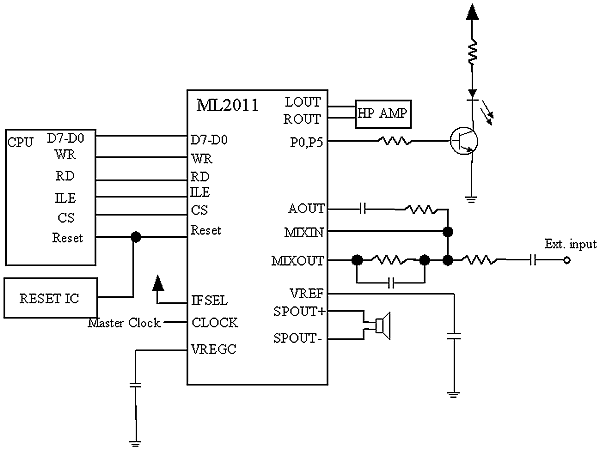
Description: The ML2011GD/ML2011HB is an MP3 decoder LSI that is user-friendly. In addition to the MP3 decoding capabilities, it includes a stereo DAC and an 8Ω 650mW drive speaker amplifier, enabling MP3 playback functionality by simply integrating this LSI into the application.
The ML2011GD/ML2011HB serves as a versatile solution for MP3 playback applications, combining multiple essential components into a single integrated circuit. The MP3 decoder functionality allows for the decoding of compressed audio files, facilitating high-quality audio playback with minimal external components.
The integrated stereo Digital-to-Analog Converter (DAC) ensures that the digital audio signals are accurately converted to analog signals, which is crucial for maintaining audio fidelity during playback. The DAC's performance can significantly affect the overall sound quality, making it an essential feature for audio applications.
The 8Ω speaker amplifier, capable of delivering 650mW of power, is designed to drive standard speakers effectively. This feature simplifies the design process by eliminating the need for a separate audio amplifier, thus reducing the overall component count and PCB space requirements. The amplifier's output stage is optimized for efficiency, providing sufficient power to drive speakers while minimizing heat generation.
Incorporating the ML2011GD/ML2011HB into a design allows for straightforward integration into various applications, such as portable audio players, alarm systems, and other consumer electronics that require MP3 playback capabilities. The compact nature of the LSI and its all-in-one design make it an ideal choice for developers aiming to create efficient and space-saving audio solutions.
Overall, the ML2011GD/ML2011HB represents a significant advancement in audio technology, streamlining the process of implementing MP3 playback in electronic devices while ensuring high-quality sound reproduction.ML2011GD/ML2011HB is MP3 decoder LSI easily used. Besides the MP3 decoder, it integrates stereo DAC and 8 © 650mW drive speaker amplifier that allows MP3 playback function only by building this LSI into the application.
The ML2011GD/ML2011HB serves as a versatile solution for MP3 playback applications, combining multiple essential components into a single integrated circuit. The MP3 decoder functionality allows for the decoding of compressed audio files, facilitating high-quality audio playback with minimal external components.
The integrated stereo Digital-to-Analog Converter (DAC) ensures that the digital audio signals are accurately converted to analog signals, which is crucial for maintaining audio fidelity during playback. The DAC's performance can significantly affect the overall sound quality, making it an essential feature for audio applications.
The 8Ω speaker amplifier, capable of delivering 650mW of power, is designed to drive standard speakers effectively. This feature simplifies the design process by eliminating the need for a separate audio amplifier, thus reducing the overall component count and PCB space requirements. The amplifier's output stage is optimized for efficiency, providing sufficient power to drive speakers while minimizing heat generation.
Incorporating the ML2011GD/ML2011HB into a design allows for straightforward integration into various applications, such as portable audio players, alarm systems, and other consumer electronics that require MP3 playback capabilities. The compact nature of the LSI and its all-in-one design make it an ideal choice for developers aiming to create efficient and space-saving audio solutions.
Overall, the ML2011GD/ML2011HB represents a significant advancement in audio technology, streamlining the process of implementing MP3 playback in electronic devices while ensuring high-quality sound reproduction.ML2011GD/ML2011HB is MP3 decoder LSI easily used. Besides the MP3 decoder, it integrates stereo DAC and 8 © 650mW drive speaker amplifier that allows MP3 playback function only by building this LSI into the application.

low power universal demultiplexer decoder
This circuit functions as a universal decoder, capable of operating either as a dual 1-of-4 decoder or as a single 1-of-8 decoder, depending on the signal applied to the Mode Control (M) input. In the dual mode, each section features...

Lessons In Semiconductors
Thyristors are a class of semiconductor components that exhibit hysteresis, which is the property whereby a system does not return to its original state after the cause of the state change has been removed. A simple example of hysteresis is...

Background music decoder
This circuit is a background music (SCA) decoder designed to process an input demodulated (multiplex) FM signal. The NE565, a Phase Locked Loop (PLL) integrated circuit, serves as the foundation for this design.
The background music (SCA) decoder circuit utilizes the...

decoder circuit
The PPI-8255 is a general-purpose I/O programmable interface that is typically connected directly to a computer bus. This article demonstrates that the card can serve dual purposes: as an expander port and for direct I/O functionality. The card can be...

The signal processing circuit
The operation of a semiconductor color sensor can be summarized as follows. The figure illustrates the spectral response curve of two photodiodes that intersect at a specific wavelength. When light of this wavelength is incident on the photodiodes, the currents...

The STA013 MP3 Decoder Chip
This page's mission is to assist in understanding the use of the STA013 MP3 decoder chip for designing an MP3 player. The player design outlined in subsequent pages utilizes the STA013, but this page aims to clarify the STA013 itself...

Sca background music decoder
A resistive voltage divider is utilized to establish a bias voltage for the input (pins 2 and 3). The demodulated FM signal is introduced to the input through a two-stage high-pass filter, which serves to provide capacitive coupling and to...

4-channel SQ logic decoder
4-channel SQ logic decoder with a current drain of 75 mA at 20 volts. The input impedance is 2M ohms, and the output impedance is 2K ohms (courtesy of GTE Sylvania Incorporated).
The 4-channel SQ logic decoder is an integrated circuit...

A practical MS Decoder Circuit
The schematic diagram of the MS Decoder may appear complex, but it is relatively straightforward. Initially, both the Mid and Side signals are buffered using unity gain inverting buffers, which are constructed around IC1b and IC2b. This buffering serves two...