


Passive mixer

Description: This simple circuit can be used to combine stereo signals to produce a monaural output. K1 and R2 isolate both circuits, while R3 controls the level of the combined output signal.
The circuit functions by taking two separate stereo input signals and merging them into a single monaural output. The primary components involved are the switch K1, resistors R2 and R3, and the input and output connectors.
K1 serves as a switch that isolates the left and right channels of the stereo input. When activated, it allows the signals from both channels to pass through while preventing interference between them. This isolation is crucial for maintaining signal integrity and ensuring that the final output is a true representation of the combined audio signals.
Resistor R2 is connected in such a way that it further isolates the two circuits, ensuring that any potential cross-talk or interference is minimized. This resistor plays a vital role in maintaining the quality of the audio output by reducing unwanted noise that can occur when combining signals.
Resistor R3 is used to adjust the level of the combined output signal. By varying the resistance, the amplitude of the output can be controlled, allowing for a balanced audio experience. This control is particularly important in applications where the output needs to match the input levels of other devices or systems, ensuring compatibility and optimal performance.
Overall, this circuit is a straightforward yet effective solution for combining stereo audio signals into a single monaural output, making it suitable for various applications in audio processing and signal routing.This simple circuit can be used to combine stereo signals to produce a monaural output K1 and R2 isolate both circuits and R3 controls the level of the combined output signal.
The circuit functions by taking two separate stereo input signals and merging them into a single monaural output. The primary components involved are the switch K1, resistors R2 and R3, and the input and output connectors.
K1 serves as a switch that isolates the left and right channels of the stereo input. When activated, it allows the signals from both channels to pass through while preventing interference between them. This isolation is crucial for maintaining signal integrity and ensuring that the final output is a true representation of the combined audio signals.
Resistor R2 is connected in such a way that it further isolates the two circuits, ensuring that any potential cross-talk or interference is minimized. This resistor plays a vital role in maintaining the quality of the audio output by reducing unwanted noise that can occur when combining signals.
Resistor R3 is used to adjust the level of the combined output signal. By varying the resistance, the amplitude of the output can be controlled, allowing for a balanced audio experience. This control is particularly important in applications where the output needs to match the input levels of other devices or systems, ensuring compatibility and optimal performance.
Overall, this circuit is a straightforward yet effective solution for combining stereo audio signals into a single monaural output, making it suitable for various applications in audio processing and signal routing.This simple circuit can be used to combine stereo signals to produce a monaural output K1 and R2 isolate both circuits and R3 controls the level of the combined output signal.

Car Amplifier Circuit Schematic using TDA2040 Integrated Audio Amplifier
A car stereo amplifier circuit utilizing the TDA2040 is presented here. The TDA2040 is a monolithic integrated audio amplifier that functions in Class AB mode. This integrated circuit features built-in short circuit protection and thermal shutdown capabilities, and it can...

AV (Audio/Video) Wireless Transmitter
This circuit enables wireless audio and visual transmission to a television, which serves as a receiver, thus negating the need for a separate monitor. Additionally, it can be connected to a VCR or CCD camera, facilitating the establishment of a...

Stereo Audio Isolator
This circuit is useful for removing ground loop hum on a remote line level audio signal line. It can be used to connect a computer sound card to a stereo amplifier's line input. Other uses include tapping into a line...

Stereo balance meter
Outputs from each channel are fed to the two inputs of IC1 connected as a differential amplifier. IC2 and IC3 are driven by the output of IC1. The output of IC1 is connected to the non-inverting inputs of IC2 and...
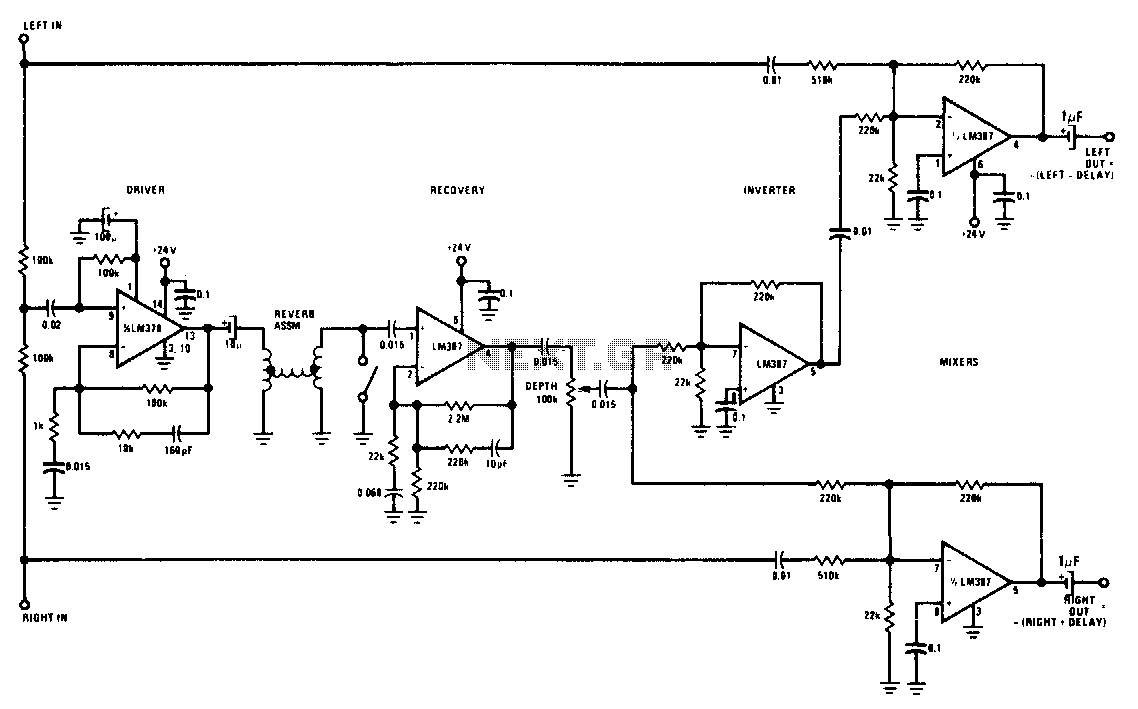
Stereo reverb enhancement system
The system can be used to synthesize a stereo effect from a monaural source such as AM radio or FM-mono broadcast. It can also be added to an existing stereo (or quad) system, where it produces an exciting "opening up"...

EUA2123 20-W Stereo Class-D Audio Power Amplifier
This application note describes the evaluation board for the AD7892-2, a 12-bit analog-to-digital (A/D) converter. The AD7892-2 is a high-speed, low-power device capable of 500 ksps sampling rate, operating from a single +5V supply. It features an on-chip track/hold amplifier,...

BA1451F Am Radio / Fm If Stereo System Ic
The BA3822LS, BA3822FS, BA3823LS, and BA3824LS are monolithic, five-point stereo graphic equalizer integrated circuits (ICs). Each IC features two channels, with five center frequencies for each channel that can be independently set using external capacitors. These ICs support a wide...

Small High Quality Audio Power Amplifier
This audio power amplifier is highly suitable for portable devices or as a headphone amplifier. The circuit design of this audio power amplifier is straightforward.
This audio power amplifier circuit is designed to enhance audio signals for portable devices and headphones,...

stereo
This audio amplifier design utilizes two LM3886 chips per channel in a parallel configuration, based on the PA100 parallel amplifier detailed in National Semiconductor's application note AN1192. The amplifier can deliver approximately 50W into an 8-ohm speaker and 100W into...