


Speakerphone
#speakerphone
#hands-free
#microphone
#loudspeaker
#conference calls
#XR-T6425
#communication
#audio IC

Description: The XR-T6425 Speakerphone IC enables conversation without the need for a handset, allowing users to speak into a microphone and listen through a loudspeaker. It is particularly suited for hands-free conference calls. The XR-T6425 incorporates various circuits designed to reduce feedback and minimize excessive background noise.
The XR-T6425 Speakerphone IC is an integrated circuit specifically designed to facilitate hands-free communication, making it an ideal choice for conference calls and other applications where traditional handset usage is impractical. The device operates by utilizing a dedicated microphone input and a loudspeaker output, enabling clear audio transmission and reception.
Key features of the XR-T6425 include advanced noise-cancellation algorithms that work to suppress ambient sounds and feedback, commonly referred to as "singing." This is achieved through the use of adaptive filtering techniques that continuously monitor and adjust to the acoustic environment, ensuring optimal audio clarity during conversations. The IC also includes a built-in automatic gain control (AGC) feature, which helps maintain consistent audio levels by automatically adjusting the microphone sensitivity and loudspeaker output based on the detected sound levels.
In terms of connectivity, the XR-T6425 typically interfaces with a variety of external components, including microphones, speakers, and additional signal processing units. The schematic design will include power supply connections, input/output pins for the microphone and speaker, and control lines for features such as mute and volume adjustment.
The integration of the XR-T6425 into a circuit design requires careful consideration of the surrounding components to ensure maximum performance. It is essential to include appropriate bypass capacitors near the power supply pins to filter out noise, as well as to design the PCB layout to minimize interference and crosstalk between the audio signals.
Overall, the XR-T6425 Speakerphone IC provides a robust solution for hands-free communication applications, combining ease of use with advanced audio processing capabilities to deliver a superior user experience in conference call settings and other hands-free scenarios.The XR-T6425 Speakerphone IC makes it possible to carry on conversation without using the handset, while the user is talking into a microphone and listening from a loudspeaker. It is ideal for hands-free conference calls. The XR-T6425 contains most of the circuits to eliminate singing and excessive background noise.
The XR-T6425 Speakerphone IC is an integrated circuit specifically designed to facilitate hands-free communication, making it an ideal choice for conference calls and other applications where traditional handset usage is impractical. The device operates by utilizing a dedicated microphone input and a loudspeaker output, enabling clear audio transmission and reception.
Key features of the XR-T6425 include advanced noise-cancellation algorithms that work to suppress ambient sounds and feedback, commonly referred to as "singing." This is achieved through the use of adaptive filtering techniques that continuously monitor and adjust to the acoustic environment, ensuring optimal audio clarity during conversations. The IC also includes a built-in automatic gain control (AGC) feature, which helps maintain consistent audio levels by automatically adjusting the microphone sensitivity and loudspeaker output based on the detected sound levels.
In terms of connectivity, the XR-T6425 typically interfaces with a variety of external components, including microphones, speakers, and additional signal processing units. The schematic design will include power supply connections, input/output pins for the microphone and speaker, and control lines for features such as mute and volume adjustment.
The integration of the XR-T6425 into a circuit design requires careful consideration of the surrounding components to ensure maximum performance. It is essential to include appropriate bypass capacitors near the power supply pins to filter out noise, as well as to design the PCB layout to minimize interference and crosstalk between the audio signals.
Overall, the XR-T6425 Speakerphone IC provides a robust solution for hands-free communication applications, combining ease of use with advanced audio processing capabilities to deliver a superior user experience in conference call settings and other hands-free scenarios.The XR-T6425 Speakerphone IC makes it possible to carry on conversation without using the handset, while the user is talking into a microphone and listening from a loudspeaker. It is ideal for hands-free conference calls. The XR-T6425 contains most of the circuits to eliminate singing and excessive background noise.

Microphone AGC amplifier
A homebrew 2M transceiver was designed for mobile use, eliminating the need for a fist microphone. A low-cost personal hands-free kit for mobile phones was initially considered, but it resulted in inadequate audio performance. The circuit utilized had a fixed...

Hi-Fi Microphone Preamplifier circuit
This microphone preamplifier circuit enhances the acoustic signal of a moving coil microphone (MC) with a sensitivity of 150μV at line level. In this design, a specific technique is not employed because the noise produced does not significantly impact the...

Low noise microphone preamplifier circuit
The microphone preamplifier circuit design presented in this schematic utilizes the SSM2015 produced by Precision Monolithics Inc. (PMI), which offers high amplification.
The SSM2015 is a low-noise, low-distortion integrated circuit designed specifically for microphone preamplification. It features a differential input stage...

microphone Neumann SM 69 fet
Both utilized a pair of capsules from Neumann's K67 family, stacked vertically, with the upper capsule capable of rotating 270° relative to the lower one (presumably between -90° and +180°, similar to the USM 69). The capsule employed is Neumann's...

Electret Condenser Microphone (ECM) Preamplifier
A microphone amplifier designed for use with either Electret Condenser Microphone (ECM) inserts or dynamic inserts, constructed with discrete components. The preamplifier circuit is self-stabilizing and sets its quiescent point at approximately half the supply voltage at the emitter of...

Microphone pre-amp
Cleaned Input:
Description: This circuit is used to give out a microphone preamp to an amplifier which will power the signal. The NPN transistors used are ECG123A. This circuit is also an older model to the one that now uses...

simple mic amplifier
Schematic and description of a simple microphone amplifier circuit. This circuit contains two stages: the first is a microphone preamplifier, and the second is an audio amplifier using the LM386 Amplifier IC.
The simple microphone amplifier circuit is designed to amplify...

Microphone Preamplifier with 5532 NE
This is a good example preamplifier for microphones that can be used in mixing consoles. The circuit uses a dual op-amp, type NE 5532. The amplifier must be adjusted. This connect the power supply and control over P1 such that...
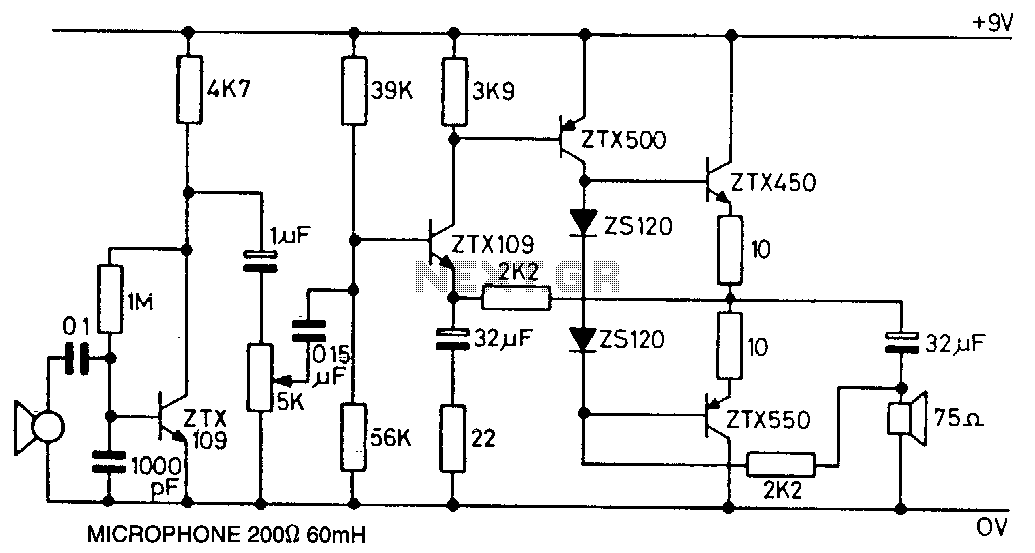
Microphone-amplifier
This circuit utilizes the ZTX450 and ZTX550 transistors configured in a push-pull output stage. The following measurements were recorded at maximum volume: Input: 0.4 mV rms, Output: 1.8 V rms, Voltage gain: 4500, Maximum output before distortion: 2.25 V rms,...