


Touch Controlled Musical Door Bell

Description: This touch-controlled musical bell circuit generates a musical tone whenever someone touches the designated touch point (TP). The circuit operates using two AA batteries and produces sufficient sound output. It utilizes the UM3481 integrated circuit, which is commonly employed in musical applications. The IC features a ROM containing 512 musical notes, a tone generator, rhythm generator, modulator, run-off control, oscillators, frequency divider, and preamplifiers. Consequently, the circuit requires very few components. Capacitor C1 and resistor R1 function as timing components for the built-in oscillator. Transistor Q1 is responsible for driving the loudspeaker, while the base of transistor Q2 serves as the touch point to trigger the musical bell.
The touch-controlled musical bell circuit is designed to provide an engaging auditory response when activated. The core of the circuit, the UM3481 IC, is a versatile component that simplifies the design by integrating multiple functionalities necessary for sound generation. The ROM within the IC stores a variety of musical notes, allowing for a rich sound palette without the need for external sound storage.
The circuit's power supply, consisting of two AA batteries, ensures portability and ease of use. The voltage provided by these batteries is sufficient to power the circuit components while maintaining an optimal sound output from the loudspeaker. The use of standard AA batteries also contributes to the circuit's accessibility for users.
The timing components, C1 and R1, create the necessary conditions for the internal oscillator to function effectively. The oscillator generates the clock signal that drives the various sound generation features of the IC. The choice of values for C1 and R1 will directly affect the frequency and quality of the sound produced, allowing for customization based on user preference.
Transistor Q1 is employed as a driver for the loudspeaker, amplifying the output from the UM3481 to produce audible sound levels. The selection of Q1 must ensure that it can handle the load presented by the loudspeaker without distortion or failure.
Transistor Q2 serves a dual role in this circuit; it acts as the touch sensor and also provides a means to trigger sound generation. When the touch point is activated, it allows current to flow into the base of Q2, which in turn activates Q1, resulting in the generation of sound. This configuration enables a simple and effective mechanism for user interaction, making the circuit intuitive and engaging.
Overall, the touch-controlled musical bell circuit exemplifies an efficient design that leverages the capabilities of the UM3481 IC, resulting in a compact and functional musical device suitable for various applications.This touch controlled musical bell circuit circuit produces a musical tone whenever someone touches the touch point designated as TP in the circuit. The circuit works from two AA cells and produces enough sound. The circuit uses IC UM 3481 commonly used in musical circuits. The IC contains a ROM with 512 musical notes, tone generator, rhythm gener ator, modulator, run off control, oscillators, frequency divider and preamplifiers, . So a very few number of components is required for this circuit. C1 and R1 act as the timing components for the built in oscillator. The transistor Q1 is used for driving the loud speaker. The base of the transistor Q2 is used as the touch point to trigger the musical bell.
The touch-controlled musical bell circuit is designed to provide an engaging auditory response when activated. The core of the circuit, the UM3481 IC, is a versatile component that simplifies the design by integrating multiple functionalities necessary for sound generation. The ROM within the IC stores a variety of musical notes, allowing for a rich sound palette without the need for external sound storage.
The circuit's power supply, consisting of two AA batteries, ensures portability and ease of use. The voltage provided by these batteries is sufficient to power the circuit components while maintaining an optimal sound output from the loudspeaker. The use of standard AA batteries also contributes to the circuit's accessibility for users.
The timing components, C1 and R1, create the necessary conditions for the internal oscillator to function effectively. The oscillator generates the clock signal that drives the various sound generation features of the IC. The choice of values for C1 and R1 will directly affect the frequency and quality of the sound produced, allowing for customization based on user preference.
Transistor Q1 is employed as a driver for the loudspeaker, amplifying the output from the UM3481 to produce audible sound levels. The selection of Q1 must ensure that it can handle the load presented by the loudspeaker without distortion or failure.
Transistor Q2 serves a dual role in this circuit; it acts as the touch sensor and also provides a means to trigger sound generation. When the touch point is activated, it allows current to flow into the base of Q2, which in turn activates Q1, resulting in the generation of sound. This configuration enables a simple and effective mechanism for user interaction, making the circuit intuitive and engaging.
Overall, the touch-controlled musical bell circuit exemplifies an efficient design that leverages the capabilities of the UM3481 IC, resulting in a compact and functional musical device suitable for various applications.This touch controlled musical bell circuit circuit produces a musical tone whenever someone touches the touch point designated as TP in the circuit. The circuit works from two AA cells and produces enough sound. The circuit uses IC UM 3481 commonly used in musical circuits. The IC contains a ROM with 512 musical notes, tone generator, rhythm gener ator, modulator, run off control, oscillators, frequency divider and preamplifiers, . So a very few number of components is required for this circuit. C1 and R1 act as the timing components for the built in oscillator. The transistor Q1 is used for driving the loud speaker. The base of the transistor Q2 is used as the touch point to trigger the musical bell.

Tone dial generator
The circuit requires a minimum number of components and utilizes a low-cost standard 379.545 MHz television color-burst crystal. The speaker can be omitted, allowing the output to be directly connected to the microphone input of a transmitter.
The circuit design is...

Atari Punk Stepped Tone Generator
The Stepped Tone Generator is a dual oscillator circuit that produces a single pulse wave output. The first oscillator controls the pitch of the output oscillator, which divides the pitch into progressively smaller amounts based on its pulse width (steps)...

Cmos Touch Dimmer Circuit
A Siemens SLB0586A IC enables the creation of a straightforward touch-controlled dimmer circuit. This circuit regulates a triac AC switch, allowing control of loads ranging from 10 to 400 W.
The Siemens SLB0586A integrated circuit is designed to facilitate the development...

Tone Doorbell circuit
When the door is pushed, a whisper is heard that transitions to a higher frequency. The oscillator frequency is determined by the audio frequency coupling capacitance, C1, and the resistance connected between the base of transistor Q1 and ground. This...

The AmG©lie project
The ROM is mapped at address &F000, which in binary is %1111 0000 0000 0000. This indicates that when accessing the ROM, the address lines A12, A13, A14, and A15 will always be high. Consequently, the I/O device selections will...
Tone Generator Circuits
Multi Tone Alarm Description This is a simple and easy-to-build multi-tone alarm circuit that can be used in burglar alarms or sirens. The circuit is based on the dual op-amp MC1458 and LM380. The two op-amps inside the MC1458 are...

Tone generator
The circuit utilizes either two 555 timers or a single dual timer. Capacitor C1 regulates the speed of the warble effect, while capacitor C2 defines the pitch. The specified values are expected to generate a notably distinctive signal.
The described circuit...

Touch Volume Control Circuit
Touch controls are not only utilized for switching devices on or off but can also manage various functions. A notable example is the TV remote control. When it is crucial to maintain activated functions for an extended period, employing a...
toy organ
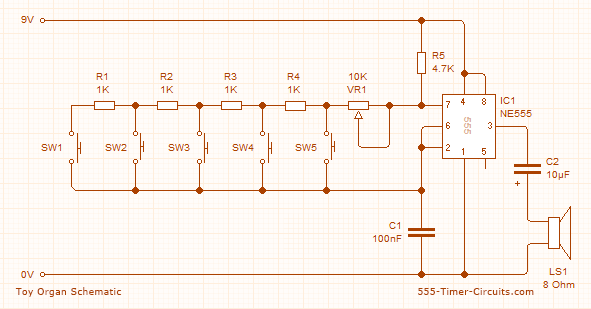
This circuit generates a tone based on the button pressed. Only one button can be activated at a time, which is why it is referred to as a monophonic organ. The 1k ohm resistors can be adjusted to create a...