


True Bypass Passive Ring Modulator
#ring modulator
#true bypass
#passive circuit
#germanium diodes
#transformer
#carrier wave
#audio effect
#LED indicator
#no power required
#signal processing

Description: A simple two-transformer, four-germanium-diode ring modulator featuring a true bypass switching scheme. It includes an input for carrier wave modulation. Power is only required for the status LED.
The described circuit is a two-transformer, four-germanium-diode ring modulator, which is a type of analog signal processing device used to create amplitude modulation. The circuit typically operates by mixing two input signals: a carrier wave and a modulating signal. The modulation occurs through the use of diodes arranged in a ring configuration, which allows for the generation of sidebands that contain the information from the modulating signal.
In this design, two transformers are utilized to couple the input signals to the diode ring. Each transformer serves to isolate the input signals and ensure proper impedance matching, which is crucial for maintaining signal integrity. The four germanium diodes are arranged in a ring topology, which enables the modulation of the carrier wave by the input signal effectively. Germanium diodes are favored in such applications due to their low forward voltage drop and fast switching capabilities, which contribute to better performance in high-frequency applications.
The true bypass switching scheme integrated into the modulator allows for the signal to be routed around the modulator circuit when it is not in use. This feature is essential for preserving the original signal quality and avoiding any unwanted coloration when the modulator is bypassed. The switching mechanism can be implemented using a mechanical switch or a relay, depending on the design requirements.
Power supply requirements for this circuit are minimal, as power is only needed for the status LED, which indicates the operational state of the modulator. This design consideration enhances its usability in various applications, particularly in live sound environments or studio settings where power conservation is often a priority.
Overall, this two-transformer, four-germanium-diode ring modulator is a versatile tool for audio processing, capable of producing complex modulation effects while maintaining a straightforward design and ease of use.A simple 2 Transformer, 4 Germanium Diode Ring Modulator with a true bypass switching scheme. Includes input for Carrier Wave modulation. Power is only required for the status LED.
The described circuit is a two-transformer, four-germanium-diode ring modulator, which is a type of analog signal processing device used to create amplitude modulation. The circuit typically operates by mixing two input signals: a carrier wave and a modulating signal. The modulation occurs through the use of diodes arranged in a ring configuration, which allows for the generation of sidebands that contain the information from the modulating signal.
In this design, two transformers are utilized to couple the input signals to the diode ring. Each transformer serves to isolate the input signals and ensure proper impedance matching, which is crucial for maintaining signal integrity. The four germanium diodes are arranged in a ring topology, which enables the modulation of the carrier wave by the input signal effectively. Germanium diodes are favored in such applications due to their low forward voltage drop and fast switching capabilities, which contribute to better performance in high-frequency applications.
The true bypass switching scheme integrated into the modulator allows for the signal to be routed around the modulator circuit when it is not in use. This feature is essential for preserving the original signal quality and avoiding any unwanted coloration when the modulator is bypassed. The switching mechanism can be implemented using a mechanical switch or a relay, depending on the design requirements.
Power supply requirements for this circuit are minimal, as power is only needed for the status LED, which indicates the operational state of the modulator. This design consideration enhances its usability in various applications, particularly in live sound environments or studio settings where power conservation is often a priority.
Overall, this two-transformer, four-germanium-diode ring modulator is a versatile tool for audio processing, capable of producing complex modulation effects while maintaining a straightforward design and ease of use.A simple 2 Transformer, 4 Germanium Diode Ring Modulator with a true bypass switching scheme. Includes input for Carrier Wave modulation. Power is only required for the status LED.

How to properly snub transient spikes from a transformer and prevent switch mode power supply burn out
The leads from the transformer to the circuit are quite long (>5m). The 110V side of the transformer has been switched off frequently, which likely caused a spike on the secondary (24V) side. The input pin of the LTC3631 shows...
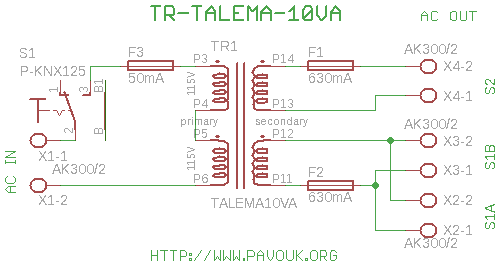
Talema 10VA transformer board
All DAC boards include a power supply section. It is sufficient to connect only a power transformer. This board is designed for a toroidal 10VA transformer manufactured by Talema, which features pins for PCB connection and exhibits minimal electromagnetic field...

Interpolating Scanner Circuit
This design is for an interpolating scanner, a circuit featuring multiple signal inputs, a control voltage input, and a signal output. The output selectively transitions between inputs, smoothly fading from one to the next as the control voltage increases. A...

Precision tandem type power supply circuit diagram
The circuit depicted features a secondary N3 center tap transformer (T) with a common point connecting diodes VD2 and VD3 to positive electrodes, along with capacitors C2, C6, C7, and negative electrodes connected to capacitors C9 and C10. Additional components...
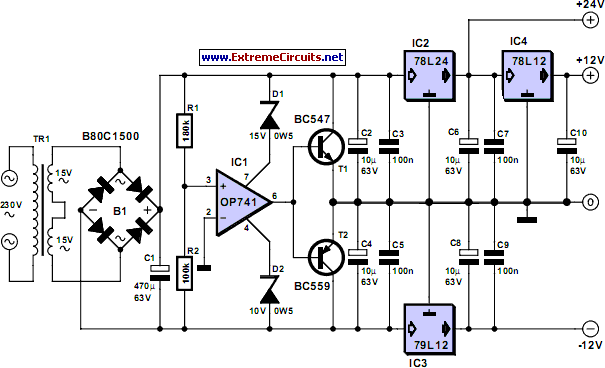
Triple Power Supply
Inexpensive miniature transformers typically provide one or two secondary voltages, which are sufficient for generating a set of positive and negative supply voltages, as required for operational amplifier circuits. However, if an additional voltage higher than either of the supply...

Electronic Transformer Coupled Oscillators
The transformer OCL and capacitor C1 create a tank circuit, which is coupled with sufficient turns to drive the grid in the lower left-hand winding. The output circuit is connected through a separate winding. For optimal waveform characteristics in such...

AC to AC Power Supplies and Transformer Circuits
An active amplified transformer isolated signal splitter that enables a hum-free connection of one guitar to multiple amplifiers, while also providing a direct output. This includes a discussion on using audio transformers for equipment interconnections and mentions line-level transformers in...

The Simplest Car Battery Charger
This very simple circuit uses a transformer, two diodes, a capacitor, and an ammeter. To charge a battery, just connect the + and - terminals of the circuit to the corresponding terminals of the battery. When the battery is not...

PF Test Equipment
A transformer ratio-arm bridge circuit is utilized as depicted in the simplified diagram of Figure 1. The circuit comprises a standard reference capacitor (CS) and the insulation under test (CX). A distinctive feature of the circuit is a specialized multi-winding...