


Voice Recorder and Playback using ISD100A
#voice recorder
#playback
#ISD1000A
#analog storage
#electret mic
#speaker
#audio recording
#audio playback
#memory storage

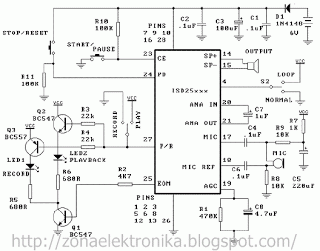
Description: The ISD1000A is a Direct Analog Storage device which allows you to store 20 seconds worth of voice data on an IC chip which can be played back anytime. The data stored will stay in memory even if the power is removed. To use the circuit below, simply apply power to the circuit, press the record button and hold. Speak clearly into the microphone. You have up to 20 seconds of voice message that you can store. If you talk beyond that time, the chip will only store the first 20 seconds. After recording, release the record button. To playback the message, press the playback message and the message you recorded will play back. The microphone is an electret mic, and the speaker is an 8-ohm speaker. If you use a 16-ohm speaker, then the 10-ohm resistor marked optional can be eliminated. This circuit can be the basis of many other larger projects. For example, it could be part of an alarm circuit which plays back a voice warning when the alarm circuit is triggered.
The ISD1000A chip is a versatile audio recording and playback device that operates on a simple principle of analog storage. The device is capable of recording up to 20 seconds of audio, which is stored in a non-volatile memory format, ensuring that the audio data remains intact even when the power supply is disconnected. This feature is particularly useful for applications requiring persistent audio messages, such as alarms or notifications.
The circuit typically involves a few key components: the ISD1000A IC, an electret microphone for audio input, and a speaker for audio output. The electret microphone is chosen for its sensitivity and ability to capture clear audio signals. It requires a bias voltage, which is often provided through a resistor connected to the power supply.
The playback mechanism is initiated by pressing a designated button, which activates the ISD1000A to reproduce the recorded audio through the connected speaker. The choice of speaker impedance is crucial; an 8-ohm speaker is commonly used, but a 16-ohm speaker can also be utilized with the optional 10-ohm resistor removed from the circuit. This allows for flexibility in speaker selection based on availability or specific project requirements.
The design of the circuit can be expanded for various applications. For instance, integrating the ISD1000A into an alarm system allows it to serve as a voice alert mechanism, enhancing the functionality of the alarm by providing a personalized message. The circuit can be adapted with additional components such as sensors, switches, and power management systems to create more complex audio-enabled devices.
Overall, the ISD1000A provides a straightforward yet effective solution for audio storage and playback, making it suitable for a wide range of electronic projects that require voice recording capabilities.The ISD1000A is a Direct Analog Storage device which allows you to store 20 seconds worth of voice data on an IC chip which can be play backed anytime. The data stored will stay in memory even if the power is removed. To use the circuit below simple apply power to the circuit, press the record button and hold. Speak clearly into the microphone. You have up to 20 seconds of voice message that you can store. If you talk beyond that time the chip will only store the first 20 seconds. After recording, release the record button. To playback the message, press the playback message and the message you recorded will play back. The microphone is an electret mic and the speaker is a 8 ohm speaker. If you use a 16 ohm speaker then the 10 ohm resistor marked optional, can be eliminated. This circuit can be the basis of many other larger projects. For example it could be part of an alarm circuit which plays back a voice warning when the alarm circuit is triggered.
The ISD1000A chip is a versatile audio recording and playback device that operates on a simple principle of analog storage. The device is capable of recording up to 20 seconds of audio, which is stored in a non-volatile memory format, ensuring that the audio data remains intact even when the power supply is disconnected. This feature is particularly useful for applications requiring persistent audio messages, such as alarms or notifications.
The circuit typically involves a few key components: the ISD1000A IC, an electret microphone for audio input, and a speaker for audio output. The electret microphone is chosen for its sensitivity and ability to capture clear audio signals. It requires a bias voltage, which is often provided through a resistor connected to the power supply.
The playback mechanism is initiated by pressing a designated button, which activates the ISD1000A to reproduce the recorded audio through the connected speaker. The choice of speaker impedance is crucial; an 8-ohm speaker is commonly used, but a 16-ohm speaker can also be utilized with the optional 10-ohm resistor removed from the circuit. This allows for flexibility in speaker selection based on availability or specific project requirements.
The design of the circuit can be expanded for various applications. For instance, integrating the ISD1000A into an alarm system allows it to serve as a voice alert mechanism, enhancing the functionality of the alarm by providing a personalized message. The circuit can be adapted with additional components such as sensors, switches, and power management systems to create more complex audio-enabled devices.
Overall, the ISD1000A provides a straightforward yet effective solution for audio storage and playback, making it suitable for a wide range of electronic projects that require voice recording capabilities.The ISD1000A is a Direct Analog Storage device which allows you to store 20 seconds worth of voice data on an IC chip which can be play backed anytime. The data stored will stay in memory even if the power is removed. To use the circuit below simple apply power to the circuit, press the record button and hold. Speak clearly into the microphone. You have up to 20 seconds of voice message that you can store. If you talk beyond that time the chip will only store the first 20 seconds. After recording, release the record button. To playback the message, press the playback message and the message you recorded will play back. The microphone is an electret mic and the speaker is a 8 ohm speaker. If you use a 16 ohm speaker then the 10 ohm resistor marked optional, can be eliminated. This circuit can be the basis of many other larger projects. For example it could be part of an alarm circuit which plays back a voice warning when the alarm circuit is triggered.
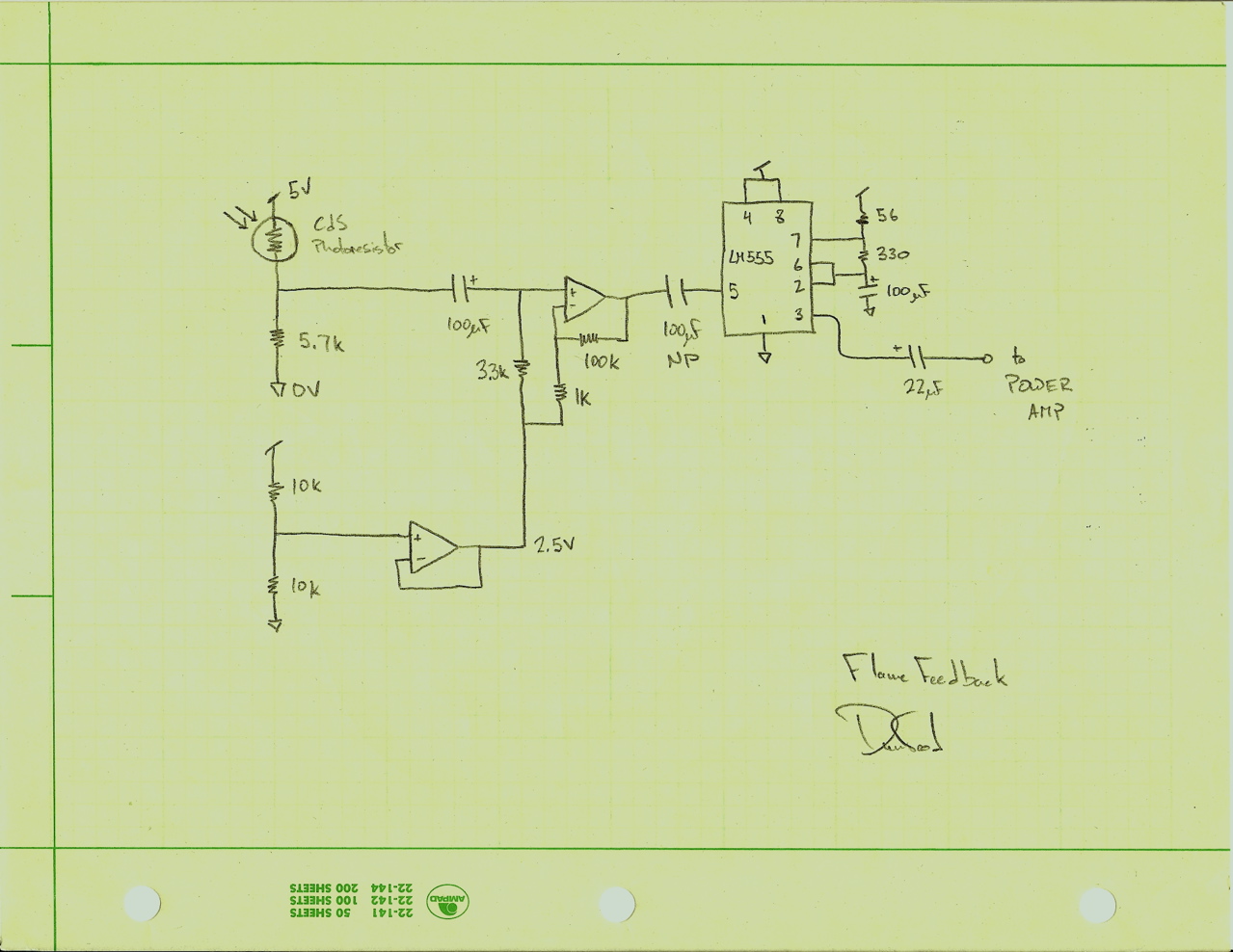
Flame Feedback
Flame Feedback is a sound sculpture constructed from a speaker driver, a candle, and electronic components. The speaker is activated with a low-frequency tone, which moves air and causes the candle to flicker. An optical sensor detects the flicker of...
Digital Message Recorder
The objective of this digital electronics project is to record messages using a dedicated voice recorder integrated circuit. Recordings are stored in non-volatile memory cells, ensuring that messages remain saved even when power is removed from the device. The Winbond...

Electret mic pre amp
Electret microphone preamplifier schematic. The operational amplifier provides an amplification of approximately 30 dB, which is adequate for the relatively high output level of an electret microphone. This gain is influenced by the values of resistors R3 and R4. To...

9V Speaker polarity Checker
In a stereo system, it is often important to determine whether the speakers are polarized. This can be especially problematic if the speaker cables lack polarity markings. The circuit described will assist in identifying the correct terminals for the speakers....

Speaker Microphone circuit diagrams
This circuit allows the use of an inexpensive loudspeaker as a microphone. Sound waves that reach the speaker cone cause fluctuations in the voice coil. The movement of the voice coil within the speaker's magnetic field generates a small electrical...

doorphone intercom
An 8-ohm speaker functions as both a microphone and an output device. The BC109C transistor operates in common base mode, providing substantial voltage gain while ensuring a low impedance input suitable for the speaker. Self DC biasing is implemented to...

A simple three-way speaker crossover circuit diagram
The divider acts as the speaker's brain and is crucial for sound quality. The music amplifier's output signal must be processed through a wave filter element to divide it into specific frequency signals for each unit. A scientifically and rationally...

sound circuit
The back of the electret microphone resembles the drawings of the CUI Inc part number CMA-4544PF-W, which will be included in the parts kit. While debugging the data logger software on Windows, an oscilloscope practice lab was conducted using the...

diy project actual good canon 5d audio
Enhancing the audio quality of the Canon 5D Mark II to achieve usable production audio involves several key steps. The initial phase of this engineering project focuses on data collection, specifically measuring the input frequency response of the 5D. The...