


A flat tire warning circuit
#tire pressure
#leak detector
#microphone sensor
#signal conversion
#bicycle
#car
#safety
#alert system
#automotive electronics

Description: Bicycle tire leak detector circuit schematic. The circuit detects air leaks in car tires caused by sharp objects. It uses a microphone (BM) to capture the sound of escaping air, which is then converted into an electrical signal. This signal is amplified through a capacitor (C6) coupled to a transistor (VT) for further amplification. The amplified signal passes through coupling capacitors (C3, C4) and is adjusted by a volume potentiometer (RP) before being played back through headphones (EJ). The circuit is designed to operate at low voltages using an integrated power amplifier (SL31 or LA4101), which can function with a supply voltage ranging from 2V to 4.5V, with an active supply of 3V. The transistor (VT) is a silicon NPN type (3DG8) with low noise characteristics, aiding in the detection of gas leaks. The circuit requires a current of less than 1 mA, allowing for the use of low-resistance earplug headsets. The microphone used is an electret type (CR22-9B), which is miniature and omnidirectional. The remaining components include small resistor-capacitor elements. The entire assembly can fit into a compact molded housing, approximately 68mm x 8mm. The power supply consists of two R-type batteries connected in series. The potentiometer (RP) is a small synthetic membrane type (WH15-K22) and includes a power switch.
The bicycle tire leak detector circuit is an innovative solution for identifying air leaks in tires, particularly useful for vehicles exposed to sharp objects. The core functionality lies in the electret microphone (BM), which is sensitive to the high-frequency sounds of escaping air. Once the microphone detects these sounds, it converts them into an electrical signal that is then processed by the circuit.
The initial amplification stage is crucial. Capacitor C6 couples the microphone output to the transistor (VT), which acts as an amplifier. The choice of the silicon NPN transistor (3DG8) is significant due to its low noise performance, which enhances the detection capability by minimizing background noise interference. The amplified signal is further processed through coupling capacitors (C3 and C4), which ensure that the DC component is blocked while allowing the AC signal to pass through, thus maintaining the integrity of the sound signal.
The volume potentiometer (RP) allows the user to adjust the output level, ensuring that the sound played through the headphones (EJ) is at a comfortable listening level. The integration of the power amplifier (SL31 or LA4101) is designed to operate efficiently within a low voltage range, making the circuit suitable for battery-powered applications. The active supply voltage of 3V is optimal for maximizing performance while conserving battery life.
The use of low-resistance earplug headsets is advantageous, as it requires minimal current draw, which is essential for prolonging battery life. The electret microphone (CR22-9B) is selected for its compact size and omnidirectional characteristics, making it capable of detecting sounds from various angles, thereby increasing the likelihood of capturing the sound of air escaping from a tire.
The overall design emphasizes portability and ease of use, with the compact housing allowing for convenient placement. The inclusion of a power switch integrated into the potentiometer (WH15-K22) simplifies operation, enabling users to turn the device on and off easily. The circuit's power supply configuration, utilizing two R-type batteries connected in series, ensures a reliable and consistent power source, essential for continuous monitoring of tire integrity. Bicycle tire leak detector circuit schematic. Car tire punctured by sharp objects leak site air sound microphone BM is received after the closing, signal conversion, via a capa citor 6 is coupled to the transistor VT amplification, and then by coupling capacitor C3, C4 by volume potentiometer RP select from integration PA SL31 sufficiently amplified by the headphone EJ playback. Bicycle tire leak detector is selected at a low voltage power amplifier integrated circuits SL31 (or LA4101), which uses a voltage can be 2 ~ 4.
5V to choose between, the active 3V supply. Transistor VT silicon NPN transistor 3DG8, noise itself is small, there is help determine fault expel gas, port selected value above 120, through current J.. Less than 1 only. Available 8n low resistance headset earplugs. BM electret microphone with omni-directional miniature electret condenser microphone CR22- 9B. The rest were with a small resistor-capacitor element. The housing may use a small transistor radio Molded type, size of about 68mm s8mm. Power supply with two R type batteries connected in series. Potentiometer RP use of small synthetic membrane potentiometer WH15-K22 type, with the power switch.
The bicycle tire leak detector circuit is an innovative solution for identifying air leaks in tires, particularly useful for vehicles exposed to sharp objects. The core functionality lies in the electret microphone (BM), which is sensitive to the high-frequency sounds of escaping air. Once the microphone detects these sounds, it converts them into an electrical signal that is then processed by the circuit.
The initial amplification stage is crucial. Capacitor C6 couples the microphone output to the transistor (VT), which acts as an amplifier. The choice of the silicon NPN transistor (3DG8) is significant due to its low noise performance, which enhances the detection capability by minimizing background noise interference. The amplified signal is further processed through coupling capacitors (C3 and C4), which ensure that the DC component is blocked while allowing the AC signal to pass through, thus maintaining the integrity of the sound signal.
The volume potentiometer (RP) allows the user to adjust the output level, ensuring that the sound played through the headphones (EJ) is at a comfortable listening level. The integration of the power amplifier (SL31 or LA4101) is designed to operate efficiently within a low voltage range, making the circuit suitable for battery-powered applications. The active supply voltage of 3V is optimal for maximizing performance while conserving battery life.
The use of low-resistance earplug headsets is advantageous, as it requires minimal current draw, which is essential for prolonging battery life. The electret microphone (CR22-9B) is selected for its compact size and omnidirectional characteristics, making it capable of detecting sounds from various angles, thereby increasing the likelihood of capturing the sound of air escaping from a tire.
The overall design emphasizes portability and ease of use, with the compact housing allowing for convenient placement. The inclusion of a power switch integrated into the potentiometer (WH15-K22) simplifies operation, enabling users to turn the device on and off easily. The circuit's power supply configuration, utilizing two R-type batteries connected in series, ensures a reliable and consistent power source, essential for continuous monitoring of tire integrity. Bicycle tire leak detector circuit schematic. Car tire punctured by sharp objects leak site air sound microphone BM is received after the closing, signal conversion, via a capa citor 6 is coupled to the transistor VT amplification, and then by coupling capacitor C3, C4 by volume potentiometer RP select from integration PA SL31 sufficiently amplified by the headphone EJ playback. Bicycle tire leak detector is selected at a low voltage power amplifier integrated circuits SL31 (or LA4101), which uses a voltage can be 2 ~ 4.
5V to choose between, the active 3V supply. Transistor VT silicon NPN transistor 3DG8, noise itself is small, there is help determine fault expel gas, port selected value above 120, through current J.. Less than 1 only. Available 8n low resistance headset earplugs. BM electret microphone with omni-directional miniature electret condenser microphone CR22- 9B. The rest were with a small resistor-capacitor element. The housing may use a small transistor radio Molded type, size of about 68mm s8mm. Power supply with two R type batteries connected in series. Potentiometer RP use of small synthetic membrane potentiometer WH15-K22 type, with the power switch.

Car Headlight Control
It is frustrating to discover that the car headlights have been left on, resulting in a dead battery. One solution to this problem is the proposed control circuit. This circuit does not issue a warning; instead, it takes action: when...

Bicycle Sensing
Bicycle sensors serve two primary functions: recording the motion of the bicycle for collision reconstruction and transmitting signals to the bicycle controls to ensure proper navigation. This necessitates several component specifications, as the sensors need to be robust enough to...

Simple bicycle alarm
The switch has been installed within the handlebar's tap. A battery holder has been created from a repurposed flashlight. As demonstrated in the video in step 1, the siren has been placed inside the left end-bar grip, with the wires...

Light turning bike using IC LM3909
A bicycle typically does not have a turning light. When a cyclist wants to turn, it can be dangerous as vehicles following may not be aware of the turn. To enhance safety, a turning light circuit for bicycles can be...

car reverse beeper
After installation in the car (not running but in reverse with the emergency brake engaged), the system functioned well. However, when the car was started and reversed out of the garage, the beeping frequency became erratic while tapping the brake...

PULSE PERIOD TO VOLTAGE CONVERTER
This circuit is designed to convert a square wave input signal into a voltage output. The voltage produced is proportional to the time interval between the edges (period) of the signal, rather than its frequency. The operational range of the...

Bicycle tail light flashing
Present roads are in better condition than the former Pan. The traffic flow is convenient; however, high speeds are often observed. When using bicycles at night, safety concerns arise.
The statement highlights the improvement in road conditions compared to previous infrastructure....

Car brake Light
What's so special about this circuit? Well, the first third-brake light I installed I had to pull a wire from the Third Brake Light all the way underneath the carpet to the brake-pedal-switch and I thought it would be easier...
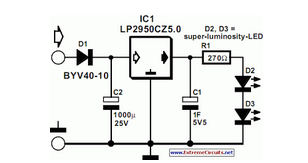
Rear Light After Glow (For Bicycles)
This article is relevant only to readers whose bicycle lights are powered by a dynamo. The regulations regarding bicycle lights in the United Kingdom are more stringent.
Dynamo-powered bicycle lights are an essential component for cyclists, providing illumination without the need...