


Car BackUp Alarm
#backup alarm
#brake light trigger
#automotive safety
#alarm circuit
#Popular Electronics
#vehicle electronics
#sound alarm
#car accessory
#circuit design
#retro electronics

Description: The brake lights of the automobile activate this circuit intermittently. This prevents unnecessary alarm activation when it is not required. Although this is an older circuit originally published in Popular Electronics Magazine, it remains effective today.
The described circuit utilizes the automobile's brake light system to control an alarm or notification system, ensuring that the alarm only sounds when necessary. The design typically incorporates a relay that is activated by the brake light switch. When the brake pedal is pressed, the circuit completes, allowing current to flow and energizing the relay. This action can trigger an alarm or other signaling device, alerting the driver or nearby individuals.
In a typical implementation, the circuit may include a diode in parallel with the relay coil to prevent back EMF from damaging other components when the relay is deactivated. A capacitor may also be added to smooth out the voltage changes, ensuring stable operation.
The circuit can be further enhanced by incorporating an adjustable timer, allowing for a delay in the alarm activation after the brake is released, which can be useful in scenarios where the driver may momentarily pause before moving.
Overall, while the circuit is based on older technology, its fundamental principles remain relevant. The simplicity and effectiveness of this design make it a reliable choice for applications requiring controlled alarm systems in automotive environments.The brake lights of the automobile trigger this circuit on and off. This save the annoyance of the alarm when it is not needed. This is an older circuit which was published in Popular Electronics Magazine, but still a good circuit today.
The described circuit utilizes the automobile's brake light system to control an alarm or notification system, ensuring that the alarm only sounds when necessary. The design typically incorporates a relay that is activated by the brake light switch. When the brake pedal is pressed, the circuit completes, allowing current to flow and energizing the relay. This action can trigger an alarm or other signaling device, alerting the driver or nearby individuals.
In a typical implementation, the circuit may include a diode in parallel with the relay coil to prevent back EMF from damaging other components when the relay is deactivated. A capacitor may also be added to smooth out the voltage changes, ensuring stable operation.
The circuit can be further enhanced by incorporating an adjustable timer, allowing for a delay in the alarm activation after the brake is released, which can be useful in scenarios where the driver may momentarily pause before moving.
Overall, while the circuit is based on older technology, its fundamental principles remain relevant. The simplicity and effectiveness of this design make it a reliable choice for applications requiring controlled alarm systems in automotive environments.The brake lights of the automobile trigger this circuit on and off. This save the annoyance of the alarm when it is not needed. This is an older circuit which was published in Popular Electronics Magazine, but still a good circuit today.

Easy Alarms Police / Ambulance Electronic
The following circuit illustrates the electronic diagram design for police and ambulance alarms. Features include simplicity and ease of assembly, as well as cost-effectiveness.
This electronic schematic represents a basic alarm system intended for use in police and ambulance applications. The...

Induction high pressure alarm circuit
It utilizes the KD153 type "ding-dong" music integrated circuit (IC) to produce a "ding-dong" sound alarm. The reference number is 221611, and it is related to a refrigerator door alarm circuit.
The KD153 integrated circuit is designed specifically for generating melodic...

Electronic Projects
This program includes circuit design CAD, simulation, and auto-routing PC layout. PSPICE is also utilized at Unisys, which offers more capabilities but costs six times as much and requires annual renewal. With these requirements and others in mind, a variation...
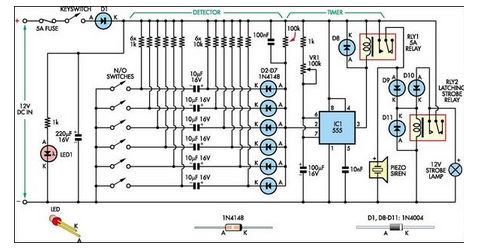
Simple 6-Input Alarm
This simple alarm circuit was designed for use in a combined garage and rumpus room. It can be assembled on Veroboard and uses just one IC plus a handful of additional components.
The alarm circuit is based on a single integrated...

A three-alarm phase circuits
The circuit features intermediate relays KAi, KA2, and KA3, which are connected to the outlet end of the low-voltage circuit breakers. An alarm circuit is linked to a backup power supply or a battery power supply. This configuration serves to...

5 Zone Alarm Circuit
Each zone uses a normally closed contact. These can be micro switches or standard alarm contacts (usually reed switches). Zone 1 is a timed zone which must be used as the entry and exit point of the building. Zones 2...

House Alarm Loop
This circuit features open and closed loop contacts (switches 1, 2, 3) that activate the alarm, which remains activated for 5 to 10 minutes. The triggering delay for entrance and exit is set to 27 seconds. Additionally, this simple alarm...

High-Output Pulsed-Tone/Light-Activated Alarm Circuit
This circuit is capable of generating up to 1 W of audio power to drive a speaker or horn. When the CDS cell is exposed to light, its resistance decreases, activating NOR gate (a). This activation causes gates (a) and...
House Alarm Loop
This circuit features open and closed loop contacts (switches 1, 2, 3) that activate the alarm, which remains activated for 5 to 10 minutes. The triggering delay for entrance and exit is set to 27 seconds. Additionally, this simple alarm...