


Car Battery Tester For Cranking Amps Circuit
#battery tester
#cold cranking amps
#constant-current source
#internal resistance
#voltage drop
#automotive electronics
#battery health
#load testing
#discharge circuit
#measurement

Description: This circuit measures the cold cranking amps of a battery by discharging the surface charge and then assessing the internal resistance. This method provides a more accurate measurement than merely observing the instantaneous voltage drop under load. A constant-current source of 2.5 A is utilized. After one minute, a voltage drop measurement is taken while under load.
The described circuit is designed to accurately evaluate the cold cranking amps (CCA) of a battery, which is crucial for assessing the battery's ability to start an engine in cold conditions. The process begins by discharging the surface charge of the battery. This step is essential because surface charge can lead to misleading voltage readings that do not reflect the battery's true state of health.
Once the surface charge is discharged, the circuit employs a constant-current source that draws 2.5 A from the battery. This current draw is significant as it simulates the load that a starter motor would place on the battery during engine cranking. The use of a constant current allows for a controlled environment in which the internal resistance of the battery can be accurately measured.
After maintaining the load for one minute, the circuit measures the voltage drop across the battery terminals. This voltage drop is directly related to the internal resistance of the battery, which can be calculated using Ohm's law. The internal resistance is a critical factor in determining the battery's performance under load, and thus, the cold cranking amps can be derived from this measurement.
In summary, this circuit provides a reliable method for determining the cold cranking amps of a battery by first eliminating the surface charge and then measuring the internal resistance under a defined load. This approach yields a more realistic assessment of the battery's capability to deliver the necessary current for engine starting, especially in cold weather conditions. This circuit determines the cold cranking amps of a battery by first discharging the surface charge, then checking the internal resistance. This gives a more realistic measurement than simply measuring the instantaneous drop in voltage with a load.
A constant-current source draws 2.5 A. Then, after one minute, a voltage drop measurement is made under load.
The described circuit is designed to accurately evaluate the cold cranking amps (CCA) of a battery, which is crucial for assessing the battery's ability to start an engine in cold conditions. The process begins by discharging the surface charge of the battery. This step is essential because surface charge can lead to misleading voltage readings that do not reflect the battery's true state of health.
Once the surface charge is discharged, the circuit employs a constant-current source that draws 2.5 A from the battery. This current draw is significant as it simulates the load that a starter motor would place on the battery during engine cranking. The use of a constant current allows for a controlled environment in which the internal resistance of the battery can be accurately measured.
After maintaining the load for one minute, the circuit measures the voltage drop across the battery terminals. This voltage drop is directly related to the internal resistance of the battery, which can be calculated using Ohm's law. The internal resistance is a critical factor in determining the battery's performance under load, and thus, the cold cranking amps can be derived from this measurement.
In summary, this circuit provides a reliable method for determining the cold cranking amps of a battery by first eliminating the surface charge and then measuring the internal resistance under a defined load. This approach yields a more realistic assessment of the battery's capability to deliver the necessary current for engine starting, especially in cold weather conditions. This circuit determines the cold cranking amps of a battery by first discharging the surface charge, then checking the internal resistance. This gives a more realistic measurement than simply measuring the instantaneous drop in voltage with a load.
A constant-current source draws 2.5 A. Then, after one minute, a voltage drop measurement is made under load.
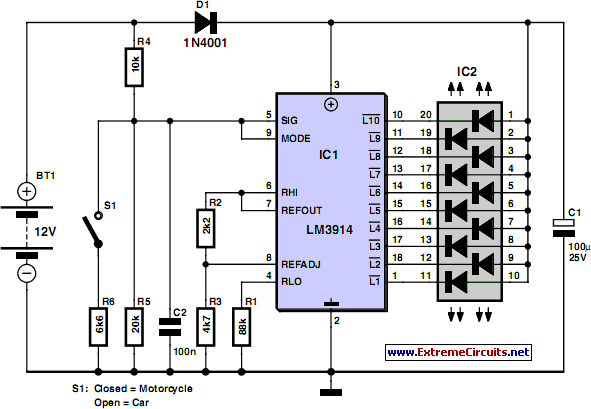
Motorcycle and Car Battery Tester Circuit
Camping today often involves various electronic accessories for daily activities or entertainment. Typically, a portable battery charger and a power inverter are used to ensure a well-organized campsite where both adults and children can comfortably use their electronic devices. With...

Car battery tester circuit
During rainy seasons, it can be quite bothersome when the car wipers operate continuously without pause. Have you ever considered implementing speed control for the wipers? While there are wiper control modules available commercially, many of them can be expensive....
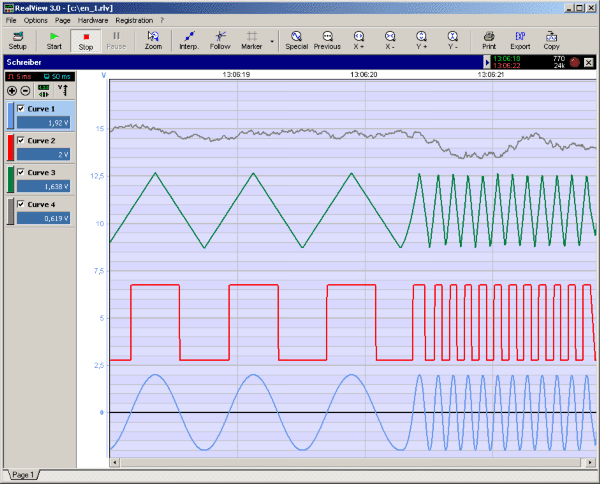
RealView 2.0
RealView is a measurement application, which records and plots measured values from analogue hardware devices in real-time. Several curves can be plotted into a single diagram. Several diagrams can be arranged on one or more pages if necessary. Plot options...

Simple but reliable car battery tester
This circuit utilizes the widely available LM3914 integrated circuit (IC). The LM3914 is straightforward to operate, does not require external voltage regulators due to its built-in voltage regulation, and can be powered by a variety of sources.
The LM3914 is a...
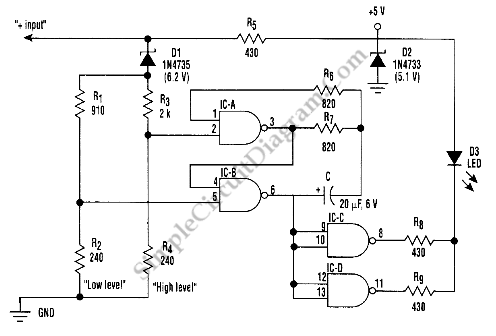
Battery Tester/Indicator/Monitor
This is a battery tester circuit. This circuit is used to indicate whether the level of a battery voltage is normal, under-voltage, or over-voltage.
The battery tester circuit is designed to assess the voltage level of a battery and provide a...

Simple but reliable car battery tester
This circuit utilizes the widely available and user-friendly LM3914 integrated circuit (IC). The LM3914 is straightforward to operate, does not require external voltage regulators due to its built-in voltage regulation, and can be powered by nearly any voltage source. When...
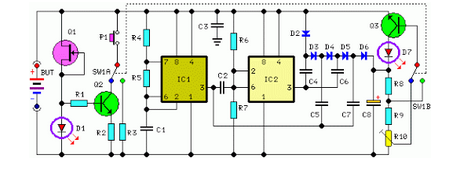
Self-Powered Fast Battery Tester Schematic
This circuit conducts a rapid battery test without requiring an external power supply or costly moving-coil voltmeters. It offers two testing ranges: when switch SW1 is configured as indicated in the circuit diagram, it can evaluate batteries ranging from 3V...
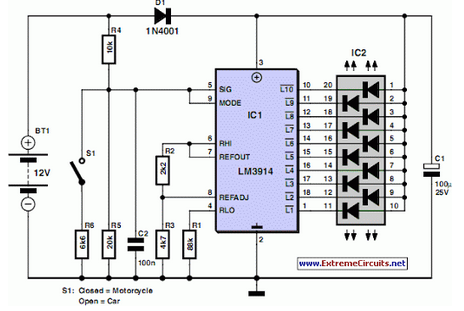
Car and Motorcycle Battery Tester
Camping today often requires bringing various electronic devices for daily activities or entertainment. Frequently, a charge is needed for these devices.
In modern camping scenarios, the reliance on electronic devices has significantly increased. Campers typically bring smartphones, tablets, GPS devices, portable...

Simple but reliable car battery testers
This circuit utilizes the widely available LM3914 integrated circuit (IC). The LM3914 is straightforward to operate, does not require external voltage regulators due to its built-in voltage regulation, and can be powered from nearly any voltage source. This makes it...