


Evaporative Emission Controls
#emission control
#automotive
#sensors
#fuel system
#driveability
#repair guide
#evaporative system
#vehicle maintenance
#engine control
#pollution control

Description: AutoZone Repair Guide for Driveability and Emission Controls, focusing on Evaporative Emission Controls.
The AutoZone Repair Guide provides comprehensive information regarding driveability and emission control systems, with a specific emphasis on evaporative emission controls. These systems are crucial for reducing harmful emissions from vehicles, particularly those that evaporate from the fuel system. They aim to prevent fuel vapors from escaping into the atmosphere, thereby improving air quality and ensuring compliance with environmental regulations.
Evaporative emission control systems typically include components such as the charcoal canister, fuel tank, and various valves and sensors. The charcoal canister captures fuel vapors from the fuel tank and stores them until they can be purged and sent to the engine for combustion. This process not only minimizes emissions but also enhances fuel efficiency.
Key elements of the evaporative emission control system include the following:
1. **Charcoal Canister**: This component is filled with activated charcoal, which absorbs fuel vapors. When the engine is running, the vapors are drawn into the intake manifold and burned, reducing overall emissions.
2. **Purge Valve**: This electrically operated valve controls the flow of vapors from the charcoal canister to the engine. It is typically activated by the engine control unit (ECU) based on specific conditions, such as engine temperature and load.
3. **Vent Valve**: This valve allows fresh air to enter the charcoal canister, facilitating the absorption of fuel vapors. It also prevents pressure buildup in the fuel system.
4. **Fuel Tank Pressure Sensor**: This sensor monitors the pressure within the fuel tank and provides feedback to the ECU. If a leak is detected, the ECU can trigger diagnostic trouble codes (DTCs) for further investigation.
5. **Diagnostic Capabilities**: Modern vehicles are equipped with onboard diagnostics (OBD) systems that monitor the performance of the evaporative emission control system. If any component fails or if there is a leak, the system will log a DTC, alerting the technician to the issue.
Understanding the operation and maintenance of the evaporative emission control system is essential for ensuring vehicle compliance with emission standards and optimizing performance. Regular inspections and timely repairs can prevent costly emissions-related issues and enhance the longevity of the vehicle's components.AutoZone Repair Guide for your Driveability And Emission Controls Emission Controls Evaporative Emission Controls..
The AutoZone Repair Guide provides comprehensive information regarding driveability and emission control systems, with a specific emphasis on evaporative emission controls. These systems are crucial for reducing harmful emissions from vehicles, particularly those that evaporate from the fuel system. They aim to prevent fuel vapors from escaping into the atmosphere, thereby improving air quality and ensuring compliance with environmental regulations.
Evaporative emission control systems typically include components such as the charcoal canister, fuel tank, and various valves and sensors. The charcoal canister captures fuel vapors from the fuel tank and stores them until they can be purged and sent to the engine for combustion. This process not only minimizes emissions but also enhances fuel efficiency.
Key elements of the evaporative emission control system include the following:
1. **Charcoal Canister**: This component is filled with activated charcoal, which absorbs fuel vapors. When the engine is running, the vapors are drawn into the intake manifold and burned, reducing overall emissions.
2. **Purge Valve**: This electrically operated valve controls the flow of vapors from the charcoal canister to the engine. It is typically activated by the engine control unit (ECU) based on specific conditions, such as engine temperature and load.
3. **Vent Valve**: This valve allows fresh air to enter the charcoal canister, facilitating the absorption of fuel vapors. It also prevents pressure buildup in the fuel system.
4. **Fuel Tank Pressure Sensor**: This sensor monitors the pressure within the fuel tank and provides feedback to the ECU. If a leak is detected, the ECU can trigger diagnostic trouble codes (DTCs) for further investigation.
5. **Diagnostic Capabilities**: Modern vehicles are equipped with onboard diagnostics (OBD) systems that monitor the performance of the evaporative emission control system. If any component fails or if there is a leak, the system will log a DTC, alerting the technician to the issue.
Understanding the operation and maintenance of the evaporative emission control system is essential for ensuring vehicle compliance with emission standards and optimizing performance. Regular inspections and timely repairs can prevent costly emissions-related issues and enhance the longevity of the vehicle's components.AutoZone Repair Guide for your Driveability And Emission Controls Emission Controls Evaporative Emission Controls..

Voltage Regulator For Cars And Motorcycles
This regulator circuit can be used on an alternator that has one field terminal grounded. When the input voltage becomes too high, Q1 conducts, and the base of Q2 is driven toward ground, reducing the voltage fed to Q3. This...

Automobile Lights-On Reminder
The circuit provides a visible or audible warning when the headlights are on. It utilizes a 2N1305 transistor as a switch to activate either a Sonalert tone generator or a small 12-V lamp. The operating current for the transistor is...

Camshaft Position Sensor
AutoZone Repair Guide for Engine Performance and Emission Control Components and Systems, specifically focusing on the Camshaft Position Sensor.
The Camshaft Position Sensor (CMP) is a critical component in modern internal combustion engines, playing a vital role in the management of...

simplest smf automotive battery charger
A simple battery charger circuit is described, utilizing a single transistor for voltage detection and automatically disconnecting the battery from the supply when fully charged. The circuit's high voltage trip point is set to switch off the charging voltage when...

Car battery charger Automative car and motorcycle schematics
The circuit is designed to operate with an external power supply, which is why it does not include a transformer, rectifier, or filter capacitors in the schematic. However, these components can be added if desired. To utilize the circuit, connect...

Automotive burglar alarm
The alarm activates after a 13-second delay and remains active for 1 to 1.5 minutes before automatically resetting. It can also be deactivated and reset by opening and reclosing switch SI.
The described circuit functions as a delay-triggered alarm system, incorporating...
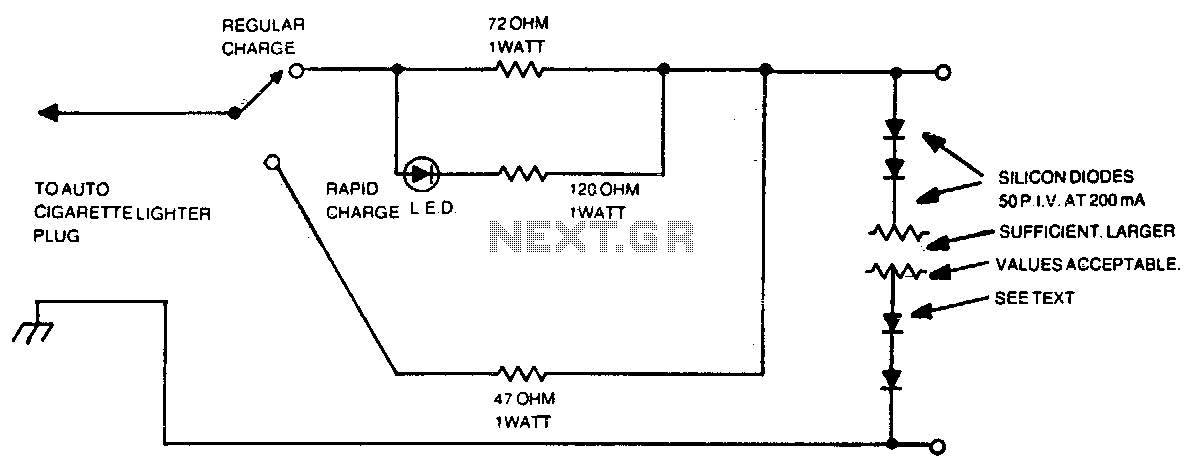
Automotive charger for ni-cad battery packs
The number of silicon diodes across the output is determined by the voltage of the battery pack. Each diode is considered at 0 volts. For example, a 10-volt pack would require 10/0 = 157, or 16 diodes.
In the context of...

Sensors and Sensing
The ability to perceive colors, shapes, distances, spatial relationships, motion, and connectivity is integral to human experience and cognition. This perceptual framework enables interpretation of sensory information through a complex model of the environment. Robots, however, lack such inherent models...

The Remote Controlling Circuit
The design of this project relies heavily on sensors, which are present in both the control module and the robot. The computer analyzes the signals from these sensors to determine appropriate output actions. The control unit utilizes potentiometers as its...