


Automatic Charger with CD4541
#automatic charger
#CD4541
#trickle charge
#high-current charge
#battery management
#charging modes
#power control
#electronics project

Description: The circuit is capable of supplying either a trickle (50 mA) or high-current (1-A) charge. You can select either charging method or an automatic mode that will first trickle charge a battery if it is particularly low before switching to high-current charging. More: If the battery's voltage is low, Zener-diode D5 will not conduct sufficient current to produce a voltage drop across R6 to turn Q2 on. With Q2 off, R4 pulls the base of Q1 high, turning it on. That activates K1. With K1 active, the only thing between the
The described circuit functions as a dual-mode battery charger, capable of operating in three distinct modes: trickle charging, high-current charging, and an automatic mode. The trickle charge mode is designed to supply a low current of 50 mA, which is suitable for maintaining battery health when the battery is not significantly depleted. The high-current mode provides a more substantial charge of 1 A, enabling faster replenishment of the battery's energy.
In the automatic mode, the circuit intelligently determines the state of the battery's charge. If it detects that the battery voltage is below a certain threshold, the Zener diode (D5) does not conduct enough current to create a sufficient voltage drop across resistor R6. As a result, transistor Q2 remains off. This state allows resistor R4 to pull the base of transistor Q1 high, turning Q1 on. Activating Q1 energizes relay K1, which connects the charger to the battery.
The operation of the Zener diode is crucial in preventing excessive current flow when the battery is in a deeply discharged state. By not conducting, D5 ensures that Q2 remains off, thereby allowing the circuit to start in trickle mode. Once the battery voltage rises above the Zener breakdown voltage, Q2 can turn on, allowing for a transition from trickle mode to high-current charging if the battery requires it.
The relay K1 serves as a switch that connects the charger to the battery when activated. The design ensures that the charger does not apply high current to a battery that may be too depleted, thereby preventing damage and prolonging battery life. This intelligent charging mechanism is essential for maintaining battery performance and safety in various applications.The circuit is capable of supplying either a trickle (50 mA) or high-current (1-A) charge. You can select either charging method or an automatic mode that will first trickle charge a battery if it is particularly low before switching to high-current charging. If the battery's voltage is low, Zener-diode D5 will not conduct sufficient current to produce a voltage drop across R6 to turn Q2 on. With Q2 off, R4 pulls the base of Q1 high, turning it on. That activates K1. With K1 active, the only thing between the
The described circuit functions as a dual-mode battery charger, capable of operating in three distinct modes: trickle charging, high-current charging, and an automatic mode. The trickle charge mode is designed to supply a low current of 50 mA, which is suitable for maintaining battery health when the battery is not significantly depleted. The high-current mode provides a more substantial charge of 1 A, enabling faster replenishment of the battery's energy.
In the automatic mode, the circuit intelligently determines the state of the battery's charge. If it detects that the battery voltage is below a certain threshold, the Zener diode (D5) does not conduct enough current to create a sufficient voltage drop across resistor R6. As a result, transistor Q2 remains off. This state allows resistor R4 to pull the base of transistor Q1 high, turning Q1 on. Activating Q1 energizes relay K1, which connects the charger to the battery.
The operation of the Zener diode is crucial in preventing excessive current flow when the battery is in a deeply discharged state. By not conducting, D5 ensures that Q2 remains off, thereby allowing the circuit to start in trickle mode. Once the battery voltage rises above the Zener breakdown voltage, Q2 can turn on, allowing for a transition from trickle mode to high-current charging if the battery requires it.
The relay K1 serves as a switch that connects the charger to the battery when activated. The design ensures that the charger does not apply high current to a battery that may be too depleted, thereby preventing damage and prolonging battery life. This intelligent charging mechanism is essential for maintaining battery performance and safety in various applications.The circuit is capable of supplying either a trickle (50 mA) or high-current (1-A) charge. You can select either charging method or an automatic mode that will first trickle charge a battery if it is particularly low before switching to high-current charging. If the battery's voltage is low, Zener-diode D5 will not conduct sufficient current to produce a voltage drop across R6 to turn Q2 on. With Q2 off, R4 pulls the base of Q1 high, turning it on. That activates K1. With K1 active, the only thing between the

Features and Power Control Circuit
The most challenging aspect of the build was to find or design a circuit capable of handling the load while remaining within budget. This circuit achieves both objectives. It adjusts the power output using a potentiometer (variable resistor) R1, which...

build automatic car battery charger
This project is designed for individuals interested in constructing their own Automatic Battery Charger. It has been developed by duc_tech.
The Automatic Battery Charger project involves creating a circuit that can efficiently charge batteries without requiring constant supervision. The design typically...

Automatic Charger for Battery Hi-Fi Preamps
This project is one for the experimenter, but as shown will work extremely well. The sensing circuit can be made so sensitive that a load of only 2.5mA is enough for the circuit to detect, and disconnect the charger. The...

One Foot Spot Welder circuit uses IC CD4541
One Foot Spot Welder circuit. The circuit utilizes the IC CD4541 to provide precise delay characteristics, enabling the electrical time constant necessary for effective welding. This ensures consistent welding quality across identical weldments. For varying weldments, the electrical locator RP...
Automatic Charger for Battery Hi-Fi Preamps
This project is one for the experimenter, but as shown will work extremely well. The sensing circuit can be made so sensitive that a load of only 2.5mA is enough for the circuit to detect, and disconnect the charger. The...
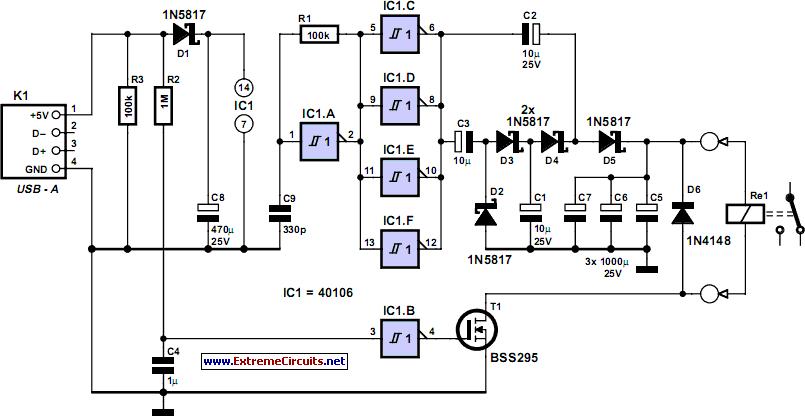
Computer Off Switch
How often does it happen that a user closes down Windows and then forgets to turn off the computer? This circuit addresses that issue by automatically powering off the computer after Windows has been shut down.
This circuit operates by monitoring...