


Li Ion Battery Charger Circuit Using IC LP2951
#Li-Ion
#LP2951
#charging circuit
#1C rate
#3.7V
#external charger
#cell phone battery
#current regulation

Description: Unlike lead-acid batteries, one advantage of lithium-ion (Li-Ion) batteries is that they can be charged at a 1C rate initially. This means the charging current can be as high as the rated ampere-hour (AH) capacity of the battery at the beginning of the charging process. The design presented in this article can be utilized for charging a single 3.7V Li-Ion cell or a standard cell phone battery externally at a relatively slower rate. In this circuit, the integrated circuit (IC) LP2951 serves as the main active component, chosen for its capability to deliver a very stable output voltage over varying temperatures. Initially, when the discharged cell's voltage is below 4.2V, the IC provides a maximum current of approximately 160mA. Once the terminal voltage of the Li-Ion cell reaches 4.2V, the LP2951 quickly reduces the current to prevent the battery from exceeding this voltage level. The large value resistors included in the circuit ensure that the "OFF" current drain of the battery remains below 2mA, while a 330pF capacitor stabilizes the circuit against unwanted noise generated at the high-impedance feedback node.
The charging circuit for the Li-Ion battery is designed to ensure efficient and safe charging while maintaining the integrity of the battery. The LP2951 voltage regulator is a low-dropout (LDO) linear regulator that provides a regulated output voltage, making it suitable for charging applications where a stable voltage is critical. The ability to charge at a 1C rate allows for rapid charging, which is beneficial in applications where downtime must be minimized.
In the circuit, the inclusion of large value resistors serves a dual purpose. They limit the current when the battery is in the "OFF" state, thereby reducing the self-discharge rate of the battery. This feature is particularly important for maintaining battery health over extended periods of inactivity. The 330pF capacitor plays a crucial role in filtering out high-frequency noise that could interfere with the voltage regulation process. This noise can originate from various sources, including switching power supplies and other electronic components in proximity to the charging circuit.
The charging process begins with the detection of the battery's voltage level. If the voltage is below the threshold of 4.2V, the LP2951 allows maximum current to flow into the battery. As the battery charges and its voltage approaches 4.2V, the LP2951 automatically reduces the current to a safe level. This automatic regulation is vital to prevent overcharging, which can lead to battery damage or reduced lifespan.
Overall, this charging circuit design effectively balances the need for rapid charging with safety and battery longevity. The choice of components and their configuration ensures that the circuit operates within safe parameters while providing reliable performance.Unlike lead acid batteries one good thing about the Li-Ion batteries is that they can be charged at 1C rate initially. It means the charging current may be as high as the rated AH of the battery at the onset. The design presented in this article can be used for charging a single 3. 7V Li-ion cell or a standard cell phone battery externally at a rel atively slower rate. In the given circuit the IC LP2951 becomes the main active component which has been specifically chosen because it is capable of delivering an output voltage thats very stable over temperature. Initially when the particular discharged cell has a voltage level thats below the 4. 2V, the IC generates maximum current to the cell which is around 160mA as discussed above. Once the terminal voltage of the Li-Ion cell reaches the 4. 2V mark, the IC LP2951 instantly inhibits the current so that the battery can longer exceed the 4. 2 V level. The big value resistors included in the circuit ensures the "OFF" current drain of the battery to below 2mA, the 330pF capacitor stabilizes the circuit from unwanted noises created at thehigh-impedance feedback node.
The charging circuit for the Li-Ion battery is designed to ensure efficient and safe charging while maintaining the integrity of the battery. The LP2951 voltage regulator is a low-dropout (LDO) linear regulator that provides a regulated output voltage, making it suitable for charging applications where a stable voltage is critical. The ability to charge at a 1C rate allows for rapid charging, which is beneficial in applications where downtime must be minimized.
In the circuit, the inclusion of large value resistors serves a dual purpose. They limit the current when the battery is in the "OFF" state, thereby reducing the self-discharge rate of the battery. This feature is particularly important for maintaining battery health over extended periods of inactivity. The 330pF capacitor plays a crucial role in filtering out high-frequency noise that could interfere with the voltage regulation process. This noise can originate from various sources, including switching power supplies and other electronic components in proximity to the charging circuit.
The charging process begins with the detection of the battery's voltage level. If the voltage is below the threshold of 4.2V, the LP2951 allows maximum current to flow into the battery. As the battery charges and its voltage approaches 4.2V, the LP2951 automatically reduces the current to a safe level. This automatic regulation is vital to prevent overcharging, which can lead to battery damage or reduced lifespan.
Overall, this charging circuit design effectively balances the need for rapid charging with safety and battery longevity. The choice of components and their configuration ensures that the circuit operates within safe parameters while providing reliable performance.Unlike lead acid batteries one good thing about the Li-Ion batteries is that they can be charged at 1C rate initially. It means the charging current may be as high as the rated AH of the battery at the onset. The design presented in this article can be used for charging a single 3. 7V Li-ion cell or a standard cell phone battery externally at a rel atively slower rate. In the given circuit the IC LP2951 becomes the main active component which has been specifically chosen because it is capable of delivering an output voltage thats very stable over temperature. Initially when the particular discharged cell has a voltage level thats below the 4. 2V, the IC generates maximum current to the cell which is around 160mA as discussed above. Once the terminal voltage of the Li-Ion cell reaches the 4. 2V mark, the IC LP2951 instantly inhibits the current so that the battery can longer exceed the 4. 2 V level. The big value resistors included in the circuit ensures the "OFF" current drain of the battery to below 2mA, the 330pF capacitor stabilizes the circuit from unwanted noises created at thehigh-impedance feedback node.

Built-in battery charger, Li-Ion
Build-in charger for instruments powered by single lithium-ion or Li-Pol accumulator. If external power supply not connected to charger, current back from the accu charger is very small. New version improved temperature stability and Not Needed NTC thermistor. After a...

Li-Ion Battery capacity tester
It is assumed that individuals interested in constructing this circuit can interpret the schematics provided below. Basic principles: Note that lithium-ion batteries should not be discharged below 3V.
The circuit design focuses on the safe operation of lithium-ion batteries, particularly emphasizing...
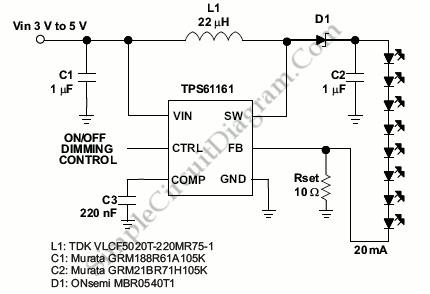
Li-Ion Driver for 8 White LEDs
A boost converter, such as the TPS61160/1, can be utilized with a 40V rated integrated switch FET to drive multiple LEDs in series. This configuration can help reduce output ripple.
The TPS61160/1 is a highly efficient boost converter designed for LED...

Stand Alone 600mA Li-ion Battery Charger
A constant-current/constant-voltage linear charger for single-cell lithium-ion (Li-ion) batteries can be constructed using the EUP8054 battery charger controller chip and a few passive components. This compact integrated circuit is suitable for various portable devices and is compatible with USB power...

Microchips MCP73113 Li-Ion Battery Charger
Microchip Technology's MCP73113, MCP73114, and MCP73213 Lithium-Ion (Li-Ion) chargers, as well as the MCP73123 and MCP73223 Lithium Iron Phosphate (LiFePO4) chargers, are equipped with Overvoltage Protection (OVP) to prevent overheating and damage to the battery-charger circuit from input voltage spikes....

ISL6291 Li-ion/Li Polymer Linear Battery Charger
The ISL6291 offers a cost-effective integrated charger solution for single-cell lithium-ion and lithium polymer rechargeable batteries. This solution does not require any external pass elements, current sensing resistors, or reverse blocking diodes. The ISL6291 functions as a constant-current (CC) and...

USB li-ion charger revision
A year ago, a circuit of a USB Li-ion charger based on the LM358 op-amp was shared. The circuit had some issues reported by commentators, including incorrect LED orientation. It is advised not to post email addresses or phone numbers...

One simple charging circuit b porcelain
After a slight loss of field strength, magnets can be re-magnetized using a simple homemade porcelain filler. Locate scrap materials such as switches and contacts, as well as other models like CJ10-60 ~ 15. The circuit can operate at 0A...

DIY Li ion battery charger w adjustable shut off current
This project originated from the need for a Li-ion charging circuit that offers more flexibility than typical do-it-yourself circuits while being more affordable than programmable computerized chargers. The primary objective was to design, build, test, and share a charger capable...