


ltc4000 lifepo4 battery charger circuit design
#LTC4000
#LiFePO4
#battery charger
#high voltage controller
#12 volts
#15 A
#Linear Technology
#programmable float voltage

Description: The LTC4000 high voltage controller, developed by Linear Technology, can be utilized to create a straightforward high current LiFePO4 battery charger. This charger delivers a fixed output voltage of 12 volts with a maximum output current of 15 A. Key features of the LTC4000-based LiFePO4 battery charger include: an accurate (±0.25%) programmable float voltage, selectable timer or current termination, temperature-qualified charging using an NTC thermistor, automatic recharge capability, C/10 trickle charge for deeply discharged cells, and bad battery detection with status indicator outputs. Additionally, this battery charging and power management system incorporates precision current sensing, which allows for lower sense voltages during high current operations. The circuit is designed to be simple, requiring minimal external electronic components, and is specifically intended for charging a three-cell LiFePO4 battery pack, providing a maximum charge current of 10 amperes.
The LTC4000 high voltage controller is engineered to efficiently manage the charging of LiFePO4 batteries, which are known for their stability and safety in energy storage applications. The charger’s ability to provide a fixed output voltage of 12 volts ensures compatibility with various LiFePO4 battery configurations. The maximum output current of 15 A allows for rapid charging, making it suitable for applications that require quick turnaround times.
The programmable float voltage feature, with a precision of ±0.25%, allows for fine-tuning of the charging process, ensuring that the battery is charged to the optimal voltage without overcharging, which can lead to reduced battery lifespan. The inclusion of a selectable timer or current termination mechanism provides flexibility in charging strategies, accommodating different battery states and user preferences.
Temperature qualification is a crucial aspect of the charging process, and the use of an NTC thermistor ensures that charging is halted or adjusted based on the battery temperature. This feature protects the battery from damage due to overheating, enhancing safety during operation.
Automatic recharge functionality ensures that the battery remains charged and ready for use, while the C/10 trickle charge capability is particularly beneficial for maintaining deeply discharged cells, gradually bringing them back to a healthy state without risking damage.
The bad battery detection feature, accompanied by status indicator outputs, provides real-time feedback on the health of the battery being charged. This capability is essential for preventing the use of faulty batteries, which can pose safety risks and affect overall system performance.
Precision current sensing is integrated into the design, allowing for accurate monitoring of the charging current. This is particularly important in high current applications, where traditional sensing methods may introduce significant voltage drops, leading to inaccurate readings.
Overall, the LTC4000 high voltage controller provides a robust and efficient solution for charging three-cell LiFePO4 battery packs, with a maximum charge current of 10 amperes, ensuring reliability and performance in various electronic applications. The circuit's simplicity and minimal component requirements make it an attractive option for engineers seeking to implement effective battery management systems.Using the LTC4000 high voltage controller designed by Linear Technology, can be designed a very simple high current LiFePO4 battery charger that will provide a fixed output voltage of 12 volts at a maximum output current of 15 A. Features of the LTC4000`s high current LiFePO4 battery charger include: accurate ( ±0. 25%) programmable float voltage , selectable timer or current termination, temperature qualified charging using an NTC thermistor, automatic recharge, C/10 trickle charge for deeply discharged cells, bad battery detection and status indicator outputs. This battery charging and power management system also includes precision current sensing that allows lower sense voltages for high current.
This power supply circuit is very simple requiring few external electronic parts and is designed for charging three cell LiFePO4 battery pack, providing a maximum charge current of 10 ampere.
The LTC4000 high voltage controller is engineered to efficiently manage the charging of LiFePO4 batteries, which are known for their stability and safety in energy storage applications. The charger’s ability to provide a fixed output voltage of 12 volts ensures compatibility with various LiFePO4 battery configurations. The maximum output current of 15 A allows for rapid charging, making it suitable for applications that require quick turnaround times.
The programmable float voltage feature, with a precision of ±0.25%, allows for fine-tuning of the charging process, ensuring that the battery is charged to the optimal voltage without overcharging, which can lead to reduced battery lifespan. The inclusion of a selectable timer or current termination mechanism provides flexibility in charging strategies, accommodating different battery states and user preferences.
Temperature qualification is a crucial aspect of the charging process, and the use of an NTC thermistor ensures that charging is halted or adjusted based on the battery temperature. This feature protects the battery from damage due to overheating, enhancing safety during operation.
Automatic recharge functionality ensures that the battery remains charged and ready for use, while the C/10 trickle charge capability is particularly beneficial for maintaining deeply discharged cells, gradually bringing them back to a healthy state without risking damage.
The bad battery detection feature, accompanied by status indicator outputs, provides real-time feedback on the health of the battery being charged. This capability is essential for preventing the use of faulty batteries, which can pose safety risks and affect overall system performance.
Precision current sensing is integrated into the design, allowing for accurate monitoring of the charging current. This is particularly important in high current applications, where traditional sensing methods may introduce significant voltage drops, leading to inaccurate readings.
Overall, the LTC4000 high voltage controller provides a robust and efficient solution for charging three-cell LiFePO4 battery packs, with a maximum charge current of 10 amperes, ensuring reliability and performance in various electronic applications. The circuit's simplicity and minimal component requirements make it an attractive option for engineers seeking to implement effective battery management systems.Using the LTC4000 high voltage controller designed by Linear Technology, can be designed a very simple high current LiFePO4 battery charger that will provide a fixed output voltage of 12 volts at a maximum output current of 15 A. Features of the LTC4000`s high current LiFePO4 battery charger include: accurate ( ±0. 25%) programmable float voltage , selectable timer or current termination, temperature qualified charging using an NTC thermistor, automatic recharge, C/10 trickle charge for deeply discharged cells, bad battery detection and status indicator outputs. This battery charging and power management system also includes precision current sensing that allows lower sense voltages for high current.
This power supply circuit is very simple requiring few external electronic parts and is designed for charging three cell LiFePO4 battery pack, providing a maximum charge current of 10 ampere.

Stand-by Battery Charger
This simple circuit will find many applications as a battery eliminator for low power requirements. It consists of a transformer, a bridge rectifier and an electrolytic capacitor followed by a zener controlled series pass transistor. The output is stabilized at...
Battery Charger
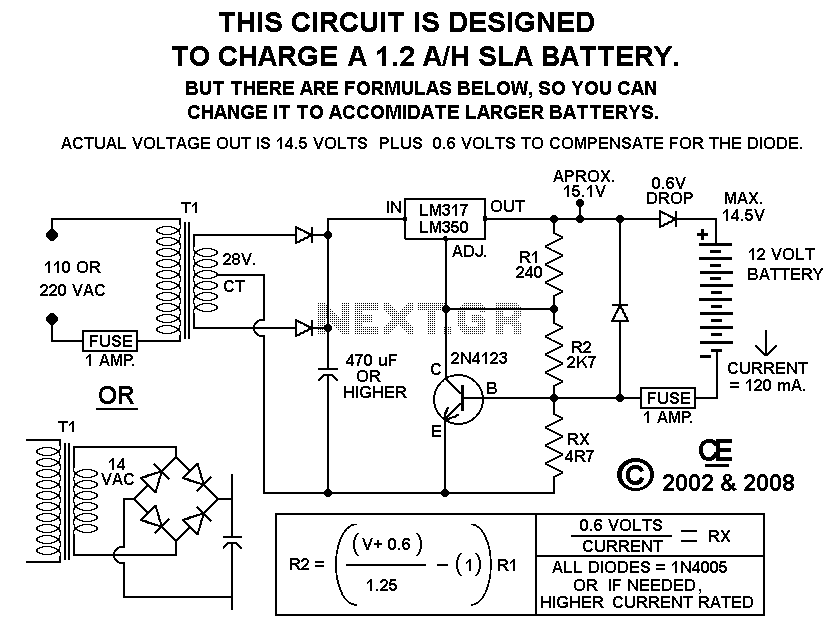
Using this circuit will give good charging results to the gel cell battery used in the metal detector or any other similar and smaller type battery. This charger is both current and voltage regulated. The output is not short circuit...

Battery-Temperature Sensing Nicad Charger
Two simple circuits enable NiCad battery charging based on the temperature differences between the battery pack and the ambient temperature. This method allows for fast charging by sensing the temperature rise that occurs after charging is complete when the battery...

Intelligent Battery-Charging Circuit Circuit
Intended for a NiCad application, this charging circuit can be used with a wide range of batteries. A low-battery detector is included, and the trip voltage is set via a 500 kΩ potentiometer. Select the resistor for the battery you...

Car Battery 6V or 12V charger circuit
This circuit is capable of automatically charging 6V and 12V batteries quickly and accurately. A key factor in the successful operation of the circuit is the use of a high-quality transformer (T1) that features excellent insulation and short-circuit resistance.
The charging...

14 Volt Battery Charger Circuit Schematic Diagram
This circuit outputs a voltage of 14 volts with a maximum current of 4A. It can be used for NiCad batteries and accumulators, both wet and dry types. However, the accumulator must be rated for 12 volts and have a...
Battery Charger
Using this circuit will give good charging results to the gel cell battery used in the metal detector or any other similar and smaller type battery. This charger is both current and voltage regulated. The output is not short circuit...
Battery-Charging Indicator For Mains Adaptor
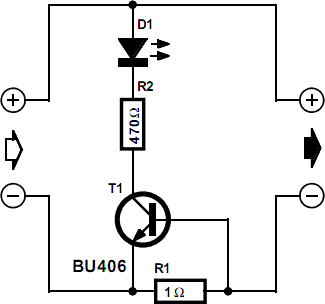
While owning a modern NiCd battery charger is advantageous, there may still be instances where an incompatible battery is encountered, such as one with an unusual voltage requirement or a need for a higher charging current than what a standard...

Battery Charger Regulator
Most off-the-shelf car battery chargers cannot be left connected to the battery for long periods of time as overcharging can cause battery damage.
The operation of car battery chargers typically involves converting alternating current (AC) from a wall outlet into direct...