


Ni-Cad battery charger
#Ni-Cad
#battery charger
#SCR
#discharge current
#zapper
#switch contacts
#heavy discharge
#battery repair
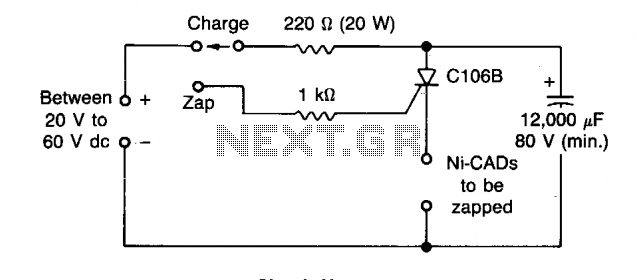
Description: The short in a Ni-Cad battery can be "burned off" with this zapper. The use of the SCR prevents heavy discharge current from damaging the switch contacts. More: follow the diagram.
This circuit utilizes a zapper to eliminate shorts in nickel-cadmium (Ni-Cad) batteries. The design incorporates a silicon-controlled rectifier (SCR) to manage the discharge current effectively. The SCR serves as a switch that can handle high currents, ensuring that the heavy discharge does not affect the integrity of the switch contacts.
In the schematic, the zapper is connected to the battery terminals, allowing for a controlled discharge to occur when a short is detected. When activated, the SCR allows current to flow through the short circuit, generating heat that effectively "burns off" the short. This process requires careful calibration to ensure that the current level is sufficient to clear the short without causing damage to the battery or the zapper circuitry.
The circuit may also include additional components such as resistors and capacitors to stabilize the operation and provide feedback to the SCR. The use of a diode may also be included to prevent reverse current flow, which could potentially harm the circuit. Proper heat dissipation mechanisms should be considered to ensure the SCR does not overheat during operation.
Overall, this circuit provides a practical solution for addressing shorts in Ni-Cad batteries, enhancing their longevity and reliability in various applications. Following the provided diagram will ensure accurate assembly and functionality of the zapper circuit.The short in a Ni-Cad battery can be "burned off" with this zapper. Use of the SCR keeps heavy discharge current from damaging switch contacts. follow the diagram.
This circuit utilizes a zapper to eliminate shorts in nickel-cadmium (Ni-Cad) batteries. The design incorporates a silicon-controlled rectifier (SCR) to manage the discharge current effectively. The SCR serves as a switch that can handle high currents, ensuring that the heavy discharge does not affect the integrity of the switch contacts.
In the schematic, the zapper is connected to the battery terminals, allowing for a controlled discharge to occur when a short is detected. When activated, the SCR allows current to flow through the short circuit, generating heat that effectively "burns off" the short. This process requires careful calibration to ensure that the current level is sufficient to clear the short without causing damage to the battery or the zapper circuitry.
The circuit may also include additional components such as resistors and capacitors to stabilize the operation and provide feedback to the SCR. The use of a diode may also be included to prevent reverse current flow, which could potentially harm the circuit. Proper heat dissipation mechanisms should be considered to ensure the SCR does not overheat during operation.
Overall, this circuit provides a practical solution for addressing shorts in Ni-Cad batteries, enhancing their longevity and reliability in various applications. Following the provided diagram will ensure accurate assembly and functionality of the zapper circuit.The short in a Ni-Cad battery can be "burned off" with this zapper. Use of the SCR keeps heavy discharge current from damaging switch contacts. follow the diagram.

200Ma-12v ni-cad battery charger
This circuit charges a battery at a rate of 75 mA, allowing the battery to remain in the charger indefinitely until fully charged. Once the battery reaches its full charge, the circuit reduces the current to a trickle rate. To...

High-Power Alarm Driver Circuit
In this circuit, a low-powered silicon-controlled rectifier (SCR) is utilized to trigger a higher-powered SCR. When a switch is opened (S2, S3, S4) or closed (S5, S6, S7), either SCR1 or SCR2 is activated. This action subsequently triggers SCR3 through...

Battery Charger Circuit
The circuit is capable of supplying either a trickle charge (50 mA) or a high-current charge (1 A). Users can select either charging method or an automatic mode that initially trickle charges a battery if it is particularly low before...

varying brightness ac lamp
In this circuit, an SCR is utilized to gradually adjust the brightness of a 120-volt light bulb by regulating the duration for which the AC line voltage is supplied to the lamp during each half-cycle.
This circuit employs a Silicon Controlled...

Battery charger
A diac is utilized in the gate circuit to enable operation for the signal applied to the gate. R1 sets a threshold level for triggering the triac. C3 and R4 are chosen to restrict the maximum charging current, forming a...

scr tester
Although SCRs and TRIACs are not present in all electronic equipment, they are significant components. Understanding how to test them is essential for troubleshooting. Testing these components can be done with meters, but using an SCR/TRIAC tester is generally easier...

Scr Circuit With Self-Interrupting Load
A self-interrupting device connected to a voltage source operates as a switch that continuously opens and closes; thus, the circuit does not latch in the conventional manner, allowing the alarm to function only while switch SI is closed. Due to...

Automatic battery charger circuit using lm301-2
This is a battery charger circuit that has the advantage of automatically disconnecting the battery when charging is complete. The voltage sensor used in this circuit is the LM301 IC, which serves to disconnect the battery when the charging voltage...

Slave Flash Trigger
The SCR is connected across the trigger circuit of the flash gun. In its default state, the SCR remains off, allowing the flash gun to charge to its trigger voltage. A phototransistor, Q1, is utilized to monitor the light level....