


50 Khz center frequency optical transmitter
#optical transmitter
#50 kHz
#IRED
#phototransistor
#modulating voltage
#information transfer
#free air range
#power consumption
#F5D1

Description: The pulse repetition rate is largely unaffected by temperature and power supply voltage, and it varies linearly with V1N, the modulating voltage. Effective information transfer was achieved at distances of 12 feet (~4m) in free air. A greater range can be realized by utilizing a higher power output infrared emitting diode (IRED) such as the F5D1 in conjunction with the L14P2 phototransistor. The average power consumption of the transmitter circuit is less than 3 watts. Additionally, incorporating lenses or reflectors at both the light emitter and detector enhances the range and reduces the impact of stray light noise.
The described circuit operates on a modulation scheme that allows for pulse repetition rates to remain stable across varying environmental conditions. The modulation voltage, V1N, plays a critical role in determining the frequency of the emitted pulses, ensuring that the system can maintain consistent communication even when external factors fluctuate.
The use of an infrared emitting diode (IRED) such as the F5D1 is essential for extending the operational range of the transmitter. This component is designed to emit infrared light at a wavelength that is optimal for detection by phototransistors like the L14P2. The selection of these components should consider their spectral characteristics to ensure that the emitted light is effectively captured by the phototransistor.
In terms of power efficiency, maintaining an average consumption of less than 3 watts is significant for battery-operated or low-power applications. This low power consumption allows for prolonged operational periods without the need for frequent recharging or battery replacement, making the system suitable for remote or portable applications.
To further enhance the system's performance, the integration of lenses or reflectors at both the emitter and detector is recommended. These optical elements can focus the emitted infrared light, increasing the intensity of the signal that reaches the phototransistor. Additionally, they can help to mitigate the effects of ambient light interference, which can adversely affect the system's performance by introducing noise into the received signal. By optimizing the optical path, the overall efficiency and reliability of the communication system can be significantly improved.
In summary, this circuit design emphasizes the importance of component selection, power efficiency, and optical enhancements to achieve effective and reliable information transfer over extended distances in various environmental conditions.The pulse repetition rate is relatively insensitive to temperature, and power supply voltage and is a linear function of V1N, the modulating voltage. Useful information transfer was obtained in free air ranges of 12 feet (~ 4m). Greater range can also be obtained by using a higher power output IRED such as the F5D1 in combination with the L14P2 phototransistor.
Average power consumption of the transmitter circuit is less than"3 watts. Lenses or reflectors at the light emitter and detector increases range and minimizes stray light noise effects.
The described circuit operates on a modulation scheme that allows for pulse repetition rates to remain stable across varying environmental conditions. The modulation voltage, V1N, plays a critical role in determining the frequency of the emitted pulses, ensuring that the system can maintain consistent communication even when external factors fluctuate.
The use of an infrared emitting diode (IRED) such as the F5D1 is essential for extending the operational range of the transmitter. This component is designed to emit infrared light at a wavelength that is optimal for detection by phototransistors like the L14P2. The selection of these components should consider their spectral characteristics to ensure that the emitted light is effectively captured by the phototransistor.
In terms of power efficiency, maintaining an average consumption of less than 3 watts is significant for battery-operated or low-power applications. This low power consumption allows for prolonged operational periods without the need for frequent recharging or battery replacement, making the system suitable for remote or portable applications.
To further enhance the system's performance, the integration of lenses or reflectors at both the emitter and detector is recommended. These optical elements can focus the emitted infrared light, increasing the intensity of the signal that reaches the phototransistor. Additionally, they can help to mitigate the effects of ambient light interference, which can adversely affect the system's performance by introducing noise into the received signal. By optimizing the optical path, the overall efficiency and reliability of the communication system can be significantly improved.
In summary, this circuit design emphasizes the importance of component selection, power efficiency, and optical enhancements to achieve effective and reliable information transfer over extended distances in various environmental conditions.The pulse repetition rate is relatively insensitive to temperature, and power supply voltage and is a linear function of V1N, the modulating voltage. Useful information transfer was obtained in free air ranges of 12 feet (~ 4m). Greater range can also be obtained by using a higher power output IRED such as the F5D1 in combination with the L14P2 phototransistor.
Average power consumption of the transmitter circuit is less than"3 watts. Lenses or reflectors at the light emitter and detector increases range and minimizes stray light noise effects.

Modulated light-beam circuit
The feedback control of the phototransistor in this optical detector helps negate the effects of varying ambient light sources. The output of a modulated visible-light LED is detected, amplified, buffered, and fed through a low-pass filter. Ambient light signals below...
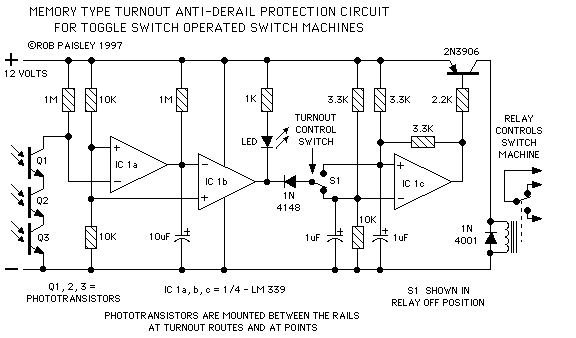
Protector
The circuits presented here will prevent turnouts from being thrown while a train is on a switch, which is ideal in situations where the switch cannot be seen by the operator. They utilize phototransistor sensors to detect the presence of...

Optical transmission detection circuit
This circuit employs a phototransistor along with four operational amplifiers to function as a total energy detector. It is designed to measure the total energy of optical pulses transmitted through an optical cable communication system. When the light intensity of...

Simple Amplifier For Phototransistors Circuit
This simple amplifier is compatible with nearly any phototransistor. Although the 741 operational amplifier is designed for use with a split supply, it can also function effectively with a single-sided supply.
The described amplifier circuit utilizes the 741 operational amplifier (op-amp),...

Optical transmitter
The driver circuit utilizes an MC74LS04 and a discrete transistor. The circuit is capable of driving the LED (MFOE12QO) at data rates of up to 1 Mbps.
The driver circuit employs the MC74LS04, which is a hex inverter, to provide signal...

phototransistor Light sensor using Photo Transistor
A circuit that uses a phototransistor to create a light-sensitive switch. When there is no light in the room, the LED connected to the phototransistor lights up, and when there is light, the LED turns off. Any schematic or circuit...

Simple optical switchs
When the phototransistor is struck by infrared (IR) light, it begins to conduct, causing the voltage across a 1 MΩ resistor (chosen arbitrarily) and the phototransistor to drop from VCC to lower values. When this voltage falls below VCC/3, the...

Auto Cutter mill circuit
The cutter is safeguarded by a printed circuit phototransistor designed to prevent accidental activation of the cutter switch during manual feeding. In the event of manual feeding, the automatic paper cutter can be controlled to shut down. A relay with...

Darlington phototransistor type light control switch circuit diagram sensitive application
Darlington phototransistor type light-sensitive switch control circuit application. The Darlington type phototransistor serves as a sensitive element, capable of detecting low light levels for the detection of reflected light signals.
The Darlington phototransistor circuit utilizes a pair of transistors configured to...