


Rs232c-led-circuit

Description: Utilize a pair of Maxim's 5V-powered MAX231 RS-232C transmitters as drivers to achieve a dual-color LED. These transmitters necessitate only a single-ended, 5-V input to internally generate ±10 V. Their outputs are designed to be short-circuit-proof and can provide up to 10 mA, which is sufficient to drive most LEDs. Depending on the chosen LED, their current-limiting feature may also remove the requirement for external series resistors. Additionally, using these straightforward circuits allows for the implementation of various functions.
The circuit employs two MAX231 RS-232C transmitters, which are integrated circuits designed for transmitting and receiving serial data over RS-232 communication lines. Each transmitter operates on a 5V power supply, converting this low voltage into a higher voltage output of ±10 V, suitable for driving devices that require RS-232 signal levels.
The configuration of the circuit allows for the control of a two-color LED by manipulating the outputs of the MAX231 transmitters. The transmitters can be connected to a microcontroller or other logic devices that provide the necessary control signals. When one transmitter is activated, it can drive one color of the LED, while the other transmitter can drive the second color. This method provides a simple yet effective means of creating visual indicators or status displays with different color outputs.
The short-circuit-proof outputs ensure that the circuit remains protected against accidental short circuits, which enhances reliability in various applications. The ability to supply up to 10 mA is adequate for most standard LEDs, allowing for bright illumination without the need for additional amplification stages.
Furthermore, the integrated current-limiting feature of the MAX231 can simplify the overall circuit design. This feature can automatically limit the current flowing through the LED, potentially eliminating the need for external resistors, which are typically used to prevent excessive current that could damage the LED. This not only reduces component count but also minimizes the space required on the PCB.
In summary, the use of MAX231 RS-232C transmitters in this configuration provides a robust solution for driving dual-color LEDs, offering simplicity, reliability, and versatility for a variety of electronic applications.Use a pair of Maxim"s 5V-powered MAX231 RS-232C transmitters as drivers to obtain a 2-color LED. The transmitters require only a singleended, 5-V input to generate ± 10 V internally. Their outputs are short-circuit-proof and can supply as much as 10 mA-enough to drive most LEDs. Depending on which LED you select, their currentlimiting feature might also eliminate the need for external series resistors. Using the simple circuits, you can implement a variety of functions.
The circuit employs two MAX231 RS-232C transmitters, which are integrated circuits designed for transmitting and receiving serial data over RS-232 communication lines. Each transmitter operates on a 5V power supply, converting this low voltage into a higher voltage output of ±10 V, suitable for driving devices that require RS-232 signal levels.
The configuration of the circuit allows for the control of a two-color LED by manipulating the outputs of the MAX231 transmitters. The transmitters can be connected to a microcontroller or other logic devices that provide the necessary control signals. When one transmitter is activated, it can drive one color of the LED, while the other transmitter can drive the second color. This method provides a simple yet effective means of creating visual indicators or status displays with different color outputs.
The short-circuit-proof outputs ensure that the circuit remains protected against accidental short circuits, which enhances reliability in various applications. The ability to supply up to 10 mA is adequate for most standard LEDs, allowing for bright illumination without the need for additional amplification stages.
Furthermore, the integrated current-limiting feature of the MAX231 can simplify the overall circuit design. This feature can automatically limit the current flowing through the LED, potentially eliminating the need for external resistors, which are typically used to prevent excessive current that could damage the LED. This not only reduces component count but also minimizes the space required on the PCB.
In summary, the use of MAX231 RS-232C transmitters in this configuration provides a robust solution for driving dual-color LEDs, offering simplicity, reliability, and versatility for a variety of electronic applications.Use a pair of Maxim"s 5V-powered MAX231 RS-232C transmitters as drivers to obtain a 2-color LED. The transmitters require only a singleended, 5-V input to generate ± 10 V internally. Their outputs are short-circuit-proof and can supply as much as 10 mA-enough to drive most LEDs. Depending on which LED you select, their currentlimiting feature might also eliminate the need for external series resistors. Using the simple circuits, you can implement a variety of functions.

LED flashing with 3909 IC circuit
This project uses a 3909 IC and a few other parts; power is 1.5 volts DC.
The project employs the 3909 integrated circuit (IC), which is a versatile component commonly used in various electronic applications, particularly in timer and oscillator configurations....

Running Message Display
Light-emitting diodes (LEDs) are advantageous due to their compact size, low current consumption, and vibrant colors. This circuit features a running message display where the letters formed by an LED arrangement illuminate progressively. Once all letters of the message are...

LED flashing circuit for toys
It consists of a 4047 low-power monostable/astable multivibrator, IC1, used in the astable mode to provide the timing pulses to control the flash rate of the LEDs. To accomplish the astable mode, pins 4, 5, 6, and 14 are connected...

Bar-Mode Lights Sequencer
The terminal of R7, indicated by an arrow, must be connected to the desired output pin of IC2 or IC3 to select the number of LEDs or clusters that will form the bar. For instance, to drive seven LEDs or...

LED Brake/Rear Light Specifically for motorcycles Circuit diagram
LEDs are increasingly utilized in motor vehicles, replacing traditional incandescent lamps due to their superior energy efficiency and extended lifespan. This article outlines a straightforward LED tail light specifically designed for motorcycles, scooters, and mopeds. There is a notable demand...

230V Blinking LED
A pulsating light is used for signaling purposes with a voltage of 230V. A simple circuit has been designed, consisting of an LED diode, two capacitors, two resistors, a diac, and a diode. The operation of the circuit is straightforward....

Solar Charged LED Utility Light
Tired of always spending money on flashlight batteries only to have them fail just when you need them? Try this simple circuit out. It would make an excellent science fair project. The white LEDs are quite bright, they provide enough...
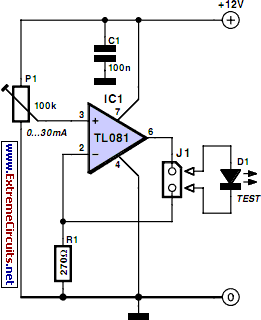
A Very Simple LED Tester
This simple LED tester consists of a current source with a potentiometer that can be used to adjust the current. The current source is implemented using a TL081 operational amplifier. The output current from the op-amp flows through the diode...

Electronic Cricket Match Game
This electronic cricket device is a gift for children. This simple battery-powered circuit can be used to simulate a cricket match with friends. Each LED in the circuit represents various statuses of the cricket match, such as a six, run...