


Serial Cable for Casio Digital Cameras
#serial cable
#RS-232
#CMOS
#Casio
#digital camera
#inverting buffer
#voltage converter
#DB9F connector
#communication

Description: I built this cable for my Casio QV-200 digital camera, it should work for many Casio models. It's basically an inverting buffer/converter to/from RS-232 voltage levels from/to CMOS levels. Why Casio didn't put this inside the camera like everyone else does is beyond me. I built the circuit inside the hood of the DB9F connector.
The described circuit functions as a level shifter, specifically designed to interface between the RS-232 communication standard and the CMOS logic levels utilized by the Casio QV-200 digital camera. The RS-232 standard operates at voltage levels typically ranging from +3 to +15 volts for a logical '0' and -3 to -15 volts for a logical '1', while CMOS logic levels operate at much lower voltages, commonly around 0 to 5 volts.
The inverting buffer/converter circuit is implemented using a suitable integrated circuit (IC) such as the 74HC14, which is a hex inverter with Schmitt-trigger inputs. This IC allows for reliable operation at the lower CMOS voltage levels while also providing the necessary inversion of the signal. The circuit design includes a series of resistors and capacitors to filter and stabilize the signal, ensuring that noise is minimized during the level conversion process.
The physical construction of the circuit within the hood of a DB9F connector is advantageous for maintaining a compact design while providing easy connectivity to the camera. The DB9F connector serves as a standard interface for serial communication, allowing the cable to be used with various devices that support RS-232 communication. Proper pin assignments must be adhered to, ensuring that the transmit (TX) and receive (RX) lines are correctly connected to facilitate data transmission between the camera and the host device.
This level-shifting cable effectively enables communication between the Casio QV-200 and other RS-232 compatible devices, thus enhancing the functionality and versatility of the camera without requiring modifications to the internal circuitry of the device itself.I built this cable for my Casio QV-200 digital camera, it should work for many Casio models. It`s basically a inverting buffer/converter to/from RS-232 voltage levels from/to CMOS levels. Why Casio didn`t put this inside the camera like everyone else does is beyond me. I built the circuit inside the hood of the DB9F connector.
The described circuit functions as a level shifter, specifically designed to interface between the RS-232 communication standard and the CMOS logic levels utilized by the Casio QV-200 digital camera. The RS-232 standard operates at voltage levels typically ranging from +3 to +15 volts for a logical '0' and -3 to -15 volts for a logical '1', while CMOS logic levels operate at much lower voltages, commonly around 0 to 5 volts.
The inverting buffer/converter circuit is implemented using a suitable integrated circuit (IC) such as the 74HC14, which is a hex inverter with Schmitt-trigger inputs. This IC allows for reliable operation at the lower CMOS voltage levels while also providing the necessary inversion of the signal. The circuit design includes a series of resistors and capacitors to filter and stabilize the signal, ensuring that noise is minimized during the level conversion process.
The physical construction of the circuit within the hood of a DB9F connector is advantageous for maintaining a compact design while providing easy connectivity to the camera. The DB9F connector serves as a standard interface for serial communication, allowing the cable to be used with various devices that support RS-232 communication. Proper pin assignments must be adhered to, ensuring that the transmit (TX) and receive (RX) lines are correctly connected to facilitate data transmission between the camera and the host device.
This level-shifting cable effectively enables communication between the Casio QV-200 and other RS-232 compatible devices, thus enhancing the functionality and versatility of the camera without requiring modifications to the internal circuitry of the device itself.I built this cable for my Casio QV-200 digital camera, it should work for many Casio models. It`s basically a inverting buffer/converter to/from RS-232 voltage levels from/to CMOS levels. Why Casio didn`t put this inside the camera like everyone else does is beyond me. I built the circuit inside the hood of the DB9F connector.

VFC62 voltage / frequencyfrequency / voltage converter circuit
The VFC62 is a voltage-to-frequency and frequency-to-voltage converter that effectively transforms analog signals into digital signals. The digital output is presented in an open collector format, where the digital pulse repetition rate is directly proportional to the amplitude of the...

Digital Inverter
The configuration involves connecting two FETs to create a CMOS digital inverter.
The CMOS (Complementary Metal-Oxide-Semiconductor) digital inverter is a fundamental building block in digital electronics, widely used in various applications such as logic gates, amplifiers, and memory circuits. This inverter...

Driver circuits
CMOS drivers for relays, lamps, speakers, and similar applications provide extremely low standby power consumption. When operating at Vcc = 15 V, the power dissipation per package is typically 750 nW when the outputs are not drawing current. Consequently, these...

Two Cmos Based 24-Hour Timers circuit
A pair of multi-range timers that provide timing periods extending up to 24 hours and beyond. Both timers are fundamentally identical, with the primary distinction being their relay behavior upon the completion of the timing cycle. Version 1 activates the...

30V from 5V converter
I made the power supply which makes about +30V with +5V power supply. The direct current is changed into the alternating current by the oscillator which used the schmitt trigger inverter which has the hysteresis characteristic and the resonance circuit....
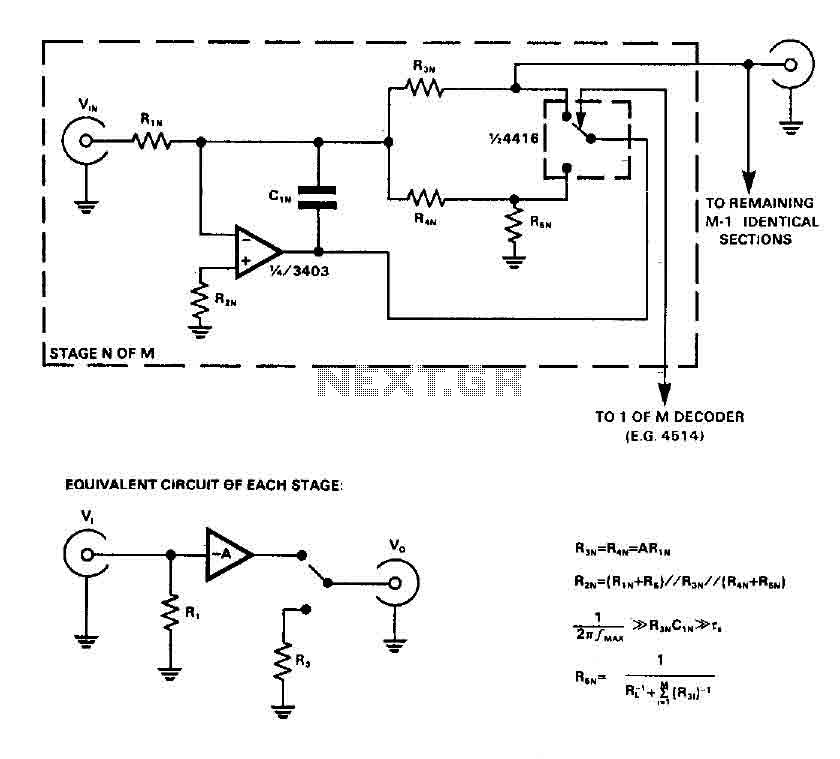
Audio input selector circuit (4416 CMOS)
CMOS switches are utilized to select entries in audio circuits. While these switches can introduce unacceptable levels of distortion, incorporating them into the feedback network of an operational amplifier (op amp) can effectively minimize this distortion. The circuit employs a...

12v to 220v converter circuit
This DIY 12V to 220V voltage converter is built with a CMOS 4047, which serves as the main component of this compact voltage converter that transforms 12V DC into 220V AC. The 4047 functions as an astable multivibrator; at pins...

ICL3232 250kbps RS-232 Transmitters/Receivers
The Intersil ICL32XX devices are powered by 3.0V to 5.5V and function as RS-232 transmitters and receivers, complying with EIA/TIA-232 and V.28/V.24 specifications, even at a supply voltage of 3.0V. These devices are designed for applications such as PDAs, palmtops,...

1.5V liquid crystal display circuit
The Motorola company's MC14440 CMOS integrated circuit is designed for timing and displaying calendar functions. It utilizes a 32.768 kHz NT cutting type quartz crystal along with fine-tune capacitance to generate time-based signals. The display circuit operates on a 1.5...