


Computer Circuit
#encoding
#decoding
#RF transmitter
#RF receiver
#wireless
#mouse
#homemade
#MC145026
#MC145027
#TDA1808

Description: This device utilizes the MC145026/MC145027 encoding and decoding circuit along with the TDA1808/TDA1809 RF transmitter/receiver module. It can be operated flexibly within a range of 10 to 120 meters, allowing users to maintain the original external appearance and internal circuitry of the mouse during the modification process. This makes it convenient and reliable, particularly suitable for homemade versions. Typically, there are four circuit lines that connect the mouse to the computer. This circuit device can accept four data wire inputs, which users can choose based on their specific mouse configuration. These connections include a power source anode, power source ground, data wire 1, and data wire 2. The circuit does not require any modifications to the mouse or computer, nor does it necessitate the installation of additional drivers for the mouse. All functions of the original mouse can be utilized normally.
The device described integrates an encoding and decoding circuit (MC145026/MC145027) with an RF transmitter and receiver module (TDA1808/TDA1809) to facilitate wireless communication between a computer and a mouse. The operational range of 10 to 120 meters enhances flexibility, making it suitable for various applications, including home automation and remote control setups.
The circuit design is particularly user-friendly, as it allows for the integration of the wireless components without altering the mouse's physical appearance or internal circuitry. This is achieved through a straightforward wiring approach that connects the mouse to the computer using four essential lines: the power source anode, power source ground, and two data wires (data wire 1 and data wire 2). Such a layout ensures that users can select the appropriate data wire inputs according to their specific mouse configuration, thereby providing customization options based on individual needs.
Importantly, the implementation of this device does not require any additional software installation or modifications to the existing mouse or computer systems. This plug-and-play characteristic ensures that all original functionalities of the mouse remain intact, allowing for seamless operation. The reliability and convenience of this setup make it an excellent choice for hobbyists and DIY enthusiasts looking to create a customized wireless mouse solution.This device adopts encoding and decoding circuit MC145026/ MC145027 and RF transmitter / receiver module TDA1808/ TDA1809, and it can beflexibly operated inthe range of 10~120m, and people have no need to change orginal mouse eterior apperance and inside circuit in the making peocess, and itis convenient and reliable, very suitablel for homemade lo vers. Generally speaking, there are four circuit lines inside mouse and computer connect line ( this circuit device can receive four data wire inputs, and reader can choose according to practical situation of theirself mouse ), they are seperately power source anode, power souce ground, data wire 1, data wire 2. The circuit has no need to change mouse and computer, no need to intall additional mouse to drive software, and all the functions of orginal mouse can benormal used.
(View)
The device described integrates an encoding and decoding circuit (MC145026/MC145027) with an RF transmitter and receiver module (TDA1808/TDA1809) to facilitate wireless communication between a computer and a mouse. The operational range of 10 to 120 meters enhances flexibility, making it suitable for various applications, including home automation and remote control setups.
The circuit design is particularly user-friendly, as it allows for the integration of the wireless components without altering the mouse's physical appearance or internal circuitry. This is achieved through a straightforward wiring approach that connects the mouse to the computer using four essential lines: the power source anode, power source ground, and two data wires (data wire 1 and data wire 2). Such a layout ensures that users can select the appropriate data wire inputs according to their specific mouse configuration, thereby providing customization options based on individual needs.
Importantly, the implementation of this device does not require any additional software installation or modifications to the existing mouse or computer systems. This plug-and-play characteristic ensures that all original functionalities of the mouse remain intact, allowing for seamless operation. The reliability and convenience of this setup make it an excellent choice for hobbyists and DIY enthusiasts looking to create a customized wireless mouse solution.This device adopts encoding and decoding circuit MC145026/ MC145027 and RF transmitter / receiver module TDA1808/ TDA1809, and it can beflexibly operated inthe range of 10~120m, and people have no need to change orginal mouse eterior apperance and inside circuit in the making peocess, and itis convenient and reliable, very suitablel for homemade lo vers. Generally speaking, there are four circuit lines inside mouse and computer connect line ( this circuit device can receive four data wire inputs, and reader can choose according to practical situation of theirself mouse ), they are seperately power source anode, power souce ground, data wire 1, data wire 2. The circuit has no need to change mouse and computer, no need to intall additional mouse to drive software, and all the functions of orginal mouse can benormal used.
(View)
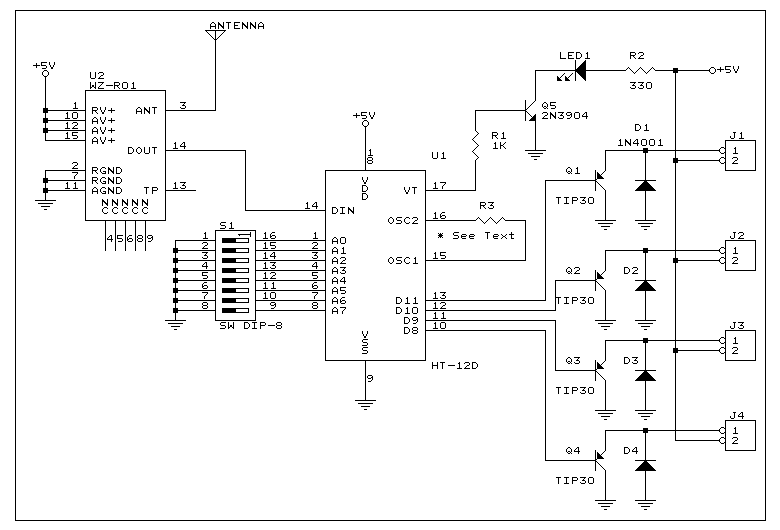
4 Channel Tranceiver
This is a simple RF transmitter circuit that includes the Holtek HT-12E encoder chip and an AM 418MHz transmitter module (WZ-X01). Using hybrid RF transmit/receive modules simplifies the construction of the RF remote control. The transmitter can operate with any...

Wireless Car Alarm
This circuit is a wireless car alarm system that consists of two modules: a transmitter and a receiver. It operates on FM radio waves and is suitable for vehicles with a 6-12V DC power supply. A voltage stabilizer can be...

Homemade metal detector circuit
This homemade metal detector circuit will assist in locating objects made of materials with relatively high magnetic permeability. It is not suitable for detecting certain metals.
This metal detector circuit operates on the principle of electromagnetic induction, utilizing a coil of...

Personal-pocket-pager
When activated, the transmitter emits a 49.890-MHz AM RF carrier signal. The receiver detects, amplifies, and decodes the RF signal, which subsequently activates a piezo buzzer. The receiver is compact enough to be carried in a pocket or placed on...

Wireless Color Sensor
Close to human perception and stable color sensing is a pervasive challenge encountered in various disciplines, such as machine vision for classification and recognition, as well as in intelligent systems like smart illumination systems in home or workplace environments. In...

Homemade metal detector
This homemade metal detector circuit is designed to locate objects made of materials with relatively high magnetic permeability. While it may not be sensitive enough for detecting buried coins, it can effectively identify larger metallic treasures. The circuit operates using...

Remote Operated Spy Robot Circuit
A remote-operated spy robot circuit can be controlled using a wireless remote controller. It captures audio and video information from the surroundings and transmits this data to a remote station via RF signals, with a maximum range of 125 meters,...

One kind of wireless remote control circuit
The remote control transmitter consists of a DTMF generator and an FM transmitter circuit. A UM91214B phone-specific integrated circuit (IC) is utilized to generate the DTMF signal, with a 3V power supply provided by a 3V zener diode (D1). The...

Building a Wireless Temperature Sensor
A wireless temperature sensor allows temperature measurements to be taken anywhere within the range of the transmitter and receiver. One straightforward approach to achieve this is by utilizing a voltage-to-frequency conversion chip in conjunction with an analog temperature sensor, such...