


OpenLx USB DMX interface
#DMX
#USB
#PIC microcontroller
#RS-485
#entertainment lighting
#PC interface
#lighting control
#serial communication

Description: This circuit is designed to produce DMX output for entertainment lighting from a PC. It offers flexibility in circuit configurations. By opting for no isolation, the setup requires only a PIC microcontroller and a standard RS-485 driver, with an estimated total cost of less than £10. For a slightly higher cost, full galvanic isolation can be implemented to protect the PC, or a keypad can be added for standalone operation. Additionally, with the incorporation of I2C memory, scenes and test sequences can be programmed on a PC and stored for later playback.
The DMX output circuit serves as an interface between a PC and DMX-compatible lighting fixtures, leveraging the DMX512 protocol commonly used in entertainment lighting systems. The core components include a PIC microcontroller, which executes the control logic and communicates with the RS-485 driver. The RS-485 driver is essential for converting the microcontroller's TTL-level signals into differential signals suitable for long-distance transmission, thus ensuring robust communication over extended distances typically encountered in stage lighting setups.
In configurations without isolation, the circuit maintains a straightforward design, minimizing costs and complexity. However, it is crucial to understand that this approach may expose the PC to potential electrical noise and voltage spikes from connected devices. To address this concern, implementing galvanic isolation is advisable. This can be achieved using opto-isolators or isolation transformers, which separate the PC's circuitry from the lighting control signals, providing a protective barrier against surges and ensuring the integrity of the PC's operation.
The option to add a keypad enhances the circuit's functionality, allowing users to operate the DMX system independently from the PC. This feature is particularly useful in scenarios where quick adjustments are necessary, such as during live performances. The keypad can be interfaced with the microcontroller, enabling direct commands to be sent to the DMX output without the need for a computer.
Furthermore, the integration of I2C memory allows for the storage of programmed scenes and test sequences. This capability enables users to create complex lighting arrangements on a PC, which can then be recalled and executed at any time. The stored sequences can include various lighting parameters such as intensity, color, and timing, providing a versatile tool for lighting designers and operators.
Overall, this circuit design is a cost-effective and flexible solution for generating DMX output, accommodating various operational needs while ensuring reliability and ease of use in entertainment lighting applications.This is yet another circuit for producing DMX output for entertainment lighting from a PC. Designed with flexibility in mind, a range of circuit configurations are possible. Opting for no isolation requires just a PIC microcontroller and a standard RS-485 driver, with an approximate total cost of less than £10, while for a few pounds more, fu ll galvanic isolation can be implemented to provide protection for the PC, or a keypad added to allow for standalone operation. With the addition of I2C memory, scenes and test sequences can be programmed with a PC and stored for playback later.
The DMX output circuit serves as an interface between a PC and DMX-compatible lighting fixtures, leveraging the DMX512 protocol commonly used in entertainment lighting systems. The core components include a PIC microcontroller, which executes the control logic and communicates with the RS-485 driver. The RS-485 driver is essential for converting the microcontroller's TTL-level signals into differential signals suitable for long-distance transmission, thus ensuring robust communication over extended distances typically encountered in stage lighting setups.
In configurations without isolation, the circuit maintains a straightforward design, minimizing costs and complexity. However, it is crucial to understand that this approach may expose the PC to potential electrical noise and voltage spikes from connected devices. To address this concern, implementing galvanic isolation is advisable. This can be achieved using opto-isolators or isolation transformers, which separate the PC's circuitry from the lighting control signals, providing a protective barrier against surges and ensuring the integrity of the PC's operation.
The option to add a keypad enhances the circuit's functionality, allowing users to operate the DMX system independently from the PC. This feature is particularly useful in scenarios where quick adjustments are necessary, such as during live performances. The keypad can be interfaced with the microcontroller, enabling direct commands to be sent to the DMX output without the need for a computer.
Furthermore, the integration of I2C memory allows for the storage of programmed scenes and test sequences. This capability enables users to create complex lighting arrangements on a PC, which can then be recalled and executed at any time. The stored sequences can include various lighting parameters such as intensity, color, and timing, providing a versatile tool for lighting designers and operators.
Overall, this circuit design is a cost-effective and flexible solution for generating DMX output, accommodating various operational needs while ensuring reliability and ease of use in entertainment lighting applications.This is yet another circuit for producing DMX output for entertainment lighting from a PC. Designed with flexibility in mind, a range of circuit configurations are possible. Opting for no isolation requires just a PIC microcontroller and a standard RS-485 driver, with an approximate total cost of less than £10, while for a few pounds more, fu ll galvanic isolation can be implemented to provide protection for the PC, or a keypad added to allow for standalone operation. With the addition of I2C memory, scenes and test sequences can be programmed with a PC and stored for playback later.

Build your own PC interface
TNCs and modems dominated the field of digital communications until recently. With the introduction of high-speed computing and digital signal processing (DSP), this landscape has changed. If an individual possesses a home computer (PC) equipped with a sound card, they...

usb joystick
With the phasing out of game, serial, and parallel ports from modern computers and the increasing popularity of USB, it is beneficial for hobbyists to learn how to work with USB. However, USB is a complex protocol that can be...

The Itsy-Bitsy USB Lamp circuit
The device is referred to as the Itsy Bitsy USB Lamp. This concept is remarkably straightforward, raising the question of why it had not been conceived earlier. Originating as a student project at Massey University in Wellington, New Zealand, it...

USB I2C Interface
This kit is based on an original design by Jan G0BBL and serves as a versatile replacement for the older "Rocky" serial interface kit. It includes control of the programmable oscillator on the V6, 3 RXTX (and the older, now...
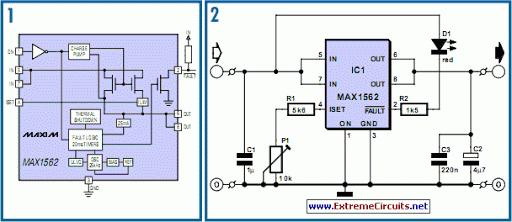
USB Fuse
Life in the 21st century would be almost unbearable without some of the computer peripherals that PC users now look upon as essentials, such as keyboards, mice, and printers.
Computer peripherals play a crucial role in enhancing the functionality and usability...

RS-485 Signal Loss Detection
The safety shutdown and fault isolation protocol is critical in various telecommunication, industrial, and data processing systems. It is essential for data sharing.
The safety shutdown and fault isolation protocol serves as a fundamental component in ensuring the reliability and safety...

usb-voltage-converter-5v-to-12v.html
This is a 5V to 12V DC-DC step-up (boost) converter circuit designed specifically for USB-powered applications. A USB port has two current supply modes. Initially, it supplies a maximum of 100mA to the load before detecting the connected device. Once...

servo motor
How to generate the signal for controlling a standard (RC) servo motor using a PIC microcontroller.
To control a standard RC servo motor with a PIC microcontroller, it is essential to generate a pulse-width modulation (PWM) signal that dictates the position...

USB Printer Share Switch Circuit
This simple device enables two computers to share a single USB printer or other USB devices, such as an external flash drive, memory card reader, or scanner. A rotary switch is used to select the PC that will be connected...