


4033 7 Segment Common Anode Display Counter
#4033 IC
#7 segment display
#common anode
#counter
#reset
#display test
#event counter
#digital circuit
#BCD counter
#LED display

Description: 4033 7 Segment Common Anode Display Event Counter Circuit. This circuit can count from 0 to 9 with a reset function and a display test feature.
The 4033 7-segment common anode display event counter circuit is designed to count events in a range from 0 to 9. It utilizes a 4033 integrated circuit, which is a decade counter that can drive a common anode 7-segment display. The circuit is capable of resetting the count and includes a display test feature to ensure proper operation of the display segments.
In this circuit, the 4033 IC is connected to the 7-segment display such that each output pin corresponds to a segment of the display. The common anode configuration means that the anodes of the display segments are connected to a positive voltage supply, while the cathodes are driven low to illuminate the segments. The counting operation is initiated by applying a clock signal to the clock input of the 4033. Each pulse of the clock increments the counter by one, and the corresponding output pins are activated to display the current count on the 7-segment display.
A reset button is typically included in the design, connected to the reset pin of the 4033. Pressing this button will reset the counter back to zero, allowing for a new counting session to begin. The display test feature is implemented by connecting a test button to the 4033, which, when pressed, activates all segments of the display simultaneously. This allows for verification that each segment is functioning correctly.
Power supply requirements for this circuit usually involve a standard voltage of 5V, which is suitable for the 4033 IC and the 7-segment display. Proper decoupling capacitors should be included near the power supply pins of the IC to filter out noise and ensure stable operation.
Overall, the 4033 7-segment common anode display event counter circuit is a straightforward yet effective solution for counting applications, providing visual feedback through the display and allowing for easy reset and testing functionalities.4033 7 Segment Common Anode Display Event Counter Circuit This circuit can count 0 to 9 with reset and display test..
The 4033 7-segment common anode display event counter circuit is designed to count events in a range from 0 to 9. It utilizes a 4033 integrated circuit, which is a decade counter that can drive a common anode 7-segment display. The circuit is capable of resetting the count and includes a display test feature to ensure proper operation of the display segments.
In this circuit, the 4033 IC is connected to the 7-segment display such that each output pin corresponds to a segment of the display. The common anode configuration means that the anodes of the display segments are connected to a positive voltage supply, while the cathodes are driven low to illuminate the segments. The counting operation is initiated by applying a clock signal to the clock input of the 4033. Each pulse of the clock increments the counter by one, and the corresponding output pins are activated to display the current count on the 7-segment display.
A reset button is typically included in the design, connected to the reset pin of the 4033. Pressing this button will reset the counter back to zero, allowing for a new counting session to begin. The display test feature is implemented by connecting a test button to the 4033, which, when pressed, activates all segments of the display simultaneously. This allows for verification that each segment is functioning correctly.
Power supply requirements for this circuit usually involve a standard voltage of 5V, which is suitable for the 4033 IC and the 7-segment display. Proper decoupling capacitors should be included near the power supply pins of the IC to filter out noise and ensure stable operation.
Overall, the 4033 7-segment common anode display event counter circuit is a straightforward yet effective solution for counting applications, providing visual feedback through the display and allowing for easy reset and testing functionalities.4033 7 Segment Common Anode Display Event Counter Circuit This circuit can count 0 to 9 with reset and display test..

Winding electronic counter 2
The electronic counter of the winding machine utilizes an LED digital display to indicate the number of turns of the wound coil, with a maximum counting capacity of 9900 turns. The operational principle of the winding machine circuit consists of...
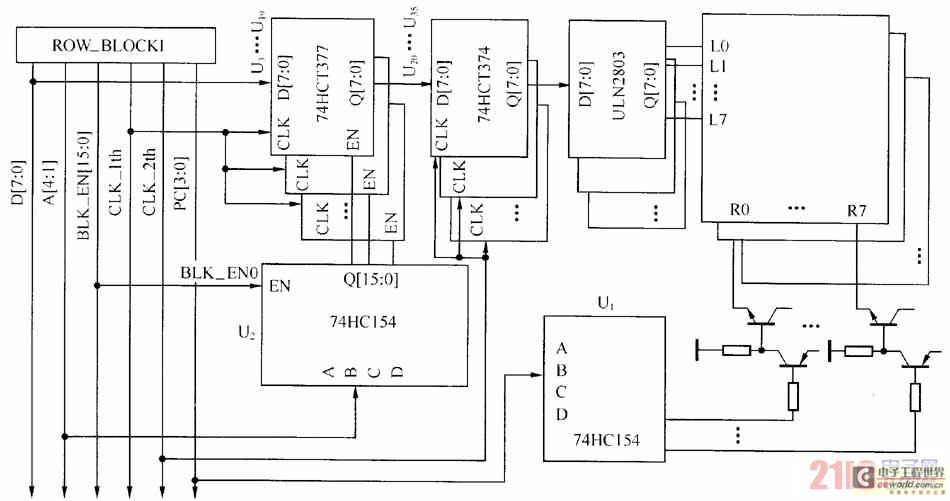
Large-scale LED display system hardware structure and principle
The large-scale LED display system utilizes a line-by-line scanning method and outlines the driving mechanisms to reduce hardware costs. It employs a 1/16 non-interlaced scanning mode, accommodating a total of 16 LED display panels. The schematic diagram of the driver...

SIMPLE EVENT COUNTER
S1 is a power switch. U2 drives counter U3 by producing a pulse when S2 is depressed. U4 and DISP1 read the count of counter IC U3. S3 is a reset to zero switch. The counter is a basic one-digit...

Digital scoreboard circuit
The digital scoreboard circuit is designed to display numerical values ranging from 0 to 9 on a 7-segment display. This display utilizes a common anode configuration.
The digital scoreboard circuit operates by controlling a 7-segment display that utilizes a common anode...

Seven-7-Segment Counter Circuit with LED Display-Diagram and Schematic
A simple seven-segment counter circuit with an LED display. This counter circuit diagram is designed using the IC CD 4033 as a counter, a 555 Timer IC, and a seven-segment LED display LT 543.
The seven-segment counter circuit utilizes the CD...

The LED car voltmeter (3)
The LED car voltmeter comprises a filter circuit, a voltage distribution filter circuit, a voltage amplifier circuit, and an LED display circuit, as illustrated in Figure 7-77. The regulator filter circuit includes a 3-terminal IC (IC1) and a filter capacitor...

Power-on reset
This type of reset pulse is ideally provided by this circuit. Due to the high input impedance of the Schmitt trigger, long reset pulse durations can be achieved without the excess dissipation that occurs when both output devices are active...

Electronic counter
Simple counting can be performed by anyone, but counting over large intervals can be tedious and prone to errors. A previously published project, the Digital Counter, serves as a foundation for this electronics counter, which is the second project in...
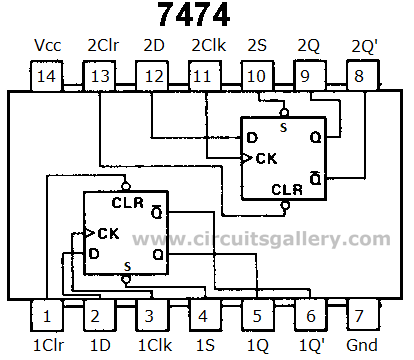
Ring Counter Circuit Working Principle with Animation and Video
Digital counters have various applications in electronic circuits. In digital electronics, counters are utilized in different situations. This article presents the concept of a ring counter circuit, which functions as a register counter. An animation and simulation video of the...