


7-Segment Common-Cathode Led Display Driver Circuit
#CD4511B
#7-segment display
#common cathode
#LED driver
#current limiting resistors
#CMOS
#display driver
#digital circuit

Description: A CD4511B CMOS LED display driver can be utilized to operate a common cathode LED display. Current limiting resistors are employed to restrict the segment current to the specified value at the maximum supply voltage.
The CD4511B is a BCD to 7-segment latch/decoder/driver that is designed for driving common cathode LED displays. This IC takes a 4-bit binary-coded decimal (BCD) input and converts it into the appropriate signals to illuminate the corresponding segments of the display. The device includes a latch that retains the input data until it is updated, allowing for stable display output.
In a typical application, the CD4511B connects to a common cathode LED display where each segment (labeled a through g) corresponds to a specific output pin on the IC. The outputs are active low, meaning that a low signal will turn on the corresponding LED segment. To ensure optimal performance and prevent damage to the LEDs, current limiting resistors must be placed in series with each segment. The value of these resistors is calculated based on the forward voltage drop of the LED segments and the supply voltage, ensuring that the current does not exceed the maximum rated value for the LEDs.
For example, if the supply voltage is 5V and the forward voltage drop of each LED segment is 2V, the current limiting resistor can be calculated using Ohm's Law (V = IR). If the desired segment current is 20 mA, the resistor value can be determined as follows:
1. Calculate the voltage across the resistor:
V_R = V_supply - V_LED = 5V - 2V = 3V.
2. Use Ohm's Law to find the resistance:
R = V_R / I = 3V / 0.02A = 150Ω.
Thus, a 150Ω resistor would be suitable for each segment to maintain the current at the desired level. It is also essential to consider the power rating of the resistors to ensure they can handle the power dissipation without overheating.
The CD4511B is widely used in various applications, including digital clocks, counters, and other devices that require numeric displays. Its ease of integration and reliable performance make it a popular choice for driving LED displays in electronic designs. A CD4511B CMOS LED display driver can be used to drive a common cathode LED display. Current limiting resistors limit the segment current to the rated value at maximum supply voltage. A sample calculation is shown.
The CD4511B is a BCD to 7-segment latch/decoder/driver that is designed for driving common cathode LED displays. This IC takes a 4-bit binary-coded decimal (BCD) input and converts it into the appropriate signals to illuminate the corresponding segments of the display. The device includes a latch that retains the input data until it is updated, allowing for stable display output.
In a typical application, the CD4511B connects to a common cathode LED display where each segment (labeled a through g) corresponds to a specific output pin on the IC. The outputs are active low, meaning that a low signal will turn on the corresponding LED segment. To ensure optimal performance and prevent damage to the LEDs, current limiting resistors must be placed in series with each segment. The value of these resistors is calculated based on the forward voltage drop of the LED segments and the supply voltage, ensuring that the current does not exceed the maximum rated value for the LEDs.
For example, if the supply voltage is 5V and the forward voltage drop of each LED segment is 2V, the current limiting resistor can be calculated using Ohm's Law (V = IR). If the desired segment current is 20 mA, the resistor value can be determined as follows:
1. Calculate the voltage across the resistor:
V_R = V_supply - V_LED = 5V - 2V = 3V.
2. Use Ohm's Law to find the resistance:
R = V_R / I = 3V / 0.02A = 150Ω.
Thus, a 150Ω resistor would be suitable for each segment to maintain the current at the desired level. It is also essential to consider the power rating of the resistors to ensure they can handle the power dissipation without overheating.
The CD4511B is widely used in various applications, including digital clocks, counters, and other devices that require numeric displays. Its ease of integration and reliable performance make it a popular choice for driving LED displays in electronic designs. A CD4511B CMOS LED display driver can be used to drive a common cathode LED display. Current limiting resistors limit the segment current to the rated value at maximum supply voltage. A sample calculation is shown.

Wide Input-Voltage Range High-Power LED Driver
This is a high-power LED driver circuit designed to accommodate a wide input-voltage range. The circuit utilizes a buck/boost converter controller to regulate the current supplied to a white LED.
The high-power LED driver circuit is engineered to effectively manage varying...

4013 datasheet
The 4013 dual D-type flip-flop is a monolithic complementary MOS (CMOS) integrated circuit constructed with N-channel and P-channel enhancement mode transistors. Each flip-flop has a data input (D), a clock input (CLK), a set input (SET), a reset input (RESET),...

Protect LED Driver in Backlit Displays
A small comparator (MAX9060/MAX9061 or MAX9028) safeguards the LED driver in a backlit display when the LEDs are disconnected, by producing a shutdown signal that eliminates the LED voltage.
The MAX9060/MAX9061 and MAX9028 are high-speed voltage comparators designed for applications such...

Single Zone CMOS Alarm
This circuit features automatic Exit/Entry delays, timed Bell Cut-off and System Reset. It has provision for normally open and normally closed switches and will accommodate the usual input devices such as Foil Tape, Pressure Mats, Magnetic Reed Contacts, Passive Infrared...

CMOS Toggle Flip Flop Using Laser Pointer circuit
The IR photo transistor Q1 (Radio Shack 276-145A) or a similar component is connected to the set input (pin 6). It is essential to shield the photo transistor from direct light to ensure that the voltage at the set input...

Cmos-short-pulse-generator
The pulse generator consists of two low-power CMOS chips that produce a precise pulse width ranging from 50 to 500 ns. IC1 is a dual monostable multivibrator (one shot) where each positive trigger pulse initiates simultaneous positive output pulses at...

Manual Adjustable LED Driver
In various electronics-level adjustments, such as LED drivers for LCD panel backlight controls, the AD5228 can be utilized. A manually adjustable LED driver is illustrated.
The AD5228 is a dual-channel, digitally controlled potentiometer (DCP) that can be employed in applications requiring...
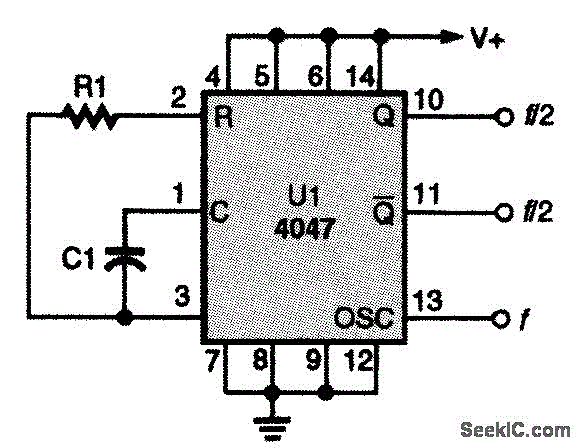
CD4047 CMOS OSCILLATOR
This CMOS square-wave oscillator utilizes the 4047 multivibrator circuit, suitable for both monostable (one-shot) and astable applications. In the provided configuration, the 4047 operates as an astable multivibrator. The circuit features three outputs from the 4047, with the first being...

TPS61059 White LED Driver for Photoflash or Movie Light
Manufacturers are beginning to utilize new high-power white-light LEDs to provide a photoflash function suitable for low-light conditions. These LEDs produce...
High-power white-light LEDs have emerged as a significant advancement in lighting technology, particularly for applications requiring enhanced illumination in low-light...