


audible logic pulses

Description: This circuit is useful for monitoring slow logic pulses as a keying monitor or digital clock alarm. The Schmitt trigger is connected as an oscillator. The trimpot controls the pitch of the output. When the input goes high, the circuit will oscillate.
The described circuit utilizes a Schmitt trigger configured as an oscillator to monitor slow logic pulses effectively. It serves dual purposes: functioning as a keying monitor and acting as a digital clock alarm. The Schmitt trigger's inherent hysteresis provides stable switching characteristics, which are essential for distinguishing between high and low logic levels, particularly in slow pulse applications.
The circuit incorporates a trimpot (trimming potentiometer) that allows for precise adjustment of the output frequency or pitch. This feature is particularly useful in applications where specific timing or frequency characteristics are required. As the input signal transitions to a high state, the oscillator becomes activated, producing an oscillating output.
In terms of implementation, the Schmitt trigger is typically connected in a feedback configuration, which establishes the oscillation. The output frequency can be adjusted by varying the resistance of the trimpot, thus changing the charge and discharge times of the timing capacitor in the circuit. This adjustment enables fine-tuning of the oscillation period, allowing the circuit to adapt to different monitoring needs or alarm conditions.
Overall, this circuit design exemplifies a versatile approach to pulse monitoring, leveraging the reliable properties of the Schmitt trigger and the adjustable nature of the trimpot to meet various application requirements.This circuit is useful for monitoring slow logic pulses as a keying monitor or digital clock alarm. The Schmitt trigger is connected as an oscillator. The trimpot controls the pitch of the output. When the input goes high, the circuit will oscillate.
The described circuit utilizes a Schmitt trigger configured as an oscillator to monitor slow logic pulses effectively. It serves dual purposes: functioning as a keying monitor and acting as a digital clock alarm. The Schmitt trigger's inherent hysteresis provides stable switching characteristics, which are essential for distinguishing between high and low logic levels, particularly in slow pulse applications.
The circuit incorporates a trimpot (trimming potentiometer) that allows for precise adjustment of the output frequency or pitch. This feature is particularly useful in applications where specific timing or frequency characteristics are required. As the input signal transitions to a high state, the oscillator becomes activated, producing an oscillating output.
In terms of implementation, the Schmitt trigger is typically connected in a feedback configuration, which establishes the oscillation. The output frequency can be adjusted by varying the resistance of the trimpot, thus changing the charge and discharge times of the timing capacitor in the circuit. This adjustment enables fine-tuning of the oscillation period, allowing the circuit to adapt to different monitoring needs or alarm conditions.
Overall, this circuit design exemplifies a versatile approach to pulse monitoring, leveraging the reliable properties of the Schmitt trigger and the adjustable nature of the trimpot to meet various application requirements.This circuit is useful for monitoring slow logic pulses as a keying monitor or digital clock alarm. The Schmitt trigger is connected as an oscillator. The trimpot controls the pitch of the output. When the input goes high, the circuit will oscillate.
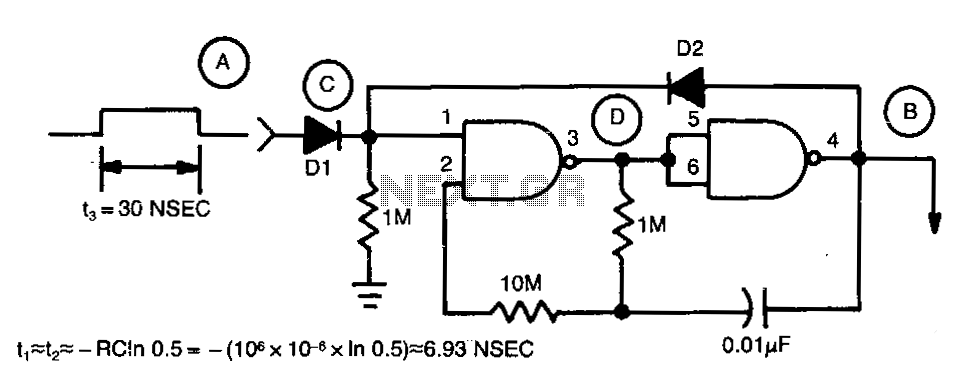
Last-cycle-completing-gated-oscillator
Regenerative feedback at capacitor C allows the oscillator to complete its timing cycle instead of shutting off immediately. The integrated circuit (IC) used was a CD4011AE, although an equivalent IC will also function.
The described circuit utilizes regenerative feedback to enhance...
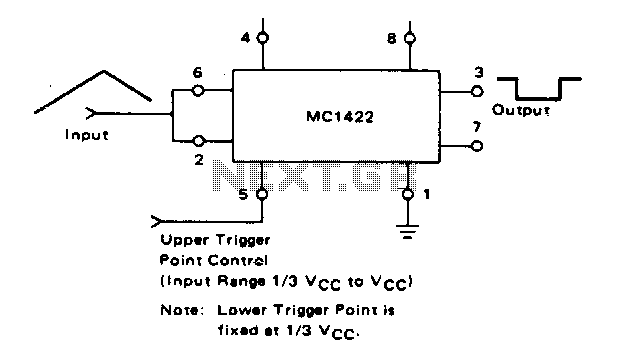
Schmitt trigger
The lower trigger point is fixed at a percentage of Vcc, while the upper trigger point can be adjusted using Pin 5, allowing it to vary from Vi to slightly less than Vcc. The Schmitt trigger is capable of operating...

Metal detector circuit diagram 8
The metal detector circuit consists of a probe oscillator, a PLL (phase-locked loop) circuit, and an audio alarm circuit. The probe oscillator includes a detection coil (L), transistor (V1), and several resistors (R1 to R3) and capacitors (C1 to C5)....

High-current-oscillator
The oscillator output of the XR-567 can be amplified using the output amplifier and high-current logic output available at pin 8. In this manner, the circuit can switch 100-mA load currents without sacrificing oscillator stability. The oscillator frequency can be...

Metal detector circuit diagram 3
The metal detector consists of a probe oscillator, a reference oscillator, an audio amplifier, and various other components, as illustrated in the schematic. The probe oscillator is made up of transistors V1 and V2, a detection coil L1, a capacitor...

Oscillator DesignGuide Reference
The Oscillator Design Guide is integrated into Agilent EEsof's Advanced Design System environment, functioning as a smart library and interactive handbook for the creation of effective designs. It facilitates quick oscillator design, interactive component characterization, and provides in-depth insights into...

Digital display electronic clock circuit
This electronic clock comprises the LM8365 and the LDD640R displays. The LM8365 can show the hour/minute and month/day. Users can set two alarm outputs, AD1 and AD2, by pressing either the 12h or 24h button. The operating voltage range is...

Schmitt trigger crystal oscillator
A Schmitt trigger provides effective squaring of the output, sometimes eliminating the need for an additional output stage.
A Schmitt trigger is a type of comparator circuit that incorporates hysteresis, which allows it to provide clean, stable output transitions. This characteristic...

Rf-genie
A variable oscillator operates in the frequency range of 3.2 to 22 MHz across two bands, enabling coverage from 80 meters to 15 meters, in addition to accommodating most crystal filter frequencies. Optional crystal oscillators at 455 kHz and 10.7...