


Digital Counter - 4029 and 4511

Description: Inquiry regarding the circuit design involving ICs 4029N and 4511N, specifically questioning whether these components function as a driver/decoder. The datasheet was consulted but did not provide precise specifications.
The IC 4029N is a binary up/down counter that can count in both directions, while the 4511N is a BCD (Binary-Coded Decimal) to 7-segment latch/decoder/driver. The 4029N features a maximum count of 15 (in binary) and can be configured to count up or down based on the input control signals. It includes features such as asynchronous reset, parallel load capability, and an enable input for counting operations.
The 4511N, on the other hand, takes a 4-bit BCD input and drives a 7-segment display, translating the binary-coded value into a human-readable format. It includes latching capabilities, allowing the output to maintain its state until explicitly changed, which can be useful in applications where the display should not change until a new input is provided.
In a circuit design utilizing both ICs, the 4029N could be employed to count events or time intervals, while the 4511N would convert the count into a visual representation on a 7-segment display. Proper interfacing between the output of the 4029N and the input of the 4511N is essential to ensure accurate representation of the counter's state on the display. Additional components, such as resistors for current limiting and capacitors for debouncing, may also be required to enhance the circuit's performance and reliability.
Overall, the combination of these two ICs allows for effective counting and display of numerical values in various electronic applications, such as timers, event counters, and scoreboards.I just about the circuit you made. what kind of IC is 4029N & 4511N Is it a diver/decoder I tried to research on the datasheet but it cannot give exact specification.
The IC 4029N is a binary up/down counter that can count in both directions, while the 4511N is a BCD (Binary-Coded Decimal) to 7-segment latch/decoder/driver. The 4029N features a maximum count of 15 (in binary) and can be configured to count up or down based on the input control signals. It includes features such as asynchronous reset, parallel load capability, and an enable input for counting operations.
The 4511N, on the other hand, takes a 4-bit BCD input and drives a 7-segment display, translating the binary-coded value into a human-readable format. It includes latching capabilities, allowing the output to maintain its state until explicitly changed, which can be useful in applications where the display should not change until a new input is provided.
In a circuit design utilizing both ICs, the 4029N could be employed to count events or time intervals, while the 4511N would convert the count into a visual representation on a 7-segment display. Proper interfacing between the output of the 4029N and the input of the 4511N is essential to ensure accurate representation of the counter's state on the display. Additional components, such as resistors for current limiting and capacitors for debouncing, may also be required to enhance the circuit's performance and reliability.
Overall, the combination of these two ICs allows for effective counting and display of numerical values in various electronic applications, such as timers, event counters, and scoreboards.I just about the circuit you made. what kind of IC is 4029N & 4511N Is it a diver/decoder I tried to research on the datasheet but it cannot give exact specification.

digital switching system
This circuit is capable of controlling one out of 16 devices using two push-to-on switches. An up/down counter functions as the master controller for the system, and visual feedback is provided through LEDs. The circuit employs IC1 (74LS193), which is...

Ic Product Detectors
These product detectors utilize integrated circuit (IC) devices. They are capable of detecting single sideband (SSB) and continuous wave (CW) signals. The circuits are designed to operate effectively up to frequencies of 20 or 30 MHz. T3 in the schematic...

Electronic Dice
When the switch SI is activated, the counter U2 is controlled by the oscillator U1A/U1B, and the count ranging from 0 to 6 is displayed on DISP1. The resistor R1 and capacitor C1 determine the count rate, which must be...

TWO SLEW RATES
The decimal value of the eight input lines is displayed on three seven-segment displays. Although chips exist to perform this function for single displays, none include the capability of displaying numbers greater than 9. No EPROM is necessary in this...
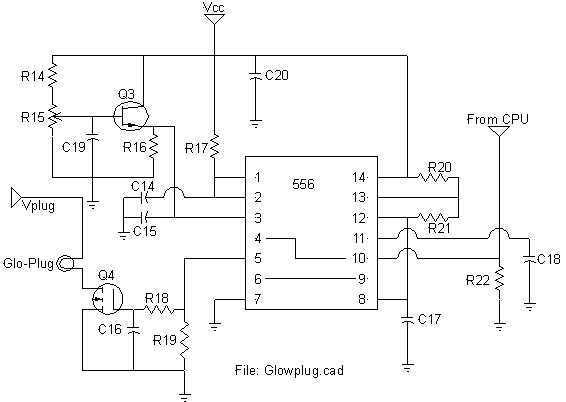
Logic adjustable Glow-Plug drive
All of my turbine starts before the research on the ECU involved a very successful spark ignition. I thought (only briefly) of trying to add spark ignition to the ECU, but the mixture of delicate logic circuitry and perhaps 30,000V...

RING COUNTER WITH VISUAL READOUT
The circuit utilizes only six components per stage. By integrating counter and indicator functions, it achieves low battery consumption. Once the reset button is released, a 0.22 µF capacitor ensures that the first stage activates. Current is drawn by the...

Bcd-to-analog converter
This circuit converts a four-bit Binary-Coded Decimal (BCD) into a variable output voltage ranging from 0 to 9 volts in 1-volt increments. The SN74141 functions as a Nixie tube driver, featuring ten open-collector outputs. These outputs are utilized to ground...

0-99 counter by IC 4017G—2
When designing a counter circuit that counts from 0 to 99, an effective approach is to utilize the IC LM4017, which is a decade counter.
The LM4017 is a CMOS decade counter capable of counting from 0 to 9, and it...
TWO SLEW RATES
The decimal value of the eight input lines is displayed on three seven-segment displays. Although chips exist to perform this function for single displays, none include the capability of displaying numbers greater than 9. No EPROM is necessary in this...