


Seven Segment LED Counter with CD4026
#CD4026
#seven segment display
#counter
#pulse counting
#multi-digit
#LED
#digital circuit
#logic IC
#display driver
#counting circuit

Description: This circuit counts pulses on a seven-segment display using the 4026 counter chip. It is easily expandable for multi-digit counting.
The circuit utilizes the 4026 integrated circuit, which is a decade counter specifically designed to drive a seven-segment display. The primary function of the 4026 is to count incoming pulses and represent the count visually on the display. The configuration of the circuit allows for simple integration with additional 4026 chips, enabling the expansion to multi-digit counting systems.
The 4026 chip operates by receiving clock pulses at its input pin, which increments the count on the display with each pulse. The output pins of the chip are connected to the segments of the seven-segment display, which light up in a specific pattern to represent the numeric value of the count. The circuit can be designed to reset the count to zero after reaching a certain number or to continue counting indefinitely, depending on the application requirements.
To expand the circuit for multi-digit counting, additional 4026 chips can be daisy-chained. The carry-out pin of the first 4026 can be connected to the clock input of the next 4026, allowing the count to propagate through multiple displays. This configuration provides a straightforward method to display larger numerical values across several digits.
Power supply considerations must be taken into account, with the 4026 typically requiring a voltage supply between 3V and 15V. Proper decoupling capacitors should be placed close to the power supply pins of the chip to ensure stable operation. Additionally, the design should include current-limiting resistors for the display segments to prevent damage from excessive current.
Overall, this circuit design offers a versatile solution for applications requiring pulse counting and visual output, with the potential for expansion to meet various counting needs.This circuit will count pulses on a seven segment display using the 4026 counter chip. It is easily expandable for multi-digit counting
The circuit utilizes the 4026 integrated circuit, which is a decade counter specifically designed to drive a seven-segment display. The primary function of the 4026 is to count incoming pulses and represent the count visually on the display. The configuration of the circuit allows for simple integration with additional 4026 chips, enabling the expansion to multi-digit counting systems.
The 4026 chip operates by receiving clock pulses at its input pin, which increments the count on the display with each pulse. The output pins of the chip are connected to the segments of the seven-segment display, which light up in a specific pattern to represent the numeric value of the count. The circuit can be designed to reset the count to zero after reaching a certain number or to continue counting indefinitely, depending on the application requirements.
To expand the circuit for multi-digit counting, additional 4026 chips can be daisy-chained. The carry-out pin of the first 4026 can be connected to the clock input of the next 4026, allowing the count to propagate through multiple displays. This configuration provides a straightforward method to display larger numerical values across several digits.
Power supply considerations must be taken into account, with the 4026 typically requiring a voltage supply between 3V and 15V. Proper decoupling capacitors should be placed close to the power supply pins of the chip to ensure stable operation. Additionally, the design should include current-limiting resistors for the display segments to prevent damage from excessive current.
Overall, this circuit design offers a versatile solution for applications requiring pulse counting and visual output, with the potential for expansion to meet various counting needs.This circuit will count pulses on a seven segment display using the 4026 counter chip. It is easily expandable for multi-digit counting

LEDs and resistors circuit
An LED, or Light Emitting Diode, is a semiconductor device that allows current to flow in one direction while blocking it in the opposite direction. This characteristic makes LEDs polarized components, having a positive side known as the anode and...

Electronic projects
The LED moving font consists of individual modules, each containing 64 LEDs arranged in an 8x8 matrix. These modules can be cascaded to achieve the desired font size. Each module is managed by the LED display driver MAX7219 (or MAX7221),...
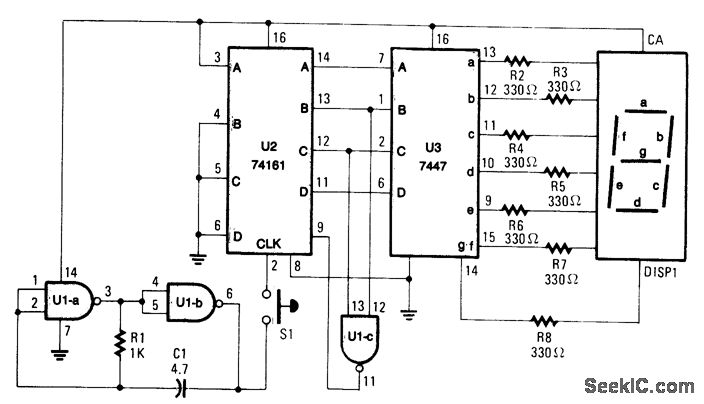
ELECTRONIC DICE
When S1 is pressed, counter U2 is activated by oscillator U1A/U1B, and the count (ranging from 0 to 6) is displayed on DISP1. The resistor R1 and capacitor C1 define the count rate, which must be sufficiently rapid to produce...

Construction LED circuit diagram CD4017 CD4011
The construction LED circuit illustrated in the figure requires manual power. Once powered, the light will blink to alert individuals to pay attention to safety.
The circuit is designed to enhance safety awareness in construction environments by utilizing a blinking LED...

LED Blinker with HT-2014M
A very simple LED flasher circuit. With HT-2014L the circuit produces 1 flash per second and the HT-2014M produces 2 flashes per second.
The LED flasher circuit is designed to provide a visual indication through intermittent illumination of an LED. It...
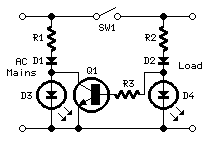
Two-LED Pilot Light
This circuit was designed on request and can be useful to those wishing to have, say, a red LED illuminated when an appliance is on and a green LED illuminated when the same appliance is off. Any mains operated appliance...

clock
A series of digital clocks with LED outputs were developed for the Electronics in Schools Strategy (EiSS) and utilized in various courses organized by SETPOINT (now STEMPOINT) Devon & Cornwall for secondary school educators in the southwest. The initial clock...

Mains operated LED night lamp
A simple and effective LED-based night lamp circuit is designed to operate directly from the 230V mains supply. The circuit utilizes a total of 24 white LEDs, producing an output of approximately 15W. Current limiting is achieved through resistor R1...

1.5V LED FLasher Using 3 Transistors
To make an LED function, a voltage source is required that exceeds the LED's forward bias voltage, which is typically greater than 1.5V (approximately 2V for red LEDs).
To effectively operate an LED, it is essential to provide a voltage source...