


Foucault Pendulum
#pendulum
#physics
#Coriolis force
#rotating reference frames
#educational tool
#demonstration
#science experiment
#mechanics
#earth rotation

Description: At the poles, the plane of a pendulum's swing completes one rotation every day, while at the equator, the plane remains stationary. This phenomenon raises questions about the underlying reasons for this rotation. The variation in rotation is attributed to rotating reference frames and the Coriolis force, which causes the pendulum to rotate at different rates depending on the latitude. For an observer on Earth, the perceived speed of rotation varies based on their location.
For instance, at the North Pole, the Earth appears to rotate clockwise, causing hanging objects to seem as if they are rotating counterclockwise. Being situated on the axis of rotation means that only the effects of rotation are observable. Conversely, at the equator, the Earth does not appear to rotate in the observer's reference frame, and as one moves toward the poles, the perceived rotation increases. The rotation of the Foucault Pendulum can be quantified using the formula N = 360 * sin(x), where x represents the latitude in degrees and N denotes the amount of rotation per day.
To further illustrate the concept of rotating reference frames, consider a child on a merry-go-round who releases a ball. An observer would see the ball travel in a straight line, while the child perceives a curve due to their own rotation. This analogy highlights the Coriolis force, which gives the impression of a force acting on objects due to the Earth's rotation.
Pendulums in the atmosphere face challenges from air resistance that dampens their oscillations. To maintain motion, energy must be added to the pendulum without altering its swing, a process referred to as "driving" the pendulum. There are various methods to achieve this. One approach is to connect the pendulum's top to a speaker, which adjusts the string length dynamically, thereby supplying energy similar to how a child pumps their legs on a swing.
Alternatively, an electromagnetic coil positioned beneath the pendulum can be used in conjunction with a light sensor at the top. As the pendulum's string passes through the light beam, the sensor activates the coil, providing the necessary energy to sustain its motion. Another method employs a second coil at the bottom to detect the pendulum's position and control the activation of the first coil, thus ensuring consistent energy input.
The circuit design for driving a pendulum can incorporate these elements effectively. The electromagnetic coil would be connected to a microcontroller that processes input from the light sensor or the coil sensor. The microcontroller can be programmed to activate the coil based on the pendulum's position, ensuring that energy is provided precisely when needed. Additionally, feedback mechanisms can be integrated to adjust the energy output dynamically, compensating for variations in air resistance and maintaining consistent oscillation amplitudes. This approach allows for a robust and efficient system for sustaining pendulum motion, facilitating experiments and demonstrations of the principles of rotational dynamics and the Coriolis effect.On the poles, the plane of the pendulum swing would make one rotation each day. On the equator, however, the plane will not rotate at all. This begs the question of why the plane rotates. Due to rotating reference frames and the Coriolis force, the pendulum rotates at a different rate at different latitudes. If your frame of reference were on the earth, then depending on where you stand, the earth will be moving at different speeds.
Suppose we were standing on the North Pole. In our reference frame, the earth would rotate clockwise making hanging objects appear as though they were rotating counterclockwise. At the North Pole, you are on the axis of spin, and would therefore only see the affects of rotation.
If you stand on the equator, keeping the axis of rotation at a constant angle, the earth does not rotate in your reference frame. As you move closer to the pole, the rotation in your reference frame becomes greater and greater. This allows for different amounts of rotation on different latitudes for the Foucault Pendulum. The amount of rotation per day for the pendulum can be found using the following formula. N=360*sin(x), where x is the latitude in degrees and N is the amount of rotation per day. Another way to think about the rotating frame of reference is to think of a child on a merry-go-round.
If the child is spinning around and lets go of a ball, anybody watching would see the ball go in a straight line off the merry-go-round. But in the reference frame of the child, it appears that there is some force making the ball curve, as the child must turn his or her head in order to keep seeing the ball.
So, just as the child on the merry-go-round thinks there is some force pulling on the ball after it left their hand, we think there is a force pulling things in directions since we are on a spinning ball. This is the Coriolis force that we mentioned earlier. Pendulums in the atmosphere have the problem that air resistance damps the oscillations. Because of this damping, we must provide the pendulum with energy (without biasing the swing) to keep it from stopping.
From now on in this paper, this addition of energy will be called driving the pendulum. There are different ways to drive a pendulum. One of these ways is to connect the top of the pendulum to a speaker which would decrease the length of the string at the pendulum`s lowest point and increase the length of the string at the highest point in its swing. This would provide the energy needed to drive the pendulum as a child on a swing pumps their legs in order to increase their amplitude.
Another way to drive the pendulum would be to have an electromagnetic coil below the pendulum and have a light sensor at the top of the pendulum to detect when the string passes through. As the string disrupts the light sensor, the coil would turn on, giving the pendulum the extra energy needed for sustaining its swing.
Another option that would also use the electromagnetic coil at the bottom would, instead of having a light sensor at the top, have a second coil at the bottom to detect when the pendulum is over the coil. This would then be used to turn the first coil on and off. This is the signal at various stages in our circu
For instance, at the North Pole, the Earth appears to rotate clockwise, causing hanging objects to seem as if they are rotating counterclockwise. Being situated on the axis of rotation means that only the effects of rotation are observable. Conversely, at the equator, the Earth does not appear to rotate in the observer's reference frame, and as one moves toward the poles, the perceived rotation increases. The rotation of the Foucault Pendulum can be quantified using the formula N = 360 * sin(x), where x represents the latitude in degrees and N denotes the amount of rotation per day.
To further illustrate the concept of rotating reference frames, consider a child on a merry-go-round who releases a ball. An observer would see the ball travel in a straight line, while the child perceives a curve due to their own rotation. This analogy highlights the Coriolis force, which gives the impression of a force acting on objects due to the Earth's rotation.
Pendulums in the atmosphere face challenges from air resistance that dampens their oscillations. To maintain motion, energy must be added to the pendulum without altering its swing, a process referred to as "driving" the pendulum. There are various methods to achieve this. One approach is to connect the pendulum's top to a speaker, which adjusts the string length dynamically, thereby supplying energy similar to how a child pumps their legs on a swing.
Alternatively, an electromagnetic coil positioned beneath the pendulum can be used in conjunction with a light sensor at the top. As the pendulum's string passes through the light beam, the sensor activates the coil, providing the necessary energy to sustain its motion. Another method employs a second coil at the bottom to detect the pendulum's position and control the activation of the first coil, thus ensuring consistent energy input.
The circuit design for driving a pendulum can incorporate these elements effectively. The electromagnetic coil would be connected to a microcontroller that processes input from the light sensor or the coil sensor. The microcontroller can be programmed to activate the coil based on the pendulum's position, ensuring that energy is provided precisely when needed. Additionally, feedback mechanisms can be integrated to adjust the energy output dynamically, compensating for variations in air resistance and maintaining consistent oscillation amplitudes. This approach allows for a robust and efficient system for sustaining pendulum motion, facilitating experiments and demonstrations of the principles of rotational dynamics and the Coriolis effect.On the poles, the plane of the pendulum swing would make one rotation each day. On the equator, however, the plane will not rotate at all. This begs the question of why the plane rotates. Due to rotating reference frames and the Coriolis force, the pendulum rotates at a different rate at different latitudes. If your frame of reference were on the earth, then depending on where you stand, the earth will be moving at different speeds.
Suppose we were standing on the North Pole. In our reference frame, the earth would rotate clockwise making hanging objects appear as though they were rotating counterclockwise. At the North Pole, you are on the axis of spin, and would therefore only see the affects of rotation.
If you stand on the equator, keeping the axis of rotation at a constant angle, the earth does not rotate in your reference frame. As you move closer to the pole, the rotation in your reference frame becomes greater and greater. This allows for different amounts of rotation on different latitudes for the Foucault Pendulum. The amount of rotation per day for the pendulum can be found using the following formula. N=360*sin(x), where x is the latitude in degrees and N is the amount of rotation per day. Another way to think about the rotating frame of reference is to think of a child on a merry-go-round.
If the child is spinning around and lets go of a ball, anybody watching would see the ball go in a straight line off the merry-go-round. But in the reference frame of the child, it appears that there is some force making the ball curve, as the child must turn his or her head in order to keep seeing the ball.
So, just as the child on the merry-go-round thinks there is some force pulling on the ball after it left their hand, we think there is a force pulling things in directions since we are on a spinning ball. This is the Coriolis force that we mentioned earlier. Pendulums in the atmosphere have the problem that air resistance damps the oscillations. Because of this damping, we must provide the pendulum with energy (without biasing the swing) to keep it from stopping.
From now on in this paper, this addition of energy will be called driving the pendulum. There are different ways to drive a pendulum. One of these ways is to connect the top of the pendulum to a speaker which would decrease the length of the string at the pendulum`s lowest point and increase the length of the string at the highest point in its swing. This would provide the energy needed to drive the pendulum as a child on a swing pumps their legs in order to increase their amplitude.
Another way to drive the pendulum would be to have an electromagnetic coil below the pendulum and have a light sensor at the top of the pendulum to detect when the string passes through. As the string disrupts the light sensor, the coil would turn on, giving the pendulum the extra energy needed for sustaining its swing.
Another option that would also use the electromagnetic coil at the bottom would, instead of having a light sensor at the top, have a second coil at the bottom to detect when the pendulum is over the coil. This would then be used to turn the first coil on and off. This is the signal at various stages in our circu

experimental pendulum clock
This design allows for the construction of an electromagnetically impulsed pendulum clock with a one-second beat. The prototype features a pendulum rod measuring 115 cm in length, with a bob adjusted to achieve a one-second beat. The pendulum is suspended...

Experimental Pendulum Clock
This design allows for the construction of an electromagnetically impulsed pendulum clock with a 1-second beat. The prototype features a pendulum rod measuring 115 cm in length, with a bob adjusted to achieve a 1-second beat. The pendulum is suspended...
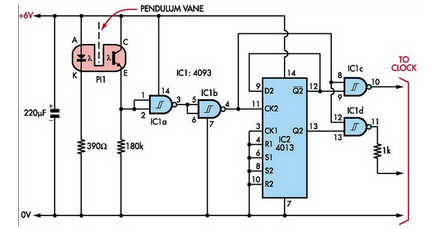
Pendulum Controlled Clock
Here is how to build a pendulum-controlled clock that can be made very accurate. Retro? Yes, but it is an interesting project nonetheless. You will need a specific set of components.
A pendulum-controlled clock is a mechanical timekeeping device that utilizes...
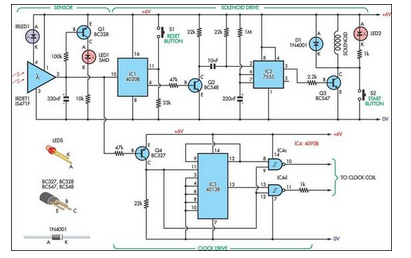
Experimental Pendulum Clock
This design allows for the construction of an electromagnetically impulsed pendulum clock with a 1-second beat. The prototype features a pendulum rod measuring 115 cm in length, with a bob adjusted to achieve a 1-second beat. It is suspended from...

pendulum controlled clock
This document outlines the construction of a pendulum-controlled clock designed for high accuracy. Although it has a retro appeal, it represents an intriguing project. The project requires a spare quartz clock, which must be modified by isolating two pads on...

Pendulum
This project aims to create a pendulum that swings indefinitely. It is a personal interpretation of a concept that has been explored in various forms previously. The project utilizes a small PIC microcontroller, which offers flexibility in substituting traditional components...