


solar watering system

Description: A solar-powered watering system has been proposed to irrigate plants daily using water collected in butts located by the greenhouse. This project has been under development for a considerable time and is now being revisited with the aim of completion. The control box, with its lid removed, reveals all major system components. The pumps are situated at the base, while the control unit and battery are housed in the lid to prevent flooding of the electronics in case of leaks. The top side of the main control PCB displays switching FETs (top left), control and timing circuits (left), and power filtering/switching components (bottom right). A not yet implemented Maximum Power Point Tracking (MPPT) controller circuit is located at the top left. The bottom side of the main control PCB features power supply connections made with tinned copper wire, while other connections utilize enamelled copper wire (transformer wire). A D2PAK transistor is utilized for switching the power rail. The control panel, visible in the greenhouse, includes a timing pot dial marked in 0.5-liter increments up to 2 liters, a force watering button, and a power switch. LED indicators are provided to show which pump is active and whether the control circuit is powered. At the opposite end of the case, a 15-way D-type connector facilitates connection to an alarm clock. 3.5mm stereo jack sockets are used to connect all eight soil moisture sensors as well as the solar panel. A low-power water pump is required, and generic windscreen washer pumps sourced from eBay have been selected due to their cost-effectiveness compared to retail options. These pumps are rated at 12V, but their design suggests they are not intended for continuous operation. To determine the appropriate battery size, the performance of the pumps was characterized by transferring a pint of water between two milk bottles at varied voltages, measuring the time taken for each transfer. The results indicate that a pump voltage of approximately 9V to 10V yields the highest efficiency. Among the available battery technologies, Sealed Lead Acid (SLA) was chosen for its low cost, high capacity, robustness, and ease of charging. Weight considerations are minimal since this is a static installation. A 6V battery was ultimately selected due to the reduced power dissipation of the pump, which enhances long-term reliability. A Yuasa NP series 6V, 4Ah battery was chosen for its ideal price and size, providing excess capacity as a buffer for poor charging conditions or decreased battery life. The water demand increases with sunlight exposure, ensuring the battery remains adequately charged during periods of high pumping requirements. A BQ2031 SLA battery charger evaluation board has been acquired, with the maximum charge current reduced by increasing the value of the current sense resistor. This configuration enables trickle charging of the battery when sufficient input power is available. The switch-mode converter's efficiency surpasses that of a linear regulator, which is advantageous for solar applications. The solar panel's efficiency can be significantly improved by employing an MPPT, which optimizes the power extracted from the solar panel, a critical feature for this application. Monitoring the charging current in the battery alongside the solar panel voltage allows for maximizing the power delivered to the battery.
The proposed solar-powered watering system integrates several essential components to enhance its functionality and efficiency. The system employs a control box that protects critical electronics from environmental exposure, ensuring longevity and reliability. The main control PCB is designed with various functionalities, including power management and control logic, which are vital for the operation of the watering system. The implementation of switching FETs allows for efficient control of the pumps, minimizing power losses during operation.
The use of a 15-way D-type connector and 3.5mm stereo jack sockets facilitates flexible connectivity for multiple soil moisture sensors and the solar panel, enabling comprehensive monitoring and control of the irrigation process. The selection of windscreen washer pumps, while cost-effective, necessitates careful consideration of their operational limits, particularly regarding continuous use. The empirical testing of pump performance at different voltages aids in the optimization of the system's power requirements.
Furthermore, the choice of a 6V SLA battery is strategic, providing a balance between cost and performance while ensuring that the system can handle variations in solar charging conditions. The incorporation of a BQ2031 SLA battery charger evaluation board enhances the system's charging efficiency, while the potential addition of an MPPT allows for maximum energy harvest from the solar panel. This holistic approach to design ensures that the solar-powered watering system operates effectively, providing reliable irrigation for the greenhouse plants while maximizing the use of renewable energy resources.I proposed a solar powered watering system for the plants to water them daily from the water butts by the greenhouse. As with all my projects, this has been work in progress for a long time now, but I have picked it up again with the intention of completion!
View of the control box with the lid off showing all the major system components. Pumps go on the base, control and battery on the lid (in case of leaks the electronics don`t get flooded) Main control PCB top side showing switching FETs (top left), control and timing (left) and power filtering / switching (bottom right). Top left is a not yet implemented MPPT controller circuit. Main control PCB bottom side. Power supply connections made with tinned copper wire, other connections made with enamelled copper wire (transformer wire).
Note D2PAK transistor for switching the power rail. The control panel end that will be visible in the greenhouse. Dial of timing pot marked in 0. 5l increments to 2l. Force watering button and power switch. LED indicators to show which pump is active and if the control circuit is powered. At the other end of the case, a 15-way D-type connector forms the connection to the alarm clock. 3. 5mm stereo jack sockets form the connection to all 8 soil moisture sensors as well as the solar panel. Some kind of low power water pump is required so I picked up a couple of generic windscreen washer pumps from eBay (much cheaper than Halfrauds ).
These are 12V rated, but judging by the power consumption they are not designed for continuous operaton. To decide how big the battery needed to be, I needed to characterise the pumps performance. To do this I pumped a pint of water between two milk bottles, varied the voltage and measured the time taken for the transfer.
Measurements are in the below table. This is better shown in this graph below showing pump voltage vs the battery energy required to move the water. As you can see, a pump voltage of about 9V to 10V is the most efficient. Of the battery technologies that are available, the best choice was Sealed Lead Acid (SLA) ( info, more info ) because of its low cost, high capacity, robustness and ease of charging.
Weight was not a concern as this would be a static installation, not portable. In the end I selected a 6V battery because the lower power dissipation of the pump should increase long term reliability. Also, 9V SLA batteries are not commonly available. I picked a Yuasa NP series 6V, 4Ah battery because the price and physical size were ideal. Also the excess capacity gives me a nice buffer in the event of poor charging and/or decreased battery life.
In reality, the amount of water required increases with the amount of sun so the battery will always be well charged on days when pumping requirements are higher. I`ve managed to get hold of a BQ2031 SLA battery charger evaluation board. I`ve reduced the maximum charge current by increasing the value of the current sense resistor on the board.
This will trickle charge the battery when there is enough power on the input. Being a switchmode converter, efficiency will be better than a linear regulator - very useful for a solar application. Solar panel efficiency can be greatly increased by using a maximum power point tracker (MPPT). This allows the maximum amount of useful power to be extracted from the solar panel - very useful in this application.
Measuring the charging current in the battery and the solar panel voltage gives the capability to maximise the power delivered to the battery. The intention would be to implement th
The proposed solar-powered watering system integrates several essential components to enhance its functionality and efficiency. The system employs a control box that protects critical electronics from environmental exposure, ensuring longevity and reliability. The main control PCB is designed with various functionalities, including power management and control logic, which are vital for the operation of the watering system. The implementation of switching FETs allows for efficient control of the pumps, minimizing power losses during operation.
The use of a 15-way D-type connector and 3.5mm stereo jack sockets facilitates flexible connectivity for multiple soil moisture sensors and the solar panel, enabling comprehensive monitoring and control of the irrigation process. The selection of windscreen washer pumps, while cost-effective, necessitates careful consideration of their operational limits, particularly regarding continuous use. The empirical testing of pump performance at different voltages aids in the optimization of the system's power requirements.
Furthermore, the choice of a 6V SLA battery is strategic, providing a balance between cost and performance while ensuring that the system can handle variations in solar charging conditions. The incorporation of a BQ2031 SLA battery charger evaluation board enhances the system's charging efficiency, while the potential addition of an MPPT allows for maximum energy harvest from the solar panel. This holistic approach to design ensures that the solar-powered watering system operates effectively, providing reliable irrigation for the greenhouse plants while maximizing the use of renewable energy resources.I proposed a solar powered watering system for the plants to water them daily from the water butts by the greenhouse. As with all my projects, this has been work in progress for a long time now, but I have picked it up again with the intention of completion!
View of the control box with the lid off showing all the major system components. Pumps go on the base, control and battery on the lid (in case of leaks the electronics don`t get flooded) Main control PCB top side showing switching FETs (top left), control and timing (left) and power filtering / switching (bottom right). Top left is a not yet implemented MPPT controller circuit. Main control PCB bottom side. Power supply connections made with tinned copper wire, other connections made with enamelled copper wire (transformer wire).
Note D2PAK transistor for switching the power rail. The control panel end that will be visible in the greenhouse. Dial of timing pot marked in 0. 5l increments to 2l. Force watering button and power switch. LED indicators to show which pump is active and if the control circuit is powered. At the other end of the case, a 15-way D-type connector forms the connection to the alarm clock. 3. 5mm stereo jack sockets form the connection to all 8 soil moisture sensors as well as the solar panel. Some kind of low power water pump is required so I picked up a couple of generic windscreen washer pumps from eBay (much cheaper than Halfrauds ).
These are 12V rated, but judging by the power consumption they are not designed for continuous operaton. To decide how big the battery needed to be, I needed to characterise the pumps performance. To do this I pumped a pint of water between two milk bottles, varied the voltage and measured the time taken for the transfer.
Measurements are in the below table. This is better shown in this graph below showing pump voltage vs the battery energy required to move the water. As you can see, a pump voltage of about 9V to 10V is the most efficient. Of the battery technologies that are available, the best choice was Sealed Lead Acid (SLA) ( info, more info ) because of its low cost, high capacity, robustness and ease of charging.
Weight was not a concern as this would be a static installation, not portable. In the end I selected a 6V battery because the lower power dissipation of the pump should increase long term reliability. Also, 9V SLA batteries are not commonly available. I picked a Yuasa NP series 6V, 4Ah battery because the price and physical size were ideal. Also the excess capacity gives me a nice buffer in the event of poor charging and/or decreased battery life.
In reality, the amount of water required increases with the amount of sun so the battery will always be well charged on days when pumping requirements are higher. I`ve managed to get hold of a BQ2031 SLA battery charger evaluation board. I`ve reduced the maximum charge current by increasing the value of the current sense resistor on the board.
This will trickle charge the battery when there is enough power on the input. Being a switchmode converter, efficiency will be better than a linear regulator - very useful for a solar application. Solar panel efficiency can be greatly increased by using a maximum power point tracker (MPPT). This allows the maximum amount of useful power to be extracted from the solar panel - very useful in this application.
Measuring the charging current in the battery and the solar panel voltage gives the capability to maximise the power delivered to the battery. The intention would be to implement th

Portable Solar Powered Lantern Circuit
The 5W/6V solar panel can achieve a maximum current of approximately 500 to 800mA, peaking at 800mA during noon. Limiting the current to 150mA appears inefficient. A 1W panel can supply around 160mA during peak performance for up to 6...

solar robot
This document outlines the construction of a trimet. The required components include three capacitors, a 2N3904 transistor, a 2N3906 transistor, a resistor with a value between 1k to 10k ohms, and a solar cell with a minimum voltage of 3...

improved vibrating battery
Many blind and deaf-blind individuals utilize portable electronic devices to assist in their daily activities; however, testing the batteries used in such equipment can be challenging. While talking voltmeters are available for the blind, there is no commercially available equivalent...

Sustainably solar and wind powered wireless networking
Sustainable satellite 802.11b wireless internetwork and how it was achieved.
The design of a sustainable satellite 802.11b wireless internetwork involves the integration of satellite communication technology with wireless networking standards to create a robust and efficient communication system. This architecture typically...
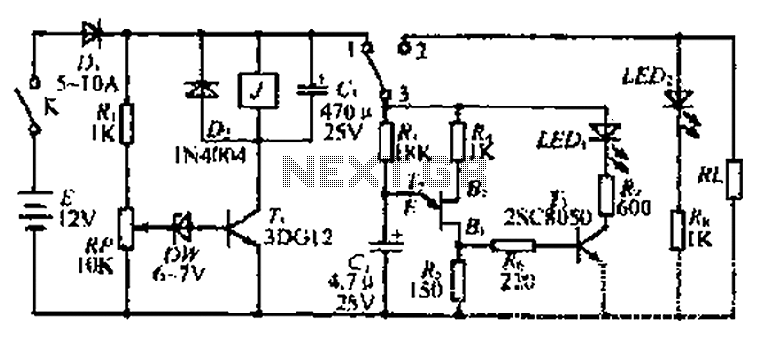
Tip a battery discharge control circuit
The discharge control circuit consists of a battery management system designed to prevent over-discharge of a battery. It features a relay control mechanism that activates when the battery voltage drops below a specified threshold of approximately 10.5V. The circuit includes...
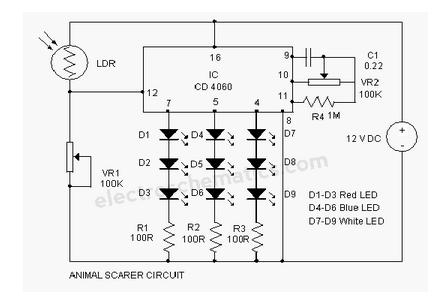
Solar Powered Animal Scarer
This is a solar-powered flasher designed to deter nocturnal animals such as bats and cats from farmyards or residential premises. The device features a bright multicolored light.
The solar-powered flasher operates by utilizing a solar panel to harness sunlight, converting it...

Precision Receiver Battery Low Voltage Alarms
Flying hand launch gliders necessitate the use of small-capacity receiver NiCad battery packs. While these lightweight packs are advantageous, they have the significant drawback of quickly depleting. Although careful timing of flights can be employed, it often results in either...

Deactivating-battery-sensor
The sensing circuit quickly disconnects the battery voltage and load when the voltage falls below a predetermined threshold. The one-way operation ensures that the circuit does not reconnect the load if the voltage subsequently rises above the threshold. Component Cl...

Make this Solar Powered Fence Charger Circuit
A fence charger or energizer is a device used to electrify a fence or boundary to protect the premises from human or animal intrusions. These boundaries are often located in large fields and parks, typically away from urban areas, making...