


Balanced cross tube inverter circuit
#balanced cross tube
#Chelles inverter
#preamp
#6N10
#611 inverted
#amplifier tube
#300B tube
#audio inverter
#tube amplifier
#vacuum tube

Balanced cross tube inverter circuit, also known as the Chelles inverter circuit, can be utilized as a preamplifier and employs 6N10 and 611 tubes in an inverted configuration. The circuit is designed to work with a final amplifier tube, specifically utilizing a 300B tube.
The balanced cross tube inverter circuit is an essential component in audio amplification systems, particularly in high-fidelity applications. This circuit operates by converting a single-ended signal into a balanced output, which significantly reduces noise and distortion, leading to improved audio quality.
The 6N10 and 611 tubes serve as the active elements in the inverter stage, providing the necessary gain and phase inversion. The 6N10 is a dual triode that allows for efficient signal amplification, while the 611 tube, a power triode, is often used in audio applications for its warm sound characteristics and high output power capability.
The circuit typically features a differential input stage, allowing for the rejection of common-mode noise, which is crucial in maintaining signal integrity in audio systems. The output stage, utilizing the 300B tube, is known for its linearity and low distortion, making it an excellent choice for driving speakers in high-end audio setups.
Overall, the balanced cross tube inverter circuit is a sophisticated design that combines the unique properties of vacuum tubes with modern audio engineering principles, resulting in a highly effective amplification solution for audiophiles and professional sound engineers alike. Balanced cross tube inverter circuit is also known Chelles inverter circuit, it can be used as a preamp and 6N10,611 inverted. With the final amplifier tube amplifier using 300 B mating.
The balanced cross tube inverter circuit is an essential component in audio amplification systems, particularly in high-fidelity applications. This circuit operates by converting a single-ended signal into a balanced output, which significantly reduces noise and distortion, leading to improved audio quality.
The 6N10 and 611 tubes serve as the active elements in the inverter stage, providing the necessary gain and phase inversion. The 6N10 is a dual triode that allows for efficient signal amplification, while the 611 tube, a power triode, is often used in audio applications for its warm sound characteristics and high output power capability.
The circuit typically features a differential input stage, allowing for the rejection of common-mode noise, which is crucial in maintaining signal integrity in audio systems. The output stage, utilizing the 300B tube, is known for its linearity and low distortion, making it an excellent choice for driving speakers in high-end audio setups.
Overall, the balanced cross tube inverter circuit is a sophisticated design that combines the unique properties of vacuum tubes with modern audio engineering principles, resulting in a highly effective amplification solution for audiophiles and professional sound engineers alike. Balanced cross tube inverter circuit is also known Chelles inverter circuit, it can be used as a preamp and 6N10,611 inverted. With the final amplifier tube amplifier using 300 B mating.

A Direct-Coupled Amplifier with Cathode Follower by Raymond H. Bates
A Direct-Coupled 6V6 Tube Amplifier with Cathode Follower by Raymond H. Bates from Radio & Television News magazine, November 1949.
The Direct-Coupled 6V6 Tube Amplifier is designed to utilize a 6V6 vacuum tube, which is known for its warm sound and...

All 7-pin Tube Based Phonostage
This project originated as an effort to create an inexpensive phono stage for an old turntable equipped with a low-cost cartridge using available components. However, it evolved into a noteworthy project that significantly enhances the overall analog setup. The construction...

Tube Headphone Amplifier II
This is the schematic of the final design including the tone stack but leaving out the volume, balance, and sonic controls. The right half of the circuit is John Broskie's original White cathode amplifier with a pair of 5687s as...
JMP50 1987 preamp
The Marshall JTM50 and JMP50 utilize two configurations for the initial preamp stage. One configuration mirrors the design found in Marshall's Bluesbreaker and JTM45, which is identical to the Fender Bassman 5F6-A, except for the tube used: a high-mu 12AX7...

The MiniBlok SET Amp
This project utilizes a single tube, specifically the 13EM7, which contains two distinct triode structures. The first structure is compact and provides substantial signal gain but limited power, making it suitable for a preamplifier stage. The second structure is larger,...

Stereo Tube Amplifier circuit
The circuit is straightforward yet capable of outstanding performance. It has been specifically designed as an amplifier for the digital sound card in a computer. Audio input can be sourced from any two-channel line-level device such as a television, CD...

Three ECC83-Based Tube Phono Preamplifier Circuits
The three circuits were based on the vacuum tube ECC83, designed to produce phono preamplifiers in compliance with RIAA standards.
The described circuits utilize the ECC83 vacuum tube, a dual-triode component known for its low noise and high gain characteristics, making...

Dynaco ST-70 Amplifier
This classic tube amplifier was once considered the best value available. Fifteen years ago, it could be purchased for $25. The amplifier was designed to be affordable while maximizing performance for the cost. At the end of its production, it...
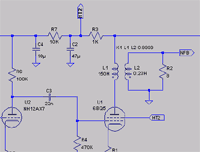
LTSpice vacuum tube models
The objective is to establish a space dedicated to art, audio, and video, centered around a vintage electronics theme. The vacuum tube is considered the core component of any vintage radio or electronic device. Currently, the usage of vacuum tubes...