


Dc/Dc Converter
#DC/DC converter
#LT1073
#voltage conversion
#power supply
#3V to -24V
#linear technology
#battery operated
#step-down converter
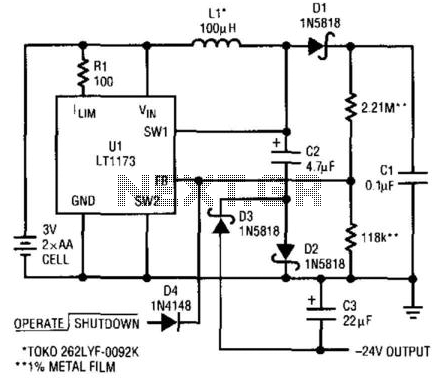
Description: This circuit utilizes a Linear Technology LT1073 to function as a -24 V converter. The power supply can consist of two AA cells (3 V) or a 5 V source. The circuit is capable of delivering a current of 7 mA.
The LT1073 is a high-performance, low-noise voltage regulator that can be configured for various output voltages, including negative voltages. In this application, it is employed to convert a lower input voltage into a -24 V output, making it suitable for powering devices that require a negative voltage supply.
The circuit design begins with the input power source, which can be either two AA batteries in series, providing a nominal voltage of 3 V, or a 5 V regulated power supply. The choice of the input voltage affects the efficiency and performance of the converter.
The LT1073 operates by switching the input voltage through an inductor, which stores energy and releases it to the output capacitor, creating a negative output voltage. The inductor value is critical for ensuring the proper operation of the converter. A typical value for the inductor in this configuration might range from 10 µH to 100 µH, depending on the desired switching frequency and load conditions.
Output capacitors are also essential for stabilizing the output voltage and reducing ripple. The selection of these capacitors should consider both capacitance and equivalent series resistance (ESR) to optimize performance. A combination of tantalum and ceramic capacitors is often used to achieve low ripple and good transient response.
The feedback loop of the LT1073 is configured to maintain the desired output voltage. A voltage divider network is used to sense the output voltage, feeding it back to the regulator to adjust the duty cycle of the switching operation, thereby stabilizing the output at -24 V.
The circuit's output current capability is rated at 7 mA, which is suitable for low-power applications. However, careful consideration of thermal management is necessary, especially when operating at maximum load conditions. Adequate heat sinking or thermal dissipation methods should be implemented to ensure the LT1073 operates within its safe temperature range.
In summary, this circuit effectively utilizes the LT1073 to create a -24 V output from a low-voltage input, providing a reliable power source for applications requiring negative voltage while ensuring stability and efficiency through careful component selection and circuit design. This circuit uses a Linear Technology LT1073 in a -24-V converter. The supply can be two AA cells (3 V) or 5 V. The circuit can deliver 7 mA.
The LT1073 is a high-performance, low-noise voltage regulator that can be configured for various output voltages, including negative voltages. In this application, it is employed to convert a lower input voltage into a -24 V output, making it suitable for powering devices that require a negative voltage supply.
The circuit design begins with the input power source, which can be either two AA batteries in series, providing a nominal voltage of 3 V, or a 5 V regulated power supply. The choice of the input voltage affects the efficiency and performance of the converter.
The LT1073 operates by switching the input voltage through an inductor, which stores energy and releases it to the output capacitor, creating a negative output voltage. The inductor value is critical for ensuring the proper operation of the converter. A typical value for the inductor in this configuration might range from 10 µH to 100 µH, depending on the desired switching frequency and load conditions.
Output capacitors are also essential for stabilizing the output voltage and reducing ripple. The selection of these capacitors should consider both capacitance and equivalent series resistance (ESR) to optimize performance. A combination of tantalum and ceramic capacitors is often used to achieve low ripple and good transient response.
The feedback loop of the LT1073 is configured to maintain the desired output voltage. A voltage divider network is used to sense the output voltage, feeding it back to the regulator to adjust the duty cycle of the switching operation, thereby stabilizing the output at -24 V.
The circuit's output current capability is rated at 7 mA, which is suitable for low-power applications. However, careful consideration of thermal management is necessary, especially when operating at maximum load conditions. Adequate heat sinking or thermal dissipation methods should be implemented to ensure the LT1073 operates within its safe temperature range.
In summary, this circuit effectively utilizes the LT1073 to create a -24 V output from a low-voltage input, providing a reliable power source for applications requiring negative voltage while ensuring stability and efficiency through careful component selection and circuit design. This circuit uses a Linear Technology LT1073 in a -24-V converter. The supply can be two AA cells (3 V) or 5 V. The circuit can deliver 7 mA.

Step Up PSU for LCD
To operate the old Optrex DMC50264N LCD module, a bias voltage of +24V is required. If only low voltage options of 3V to 5V are available, a small DC/DC converter can be constructed, as the LCD module consumes very little...

Batteries charger & PSU - ideal for digital camerass
This circuit was designed for digital cameras, which are known to have significant power consumption. For instance, the Minolta E223 camera requires approximately 800 mA. In practice, this demand can be met using a mains power supply or high-capacity NiMH...

Battery charger or Power Supply 14 volt 4 ampere
The schematic diagram originates from a circuit designed as a battery charger/power supply with an output of 14V and a maximum current of 4A, utilizing the VN64GA MOSFET. This high-performance battery charger is specifically engineered for gelled electrolyte lead-acid batteries,...

Sony KV-S29MHl TV switching power supply (SIR a 80145A) circuit diagram
The circuit of the Sony KV-S29MHl (S Movement series) TV switching power supply (SIR a 80145A) consists of three main sections: (A) the power oscillation part, (B) the regulator part, and (C) the output section.
The Sony KV-S29MHl TV switching power...

Kapanadze 2
The DC/DC converter operates from 110/220V to 12V, not in the reverse direction. The 12V output serves as a substitute for the battery. This output is derived from L4 (which has been marked as L3). The transformer T1 has four...

400mA Micropower Synchronous Step-Up DC/DC Converter with Output Disconnect
The LTC3525-3/LTC3525-3.3/LTC3525-5 are high-efficiency synchronous step-up DC/DC converters with output disconnect capability that can operate with an input voltage as low as 1V. These converters provide a compact and efficient alternative to charge pumps for single-cell or dual-cell alkaline or...

How to Boost Efficiency at Low Loads
Small additional circuitry during standby can significantly enhance efficiency. In a modern vehicle, multiple microcontrollers are required to support safety, navigation, entertainment, and comfort electronics.
The integration of additional circuitry during standby mode in automotive applications is crucial for optimizing power...

Some thoughts on DC/DC converters part five
Chapter 4, part five of a five-part series titled "Some Thoughts on DC/DC Converters," authored by the late Jim Williams and Brian Huffman, is included in Volume II of the book "Analog Circuit Design-- Immersion in the Black Art of...

Switching Regulator Circuit
This example presents a switch DC regulated power supply circuit designed for buck-mode +5V applications. It consists of a power supply circuit, an impulsator, a voltage sampling or pulse width modulation circuit, and a buffering driver circuit, as illustrated in...