


DC-DC regulating converter
#DC-DC converter
#regulating converter
#push-pull outputs
#transformer-coupled
#oscillator
#PWM signal
#voltage regulation
#flip-flop
#frequency division

Description: Push-pull outputs are utilized in this transformer-coupled DC-DC regulating converter. It is important to note that the oscillator must be configured to operate at twice the desired output frequency, as the SGI 524's internal flip-flop divides the frequency by two when switching the PWM signal between outputs. Current limiting is implemented in the primary circuit to reduce the pulse width in the event of transformer saturation.
In this transformer-coupled DC-DC regulating converter, the push-pull topology is employed to effectively manage power conversion and regulation. The configuration utilizes two transistors that alternately switch on and off, allowing for efficient energy transfer from the primary winding of the transformer to the secondary winding. The SGI 524 integrated circuit plays a critical role in this design by generating the necessary PWM (Pulse Width Modulation) control signals. The oscillator frequency must be set to twice the target output frequency to compensate for the internal frequency division performed by the flip-flop within the SGI 524. This ensures that the output frequency remains stable and adheres to the design specifications.
Additionally, the current limiting feature is crucial for protecting the circuit from potential damage due to transformer saturation. In the primary side of the converter, a current sensing mechanism monitors the flow of current through the transformer. When the current exceeds a predefined threshold, the pulse width of the PWM signal is automatically reduced. This action limits the energy delivered to the transformer, preventing saturation and ensuring that the system operates within safe parameters. The combination of push-pull outputs, precise frequency control, and current limiting mechanisms contributes to the overall reliability and efficiency of the DC-DC converter circuit.Push-pull outputs are used in this transformer-coupled dc-dc regulating converter. Note that the oscillator must be set at twice the desired output frequency as the SGI 524"s internal flip-flop divides the frequency by 2 as it switches the PWM signal from one output to the other Current limiting is done here in the primary so that the pulse width will be reduced should transformer saturation occur.
In this transformer-coupled DC-DC regulating converter, the push-pull topology is employed to effectively manage power conversion and regulation. The configuration utilizes two transistors that alternately switch on and off, allowing for efficient energy transfer from the primary winding of the transformer to the secondary winding. The SGI 524 integrated circuit plays a critical role in this design by generating the necessary PWM (Pulse Width Modulation) control signals. The oscillator frequency must be set to twice the target output frequency to compensate for the internal frequency division performed by the flip-flop within the SGI 524. This ensures that the output frequency remains stable and adheres to the design specifications.
Additionally, the current limiting feature is crucial for protecting the circuit from potential damage due to transformer saturation. In the primary side of the converter, a current sensing mechanism monitors the flow of current through the transformer. When the current exceeds a predefined threshold, the pulse width of the PWM signal is automatically reduced. This action limits the energy delivered to the transformer, preventing saturation and ensuring that the system operates within safe parameters. The combination of push-pull outputs, precise frequency control, and current limiting mechanisms contributes to the overall reliability and efficiency of the DC-DC converter circuit.Push-pull outputs are used in this transformer-coupled dc-dc regulating converter. Note that the oscillator must be set at twice the desired output frequency as the SGI 524"s internal flip-flop divides the frequency by 2 as it switches the PWM signal from one output to the other Current limiting is done here in the primary so that the pulse width will be reduced should transformer saturation occur.

Micro Power AM Broadcast Transmitter
This circuit utilizes a 74HC14 hex Schmitt trigger inverter as a square wave oscillator to drive a small signal transistor configured in a class C amplifier setup. The frequency of the oscillator can be either fixed using a crystal or...

Metal detector circuit diagram 1
The metal detector circuit includes a fixed frequency oscillator, mixer, detector, detection oscillator, and power amplifier circuit. The fixed frequency oscillator circuit is composed of a ceramic filter (ZC), transistor (V1), resistors (R1 to R4), capacitor (C2), and other components....

Dc to Dc converter using 555 Timer IC
When the power supply is connected to IC1, the output pin 3 operates at a frequency of 1 kHz. The components Q1 and Q2 work in a push-pull configuration. When a positive output signal is generated, Q1 and Q2 execute...
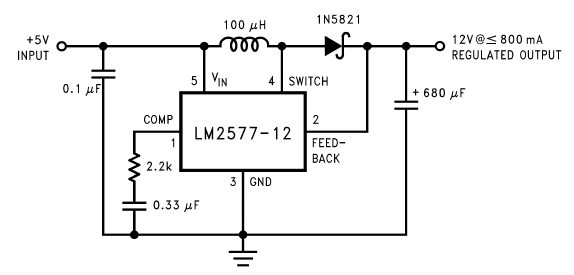
LM2577 5V to 12V DC Converter step up Voltage Regulator
If you are looking for ICs for a DC to DC converter application, the LM1577/LM2577 ICs are highly recommended as they provide all the necessary power and control functions for step-up conversion.
The LM1577 and LM2577 are versatile integrated circuits designed...

power supply design
The more one understands about any subject, the more interesting it becomes. As this article is read, it will be found that the subject of...
A comprehensive electronic schematic typically involves various components, each serving a specific function in the overall...

100v / 10ma regulator circuit
The circuit features no-load and short circuit protection mechanisms. To accommodate short circuit conditions, it is necessary to increase resistors R1 and R2 to allow for power dissipation; for example, R1 can be set to 1.2kΩ with a power rating...

Auto Flash Alarm - Staircase_Control
The circuit comprises a low-frequency oscillator, an electronic switch circuit, a control circuit, a photoelectric display circuit, and a music alarm circuit. The low-frequency oscillator is constructed using an integrated circuit (IC) with internal NAND gates and external resistor-capacitor (RC)...

6V to15V DC to DC converter using LM2585 wired in the boost mode
A simple and efficient 6 to 15V boost/step-up DC to DC converter based on IC L2585. This voltage converter circuit requires few external components.
The circuit utilizes the L2585 integrated circuit, which is designed for high-efficiency voltage boosting applications. The L2585...

10 to 1000 MHz Oscillator circuit with RF2506
Today, it is no longer necessary to use discrete components for constructing oscillators. Many manufacturers now offer ready-made voltage-controlled oscillator (VCO) integrated circuits (ICs) that require only a few external components to determine the frequency. An example of such an...