


Small DC-DC Inverter: Convert 1.5 to 9 volts
#DC-DC inverter
#voltage converter
#low cost
#simple circuit
#1.5V to 9V
#few components
#portable power
#battery powered
#schematic circuit
#power conversion

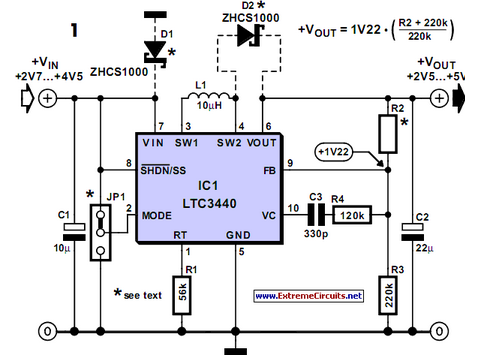
Description: This is a 1.5 to 9 volts inverter schematic circuit. It is a low-cost and simple circuit that requires few components. This circuit is used in many applications.
The 1.5 to 9 volts inverter circuit is designed to convert a low DC input voltage into a higher DC output voltage, specifically in the range of 1.5 to 9 volts. The circuit typically consists of a few essential components, including a transformer, transistors, resistors, capacitors, and a diode, which work together to achieve the desired voltage conversion.
The operation of the inverter circuit begins with the input voltage being applied to the base of a transistor, which acts as a switch. When the transistor is activated, it allows current to flow through the primary winding of the transformer. The transformer then induces a higher voltage in the secondary winding due to electromagnetic induction. The output voltage can be adjusted by selecting the appropriate turns ratio of the transformer.
To ensure stable operation and to prevent voltage spikes, capacitors are often included in the circuit. These capacitors filter the output, smoothing any fluctuations in voltage. Additionally, a diode may be used to prevent reverse current flow, protecting the circuit from potential damage.
This inverter circuit is versatile and can be utilized in various applications, including powering small electronic devices, charging batteries, and providing backup power for low-voltage equipment. Its simplicity and low cost make it an attractive option for hobbyists and professionals alike. Proper attention to component ratings and circuit layout is essential for optimal performance and reliability.This is a 1.5 to 9 volts inverter schematic circuit. This is low cost and a simple circuit that need few components.This circuit is used in many application.
The 1.5 to 9 volts inverter circuit is designed to convert a low DC input voltage into a higher DC output voltage, specifically in the range of 1.5 to 9 volts. The circuit typically consists of a few essential components, including a transformer, transistors, resistors, capacitors, and a diode, which work together to achieve the desired voltage conversion.
The operation of the inverter circuit begins with the input voltage being applied to the base of a transistor, which acts as a switch. When the transistor is activated, it allows current to flow through the primary winding of the transformer. The transformer then induces a higher voltage in the secondary winding due to electromagnetic induction. The output voltage can be adjusted by selecting the appropriate turns ratio of the transformer.
To ensure stable operation and to prevent voltage spikes, capacitors are often included in the circuit. These capacitors filter the output, smoothing any fluctuations in voltage. Additionally, a diode may be used to prevent reverse current flow, protecting the circuit from potential damage.
This inverter circuit is versatile and can be utilized in various applications, including powering small electronic devices, charging batteries, and providing backup power for low-voltage equipment. Its simplicity and low cost make it an attractive option for hobbyists and professionals alike. Proper attention to component ratings and circuit layout is essential for optimal performance and reliability.This is a 1.5 to 9 volts inverter schematic circuit. This is low cost and a simple circuit that need few components.This circuit is used in many application.

TL497A Voltage Converter
This voltage converter is constructed using the TL497A integrated circuit and is designed to convert an input voltage range of 5 to 12 volts into a higher output voltage range of 15 to 30 volts. This functionality is particularly beneficial...
Buck-Boost Voltage Converter
Sometimes it is necessary to power a circuit from a battery where the required supply voltage falls within the discharge curve of the battery. If the battery...
Powering a circuit from a battery involves understanding the discharge characteristics of the battery...

12V to 220V converter circuit
This DIY 12V to 220V voltage converter is built with a CMOS 4047, which serves as the main component for transforming 12V DC into 220V AC. The 4047 operates as an astable multivibrator, generating a symmetrical rectangular signal at pins...

5V From 4Aa Cells Circuit
This unique logic-power-converter design allows for a switchable output of 3.6 V or 5 V at 200 mA using four AA cells. The supply features a MOSFET switch that can connect to a lithium backup battery, providing a 3.4 V...

Step down voltage converter 5v with transistor BC337
The circuit reduces voltage size or functions as a step-down voltage converter circuit, specifically a DC regulated circuit model using a switching converter. It generates the desired voltage output.
The step-down voltage converter circuit, also known as a buck converter, is...

6V to 12V Converter
This inverter circuit can provide up to 800mA of 12V power from a 6V supply. For example, you could run 12V car accessories in a 6V car. The circuit is simple, about 75% efficient and quite useful. By changing just...

12v to +5V, -12V, +12V, +24V adaptor
Many times we needed a variety of voltages, from a battery 12V. With the circuit, we can take voltages smaller or bigger, positive or negative, from a battery 12V. The idea is based in oscillator roughly 7KHZ, round the R1,...

High-efficiency-flyback-voltage-converter
U1 is a dual voltage comparator with open collector outputs. The A side functions as an oscillator operating at 100 kHz, while the B side is part of the regulation circuit that compares a fraction of the output voltage to...

12V to 9 or 6 v converter
This circuit allows transistorized devices, such as radios, cassette players, and other electrical appliances, to operate from a car's electrical supply. The accompanying table provides resistor values and specifies diode types for different voltage levels. If multiple voltage levels are...