


Automatic Emergency Lighting Unit
#emergency lighting
#Nicad battery
#power failure
#automatic switch
#LED
#backup power
#T1 transistor
#lighting control

Description: This unit utilizes a NiCad battery to supply power to an emergency lighting system. During a power failure, transistor T1 becomes forward biased, activating lamps L1 and L2. The batteries are typically maintained in a charged state. When the power is restored, T1 is turned off, extinguishing the lamps.
The emergency lighting system described is designed to provide illumination during power outages, ensuring safety and visibility in critical situations. The core component of the system is the NiCad (Nickel-Cadmium) battery, which serves as a reliable power source due to its ability to be recharged and its relatively high energy density.
In normal operating conditions, when the main power supply is active, T1, a transistor, remains in the off state, effectively preventing any current from flowing to the lamps L1 and L2, thus keeping them turned off. The circuit is designed to automatically switch to battery power when the main power fails.
Upon detection of a power failure, T1 transitions to the on state, becoming forward biased. This allows current to flow through the circuit, illuminating both lamps L1 and L2. The activation of these lamps provides necessary lighting in emergency situations.
The system includes a charging circuit that ensures the NiCad battery remains charged while the main power is available. This is critical for maintaining readiness for unexpected power outages. The charging circuit typically includes a resistor and a diode to regulate the charging process and prevent backflow of current when the main power is off.
The design may also incorporate additional safety features such as fuses or circuit breakers to protect against overcurrent conditions, ensuring the longevity and reliability of the emergency lighting system. Overall, this circuit is an essential component for emergency preparedness in residential, commercial, and industrial applications. This unit uses a Nicad battery to provide power to an emergency lighting setup. When power fails, T1 beco mes forward biased, which lights LI and L2. The batteries are normally kept charged. When power is on, T1 is cut off and it keeps the lamps extinguished.
The emergency lighting system described is designed to provide illumination during power outages, ensuring safety and visibility in critical situations. The core component of the system is the NiCad (Nickel-Cadmium) battery, which serves as a reliable power source due to its ability to be recharged and its relatively high energy density.
In normal operating conditions, when the main power supply is active, T1, a transistor, remains in the off state, effectively preventing any current from flowing to the lamps L1 and L2, thus keeping them turned off. The circuit is designed to automatically switch to battery power when the main power fails.
Upon detection of a power failure, T1 transitions to the on state, becoming forward biased. This allows current to flow through the circuit, illuminating both lamps L1 and L2. The activation of these lamps provides necessary lighting in emergency situations.
The system includes a charging circuit that ensures the NiCad battery remains charged while the main power is available. This is critical for maintaining readiness for unexpected power outages. The charging circuit typically includes a resistor and a diode to regulate the charging process and prevent backflow of current when the main power is off.
The design may also incorporate additional safety features such as fuses or circuit breakers to protect against overcurrent conditions, ensuring the longevity and reliability of the emergency lighting system. Overall, this circuit is an essential component for emergency preparedness in residential, commercial, and industrial applications. This unit uses a Nicad battery to provide power to an emergency lighting setup. When power fails, T1 beco mes forward biased, which lights LI and L2. The batteries are normally kept charged. When power is on, T1 is cut off and it keeps the lamps extinguished.

LED dimmer circuit
Typical segment display LEDs consume around 25 mA for each segment and should be limited to this current with resistors. For a six-digit display to be current limited, at least 42 series resistors are needed. The brightness of the LEDs...
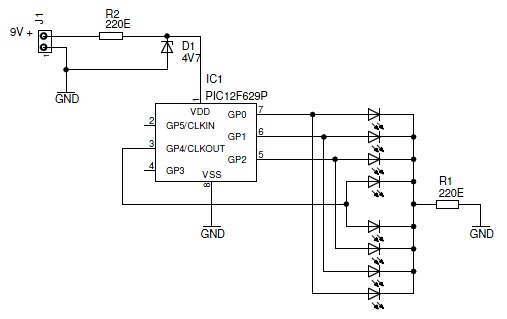
knight Rider 2
This project describes a light effect that is similar to the one of the car in the TV series "Knight Rider."
The light effect project emulates the iconic scanning LED light sequence featured in the "Knight Rider" television series. The design...

LED Torch Uses Blocking Oscillator
This simple LED torch is driven by a 2-transistor blocking oscillator that steps up the voltage from a 1.5V cell. It relies on the inherent current limiting of the 150 µH choke to protect the white LED from overdrive. With...

Light emitting diode LED displays the basic structure of the driving circuit
The circuit drives the light-emitting diode in a digital display configuration. The count signal is fed into the ICM7217 chip, which processes the count and subsequently drives the digital display board. The connection between the thumbwheel switches is illustrated in...

White LED Lamp with Solar Panel
In various industrial processes, it is essential to rotate a DC (or AC) motor both forward and reverse for a specified duration. Initially, the motor rotates forward (clockwise) for a certain period (approximately 2 to 3 minutes), then stops for...
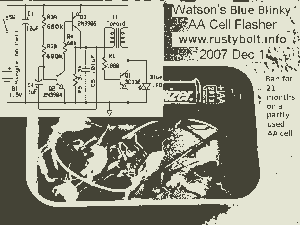
Blue Blinky Joule circuit
Daylight shutoff; the schematic has been updated but is not shown here.
The daylight shutoff circuit is designed to automatically turn off lighting systems during daylight hours, thereby conserving energy and extending the lifespan of the lighting fixtures. Typically, this circuit...

LED Flashlight circuit with MAX1811
White LEDs have a rated current at a voltage drop of about 3.3 to 3.4 V. It is ideal to be powered from the battery voltage which is slightly larger. Then there is the best energy used. In this I...

Mains Powered White LED Lamp
An array of white LEDs can serve as a compact lamp for living spaces. These LED lamps are commercially available and resemble standard halogen lamps, fitting into typical 230-V light fixtures. Upon inspection, it is evident that a capacitor is...

led table reading lamp circuit
This LED table or reading lamp circuit can be utilized for various applications, such as a reading lamp for a bed, a desktop or table lamp, a keyboard lamp (to illuminate the keys of a computer keyboard in low light),...