


Automatic Street Light Controller Circuit Using Relays and LDR
#LDR
#relay
#automatic control
#street light
#light sensor
#energy saving
#outdoor lighting
#circuit design
#electronics project
#DIY
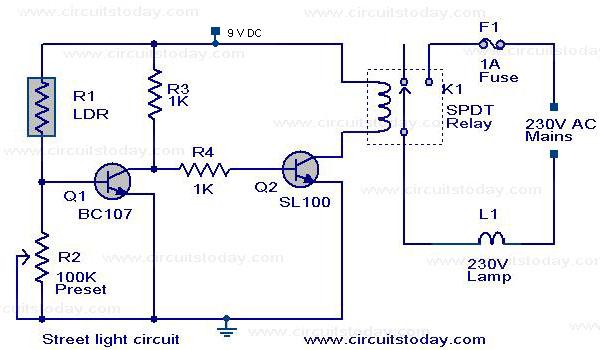
Description: The circuit diagram of an Automatic Street Light Controller Circuit is explained in this post.
The Automatic Street Light Controller Circuit is designed to automatically turn on street lights at dusk and turn them off at dawn. This functionality is achieved using a light-dependent resistor (LDR) as the primary sensor. The LDR detects ambient light levels; when the light falls below a certain threshold, the resistance of the LDR decreases, triggering a transistor that activates the street light.
The circuit typically consists of the following components: an LDR, a resistor for voltage division, a transistor (commonly an NPN type), and a relay to control the high voltage of the street light. The LDR is connected in a voltage divider configuration with a fixed resistor, creating a voltage that varies with light intensity. This voltage is fed into the base of the transistor, which acts as a switch.
When the ambient light level decreases, the voltage across the LDR and resistor combination drops, allowing the transistor to turn on. This, in turn, energizes the relay, closing its contacts and powering the street light. Conversely, when the light levels increase at dawn, the LDR's resistance increases, causing the transistor to turn off and deactivating the relay, thus turning off the street light.
The circuit can also include additional features such as time delay circuits or dimming capabilities to enhance functionality. Overall, the Automatic Street Light Controller Circuit is an efficient solution for managing outdoor lighting, reducing energy consumption, and improving street safety.The circuit diagram of an Automatic Street Light Controller Circuit is explained in this post..
The Automatic Street Light Controller Circuit is designed to automatically turn on street lights at dusk and turn them off at dawn. This functionality is achieved using a light-dependent resistor (LDR) as the primary sensor. The LDR detects ambient light levels; when the light falls below a certain threshold, the resistance of the LDR decreases, triggering a transistor that activates the street light.
The circuit typically consists of the following components: an LDR, a resistor for voltage division, a transistor (commonly an NPN type), and a relay to control the high voltage of the street light. The LDR is connected in a voltage divider configuration with a fixed resistor, creating a voltage that varies with light intensity. This voltage is fed into the base of the transistor, which acts as a switch.
When the ambient light level decreases, the voltage across the LDR and resistor combination drops, allowing the transistor to turn on. This, in turn, energizes the relay, closing its contacts and powering the street light. Conversely, when the light levels increase at dawn, the LDR's resistance increases, causing the transistor to turn off and deactivating the relay, thus turning off the street light.
The circuit can also include additional features such as time delay circuits or dimming capabilities to enhance functionality. Overall, the Automatic Street Light Controller Circuit is an efficient solution for managing outdoor lighting, reducing energy consumption, and improving street safety.The circuit diagram of an Automatic Street Light Controller Circuit is explained in this post..

DC relay circuits to delay the release of a second
The circuit depicted in Figure 6-24 includes a relay coil with both ends connected in parallel to either a resistor Rf or an auxiliary diode VD. This configuration is equivalent to providing power after a short circuit, which increases the...

The electronic energy saving lamp maintenance circuit diagram
The saving lamp circuit features two main types: glass cover and exposed. The glass cover variants include three series: spherical, cylindrical, and processing types. The first two series consist of four variations: transparent, carved, engraved, and white. These lamps are...

Light/dark relay switch
This kit is the most basic, practical circuit to build using an LDR to turn on a relay. The two transistors connected as a Darlington pair give the circuit enough sensitivity, while the trimpot gives sensitivity adjustment. The switching point...

Super Light Sensor
The "Super Light Sensor" is designed to respond to minor changes in light levels, automatically adjusting from approximately 200 lux to 60,000 lux, accommodating environments ranging from a dimly lit room to direct sunlight. Its applications include detecting vehicles entering...

Simple Relay Driver
This circuit can be used to drive a 12V relay with a triggering signal of 5V. It incorporates two 1N4002 diodes, one 2N3904 transistor, and two resistors. By altering the resistor values, the input triggering voltage can be modified.
The circuit...
push button relay selector
This circuit was designed for use in a hi-fi showroom, where a choice of speakers could be connected to a stereo amplifier for comparative purposes.
The circuit serves as a speaker selector that facilitates the connection of multiple speakers to a...

Light Controlled Relays
The first circuit energizes the relay when the light rises above the preset level. The second circuit energizes the relay when the light falls below the preset level. The two circuits are practically identical. The only difference between them is...

Relay Interface For Amateur Radio Transceivers Circuit
The relay power in the linear circuit is derived from a -120 V bias supply, while the transmit keying output from the Kenwood device is +12 V with a maximum current of 10 mA. A critical component of this circuit...

AUDIBLE LIGHT METER
A low light condition on a cadmium sulfide photocell (Radio Shack 276-116) generates a series of clicks in a miniature 8-ohm loudspeaker. As the light intensity increases, these clicks coalesce into an audio tone that escalates in frequency with rising...