


Buck-Boost High Power White LED Driver
#LED driver
#buck-boost converter
#LTC3453
#high power
#white LED
#Li-Ion battery
#DC/DC converter
#efficiency
#synchronous

Description: The LTC3453 is a synchronous buck-boost DC/DC converter optimized for driving up to 4 white LEDs at a combined current of up to 500mA from a single Li-Ion battery input. The regulator operates in either synchronous buck, synchronous boost, or buck-boost mode, depending on input voltage and LED maximum forward voltage. Optimum efficiency is achieved using a proprietary architecture that determines which LED requires the largest forward voltage drop at its programmed current, and regulates the common output rail for lowest dropout. Efficiency of 90% can be achieved over the entire usable range of a Li-Ion battery (2.7V to 4.2V).
The LTC3453 is designed to provide a versatile solution for LED driving applications, particularly in battery-powered devices where efficiency and compactness are critical. The device supports multiple operating modes: synchronous buck for high input voltages, synchronous boost for low input voltages, and buck-boost for when the input voltage is near the output voltage. This flexibility allows the LTC3453 to adapt to varying conditions while maintaining optimal performance.
The architecture of the LTC3453 includes advanced control circuitry that intelligently selects the operating mode based on the input voltage and the forward voltage requirements of the connected LEDs. This ensures that the LEDs operate within their specified current limits while maximizing efficiency. The converter can drive up to four white LEDs in series or parallel configurations, depending on the application requirements, with a total output current of up to 500mA, providing bright illumination while minimizing power consumption.
Efficiency is a key feature of the LTC3453, with reported values reaching up to 90%. This high efficiency is particularly advantageous in battery-operated devices, as it extends battery life and reduces the frequency of recharging. The converter operates effectively across a wide input voltage range of 2.7V to 4.2V, making it suitable for use with standard Li-Ion batteries.
In terms of component selection, the LTC3453 requires external inductors and capacitors, which should be chosen based on the desired output current and voltage ripple specifications. The device also includes features such as thermal shutdown and overcurrent protection, enhancing the reliability of the circuit in various operating conditions.
Overall, the LTC3453 represents a robust solution for driving white LEDs in portable applications, combining efficiency, flexibility, and reliability in a compact package.The LTC3453 is a synchronous buck-boost DC/DC converter optimized for driving up to 4 white LEDs at a combined current of up to 500mA from a single Li-Ion battery input. The regulator operates in either synchronous buck, synchronous boost, or buck-boost mode, depending on input voltage and LED maximum forward voltage.
Optimum efficiency is achieved using a proprietary architecture that determines which LED requires the largest forward voltage drop at its programmed current, and regulates the common output rail for lowest dropout. Efficiency of 90% can be achieved over the entire usable range of a Li-Ion battery (2.7V to 4.2V).
The LTC3453 is designed to provide a versatile solution for LED driving applications, particularly in battery-powered devices where efficiency and compactness are critical. The device supports multiple operating modes: synchronous buck for high input voltages, synchronous boost for low input voltages, and buck-boost for when the input voltage is near the output voltage. This flexibility allows the LTC3453 to adapt to varying conditions while maintaining optimal performance.
The architecture of the LTC3453 includes advanced control circuitry that intelligently selects the operating mode based on the input voltage and the forward voltage requirements of the connected LEDs. This ensures that the LEDs operate within their specified current limits while maximizing efficiency. The converter can drive up to four white LEDs in series or parallel configurations, depending on the application requirements, with a total output current of up to 500mA, providing bright illumination while minimizing power consumption.
Efficiency is a key feature of the LTC3453, with reported values reaching up to 90%. This high efficiency is particularly advantageous in battery-operated devices, as it extends battery life and reduces the frequency of recharging. The converter operates effectively across a wide input voltage range of 2.7V to 4.2V, making it suitable for use with standard Li-Ion batteries.
In terms of component selection, the LTC3453 requires external inductors and capacitors, which should be chosen based on the desired output current and voltage ripple specifications. The device also includes features such as thermal shutdown and overcurrent protection, enhancing the reliability of the circuit in various operating conditions.
Overall, the LTC3453 represents a robust solution for driving white LEDs in portable applications, combining efficiency, flexibility, and reliability in a compact package.The LTC3453 is a synchronous buck-boost DC/DC converter optimized for driving up to 4 white LEDs at a combined current of up to 500mA from a single Li-Ion battery input. The regulator operates in either synchronous buck, synchronous boost, or buck-boost mode, depending on input voltage and LED maximum forward voltage.
Optimum efficiency is achieved using a proprietary architecture that determines which LED requires the largest forward voltage drop at its programmed current, and regulates the common output rail for lowest dropout. Efficiency of 90% can be achieved over the entire usable range of a Li-Ion battery (2.7V to 4.2V).

High power control for sensitive contacts
Two simple arrangements for resistive loads are shown in A and B. The circuit in A will provide load power when the actuating contact is closed, and no power when the contact is open. B provides the reverse of this...

White LED Step-Up Converters with Schottky
The LT3465/LT3465A are step-up DC/DC converters designed to drive up to six LEDs in series from a Li-Ion cell. Series connection of the LEDs provides identical LED currents and eliminates the need for ballast resistors. These devices integrate the Schottky...
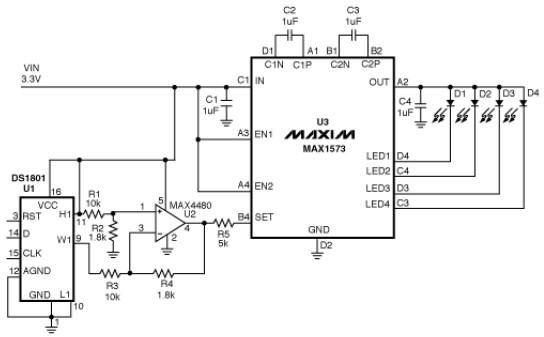
MAX1573 white led driver electronic project schematic
This white LED driver circuit operates up to four white LEDs in parallel from a 3.3V power source, adjusting the total LED current from 1mA to 106mA in 64 steps of 1dB each. The brightness control of the LEDs is...

MA1576Y charge pump LED driver circuit diagram
The circuit utilizes the MAX1576Y charge pump white LED driver, capable of supplying a total current of up to 480mA across two groups (n = 4 white LEDs). Each white LED in the flashing group can draw a maximum current...
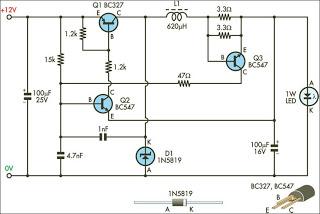
1W LED Driver
This circuit is designed to drive 1W LEDs that are commonly available. It addresses their non-linear voltage-to-current relationship and variations in forward voltage.
The circuit utilizes a constant current driver configuration to ensure that the LEDs operate efficiently while maintaining their...

230V LED DRIVER CIRCUIT
This document presents a 230V LED driver circuit that operates without a transformer. The circuit utilizes five LEDs, although the number can be increased as desired. The absence of transformers significantly reduces both the cost and size of the circuit....

800W high power mosfet amplifier Schematic Diagram
This amplifier is suitable for various applications that demand high power, low noise, minimal distortion, and superior sound quality. Examples include subwoofer amplifiers, front-of-house (FOH) stage amplifiers, and individual channels of high-powered surround sound amplifiers. For a detailed explanation of...

Dc/Dc Converter Circuit
This low-power converter supplies approximately 100 mW of DC power to a load and is useful for isolating or deriving DC voltages. It operates at a frequency of around 200 kHz. The inductor is wound on a 22-mm diameter, 13-mm...

1.5V to 5V/12V DC/DC Converter with LT1073
A compact DC/DC converter designed to provide either 5V or 12V output using the LT1073 integrated circuit (IC). This IC is available in three versions based on the desired output voltage, with two options providing fixed outputs of 5V and...