


Camera internal flash circuit

Description: This circuit consists of a light measurement circuit and a flash circuit, as illustrated in the accompanying figure. It is applicable in the POPTICS (a popular integrated camera), the Franka X-500, and the WIZEN-860S cameras. The light measurement circuit includes components VT1, VT2, and the light metering element RG.
The circuit integrates a light measurement subsystem with a flash activation mechanism, providing essential functionalities for exposure control in various camera systems. The light measurement circuit is critical for assessing ambient light levels, which informs the flash circuit when to trigger, ensuring optimal exposure during photography.
The light measurement circuit employs transistors VT1 and VT2, which serve as amplifiers to process the signal from the light metering component RG. RG typically consists of a photodiode or a phototransistor that generates a current proportional to the incident light intensity. This current is then amplified by VT1 and VT2, allowing for precise measurement of light conditions.
The output from the light measurement circuit feeds into the flash circuit, which is responsible for activating a flash unit. This circuit may include a timing mechanism to delay the flash activation until the optimal moment, based on the ambient light reading. The interaction between the light measurement and flash circuits ensures that the camera can adapt to varying lighting conditions, providing photographers with the ability to capture well-exposed images in diverse environments.
In summary, the described circuit plays a pivotal role in enhancing the functionality of integrated camera systems by ensuring accurate light measurement and flash synchronization, thereby improving overall image quality.This circuit is composed of the light measurement circuit and the flash circuit, as the figure shows. It can be used in the POPTICS (one kind of popular integration camera), the Franka X-500 and the WIZEN-860S cameras.
It is composed of the following circuits: the light measurement circuit is composed of the VT1, VT2 and the light metering component RG..
The circuit integrates a light measurement subsystem with a flash activation mechanism, providing essential functionalities for exposure control in various camera systems. The light measurement circuit is critical for assessing ambient light levels, which informs the flash circuit when to trigger, ensuring optimal exposure during photography.
The light measurement circuit employs transistors VT1 and VT2, which serve as amplifiers to process the signal from the light metering component RG. RG typically consists of a photodiode or a phototransistor that generates a current proportional to the incident light intensity. This current is then amplified by VT1 and VT2, allowing for precise measurement of light conditions.
The output from the light measurement circuit feeds into the flash circuit, which is responsible for activating a flash unit. This circuit may include a timing mechanism to delay the flash activation until the optimal moment, based on the ambient light reading. The interaction between the light measurement and flash circuits ensures that the camera can adapt to varying lighting conditions, providing photographers with the ability to capture well-exposed images in diverse environments.
In summary, the described circuit plays a pivotal role in enhancing the functionality of integrated camera systems by ensuring accurate light measurement and flash synchronization, thereby improving overall image quality.This circuit is composed of the light measurement circuit and the flash circuit, as the figure shows. It can be used in the POPTICS (one kind of popular integration camera), the Franka X-500 and the WIZEN-860S cameras.
It is composed of the following circuits: the light measurement circuit is composed of the VT1, VT2 and the light metering component RG..
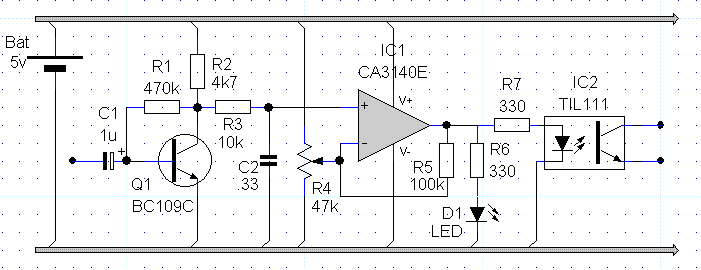
circuit trigger camera phone pda mp3
In night photography, long exposures are common, sometimes lasting several seconds to several minutes. HDR techniques often require taking a series of nine or more photos. Holding a remote trigger for an extended period can be tedious, leading to the...

Turntable Photography Equipment
The device captures 360-degree photos, which are essentially animations made from multiple images of a product taken from different angles. It requires a controllable device that can take pictures at even intervals. As depicted in the accompanying image, a device...

Synchronous Camera Flash Trigger Using IGBT
A synchronous camera flash, such as a slave flash, is typically triggered using a silicon-controlled rectifier (SCR). This document presents a circuit designed to trigger a secondary camera flash utilizing an insulated-gate bipolar transistor (IGBT). The use of an IGBT...

Flash slave driver
In photography, a separate flash, triggered by the light of a master flash, is often required to provide additional light and fill in shadows. The sensitivity of this circuit depends on the proximity of the master flash and the value...

Fill light indoor photography circuit
Engaged in indoor portrait photography, practitioners often find that using a single camera can result in images lacking depth and layering. To achieve better photographic outcomes, multiple auxiliary lighting sources are typically arranged around the subject. The following describes a...