


dimmers
#ESP
#dimmers
#electronic transformers
#lighting control
#LED
#lamp
#power regulation
#home automation
#electrical repair
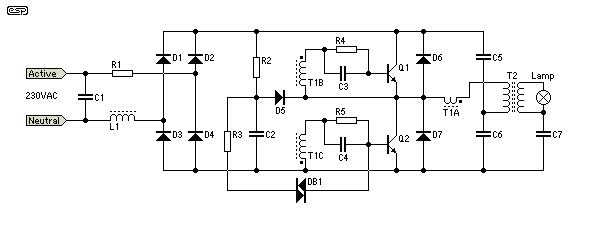
Description: ESP Lighting Information Page - Dimmers, electronic transformers, etc. - how they work, what is wrong with them, and how it can be fixed.
The ESP Lighting Information Page provides insights into various lighting components, specifically focusing on dimmers and electronic transformers. These devices are integral to modern lighting systems, allowing for adjustable brightness and efficient power conversion. Dimmers function by altering the voltage supplied to the light source, which can be achieved through phase-cutting techniques or pulse-width modulation (PWM). Electronic transformers, on the other hand, are used to convert standard mains voltage to a lower voltage suitable for low-voltage lighting applications, such as halogen or LED lamps.
Common issues encountered with these devices include flickering lights, inadequate dimming range, and compatibility problems with certain bulb types. Flickering can often be attributed to poor connections, incompatible dimmer types, or insufficient load on the dimmer. Inadequate dimming range may result from using a dimmer not rated for the load it is controlling, or from mismatched bulb types. Compatibility issues arise when LED bulbs are used with older dimmer technologies that are not designed to handle the lower wattage and electronic characteristics of modern bulbs.
To address these problems, several solutions can be implemented. Ensuring that the dimmer is compatible with the specific type of bulb being used is crucial. Upgrading to a modern, universal dimmer that supports a wide range of bulb types can resolve many compatibility issues. For flickering, checking and securing all connections can mitigate the problem, as can replacing older dimmers with newer models designed to work with LED technology. Additionally, using a load resistor or a compatible LED driver may help stabilize the performance of the lighting system.
Overall, understanding the operation of dimmers and electronic transformers, along with their common issues and solutions, is essential for effective lighting management in residential and commercial environments.ESP Lighting Information Page - Dimmers, electronic transformers, etc. - how they work, what`s wrong with them and how it can be fixed..
The ESP Lighting Information Page provides insights into various lighting components, specifically focusing on dimmers and electronic transformers. These devices are integral to modern lighting systems, allowing for adjustable brightness and efficient power conversion. Dimmers function by altering the voltage supplied to the light source, which can be achieved through phase-cutting techniques or pulse-width modulation (PWM). Electronic transformers, on the other hand, are used to convert standard mains voltage to a lower voltage suitable for low-voltage lighting applications, such as halogen or LED lamps.
Common issues encountered with these devices include flickering lights, inadequate dimming range, and compatibility problems with certain bulb types. Flickering can often be attributed to poor connections, incompatible dimmer types, or insufficient load on the dimmer. Inadequate dimming range may result from using a dimmer not rated for the load it is controlling, or from mismatched bulb types. Compatibility issues arise when LED bulbs are used with older dimmer technologies that are not designed to handle the lower wattage and electronic characteristics of modern bulbs.
To address these problems, several solutions can be implemented. Ensuring that the dimmer is compatible with the specific type of bulb being used is crucial. Upgrading to a modern, universal dimmer that supports a wide range of bulb types can resolve many compatibility issues. For flickering, checking and securing all connections can mitigate the problem, as can replacing older dimmers with newer models designed to work with LED technology. Additionally, using a load resistor or a compatible LED driver may help stabilize the performance of the lighting system.
Overall, understanding the operation of dimmers and electronic transformers, along with their common issues and solutions, is essential for effective lighting management in residential and commercial environments.ESP Lighting Information Page - Dimmers, electronic transformers, etc. - how they work, what`s wrong with them and how it can be fixed..

Simple LED Tester
Do not let its extreme simplicity deceive you — this device is useful! Many have been made over the years, and some have even been given away as gifts. Yes, multimeter...
A multimeter is an essential instrument in electronics, used for...
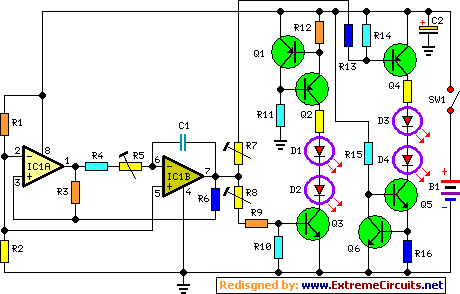
Fading Leds Circuit
This circuit operates two LED strips in pulsing mode, where one LED strip transitions from an off state to gradually lighting up, then dimming, while the other LED strip performs the opposite action. Each strip can consist of 2 to...

BarGraph Ccts
The LED meter is simpler and smaller than its analog counterpart and is commonly found in audio equipment. This version utilizes a National Semiconductor integrated circuit (IC) and employs a logarithmic scale. Each LED operates with a 3 dB difference...

UV/IR/Visible LED Flashlight with Intensity Control
Build a 10W LED flashlight that features swappable UV, IR, and visible light heads. This flashlight is designed to complement a photographer's toolkit for applications such as light painting, infrared illumination, UV-reflected photography, or UV fluorescence photography. The flashlight utilizes...

Traffic Light Project
This project operates red, amber, and green LEDs in the correct sequence for a single UK traffic light. The duration of the complete sequence—red, red & amber, green, amber—can be adjusted from approximately 7 seconds to about 2.5 minutes by...
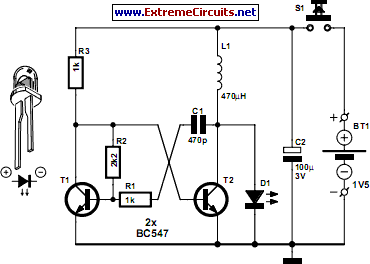
LED Phototherapy Unit
All devices emit intense red light with a wavelength of 660 nm. Some biophysicists suggest that light at this wavelength can positively affect the human body and initiate healing processes. This form of treatment, known as phototherapy, is claimed to...

Dancing LEDs
The basic circuit illuminates up to ten LEDs in sequence, synchronized with the rhythm of music or speech detected by a small microphone. The expanded version can drive up to ten strips, each consisting of up to five LEDs, powered...

220 V LED Night light
This is a capacitor power supply. This is a very small current of energy-effective because it has very little loss, much smaller than the miniature transformer. Capacitor impedance is inversely proportional to frequency. This is a great disadvantage when the...

LED fast optical pulse generating circuit diagram
The entire series of TTL monostable multivibrators lacks sufficient speed, prompting the need for an ECL voltage swing that accommodates a wide range of small power requirements. This necessitates the use of F series circuits, which offer fast transition times...