


Discrete High Current Switch Mode LED Driver
#LED driver
#switch mode
#high current
#buck-converter
#efficiency
#discrete circuit
#power electronics
#driver circuit
#lighting control
#energy efficient

Description: This is a discrete high-current switch-mode LED driver circuit. The fundamental principle of this circuit is based on the buck-converter topology. The efficiency of this circuit is 80%.
The discrete high-current switch-mode LED driver circuit utilizes a buck converter configuration to efficiently regulate the output current supplied to the LED load. The buck converter is designed to step down the input voltage while maintaining high efficiency, which is particularly important in LED applications where thermal management and power consumption are critical.
The circuit typically consists of a power switch (usually a MOSFET), an inductor, a diode, and output capacitors. The MOSFET operates as a switch, rapidly turning on and off to control the energy transferred to the inductor. When the MOSFET is turned on, current flows through the inductor, storing energy in its magnetic field. When the switch turns off, the inductor releases its stored energy to the load through the diode, ensuring a continuous current flow to the LEDs.
The output current can be regulated by adjusting the duty cycle of the PWM signal controlling the MOSFET. This is achieved using a feedback mechanism that monitors the output current and adjusts the duty cycle accordingly to maintain the desired current level. The efficiency of the circuit, reported at 80%, indicates that 80% of the input power is effectively converted into output power, with the remaining 20% lost as heat, primarily in the switching elements and passive components.
To enhance performance, proper selection of the inductor and capacitors is crucial. The inductor must have a suitable current rating and low DC resistance to minimize losses. Output capacitors should have low equivalent series resistance (ESR) to reduce ripple voltage and improve stability.
Thermal management is also essential, as high currents can generate significant heat within the components. Adequate heat sinking or thermal vias may be required to ensure reliable operation. Overall, this circuit design is well-suited for applications requiring efficient LED driving with high current capabilities.This is a discrete high current switch mode LED driver circuit. The basics of this circuit is a buck-converter principle. The efficiency of this circuit is 80..
The discrete high-current switch-mode LED driver circuit utilizes a buck converter configuration to efficiently regulate the output current supplied to the LED load. The buck converter is designed to step down the input voltage while maintaining high efficiency, which is particularly important in LED applications where thermal management and power consumption are critical.
The circuit typically consists of a power switch (usually a MOSFET), an inductor, a diode, and output capacitors. The MOSFET operates as a switch, rapidly turning on and off to control the energy transferred to the inductor. When the MOSFET is turned on, current flows through the inductor, storing energy in its magnetic field. When the switch turns off, the inductor releases its stored energy to the load through the diode, ensuring a continuous current flow to the LEDs.
The output current can be regulated by adjusting the duty cycle of the PWM signal controlling the MOSFET. This is achieved using a feedback mechanism that monitors the output current and adjusts the duty cycle accordingly to maintain the desired current level. The efficiency of the circuit, reported at 80%, indicates that 80% of the input power is effectively converted into output power, with the remaining 20% lost as heat, primarily in the switching elements and passive components.
To enhance performance, proper selection of the inductor and capacitors is crucial. The inductor must have a suitable current rating and low DC resistance to minimize losses. Output capacitors should have low equivalent series resistance (ESR) to reduce ripple voltage and improve stability.
Thermal management is also essential, as high currents can generate significant heat within the components. Adequate heat sinking or thermal vias may be required to ensure reliable operation. Overall, this circuit design is well-suited for applications requiring efficient LED driving with high current capabilities.This is a discrete high current switch mode LED driver circuit. The basics of this circuit is a buck-converter principle. The efficiency of this circuit is 80..

Lighting auto controller
The following governor is designed to regulate the light intensity of a 220 V incandescent lamp. The circuit consists of relatively few components, allowing for easy assembly on a small circuit board. It is recommended to enclose the completed assembly...

MAX8596Z drive circuit diagram of eight white LED
Driving a series of white LEDs allows for a consistent current to flow through each LED, resulting in uniform brightness. However, a disadvantage of this series configuration is that the driving voltage must account for the forward voltage drop of...

LED Driver: 6 Channels with Phase Shift Control
The ISL97676 can be utilized as an LED driver capable of managing six channels of LED current for TFT displays. This driver supports the operation of up to 78 LEDs with a voltage range of 4.5V to 26V, or up...

MAX7316 white LED driver circuit diagram
The main technical characteristics of the MAX7316 include a 400 kbps, 2-wire serial interface with a voltage tolerance of 5.5V. The operating voltage ranges from 2V to 3.6V. It features 8-bit PWM control for white LED brightness, with global brightness...

Universal High-Power LED Driver with 3D-printable Case
The core component of this controller is a switch mode voltage converter. L1 is responsible for converting voltage, while Q1 acts as the switch that controls the current flowing through L1.
The switch mode voltage converter operates by rapidly switching the...
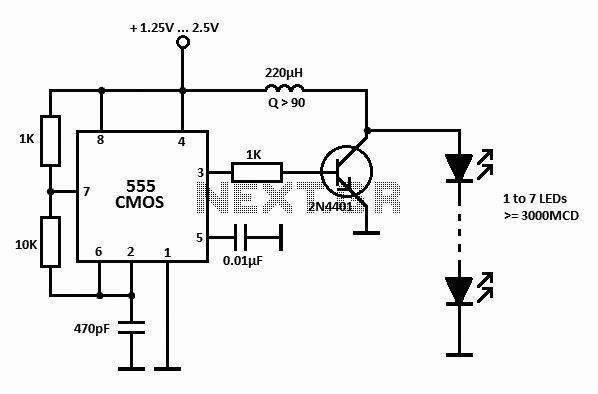
LED Driver with 555 Timer
This simple LED driver circuit enables the operation of up to seven LEDs using a single NiMH (Nickel Metal Hydride) AA cell. The circuit generates voltage pulses that exceed the input supply voltage by utilizing a 220 µH inductor.
The LED...

Luxeon Star LED driver with MAX1709 IC
Anyone who has ever dealt with construction of low-voltage-fed inverter realized that this is no easy task. The shrinking supply voltage decreases rapidly transferred power and efficiency. Samokmitající converters fail to provide sufficient power to drive control for the purpose...

converter lhc20 5ka 18v
The power converter is situated in the underground installation of the LHC, positioned close to the loads to minimize cable losses. It is a high-current switch mode power converter, specifically designed to power superconducting loads that require only positive current...
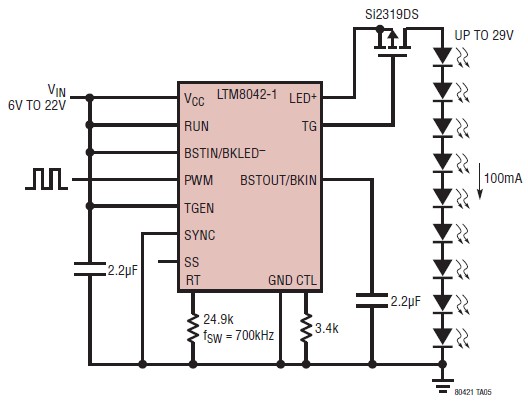
Led driver using LTM8042 ??Module Boost Driver
The LTM8042 integrates a boost power topology with a unique current loop to function as a constant-current source. The PWM input allows for LED dimming ratios of up to 3000:1, while analog dimming can be achieved with a single resistor...