


How to Apply Additional PWM Intensity Control to LED Drivers
#PWM
#LED driver
#intensity control
#light-emitting diode
#pulse-width modulation
#lighting control
#electronics
#circuit design
#dimmer

Description: Various techniques demonstrate how enhanced PWM (pulse-width modulation) intensity control can be utilized in LED (light-emitting diode) drivers.
PWM intensity control is a widely adopted method in LED driver circuits to regulate brightness levels. This technique involves modulating the width of the pulses in a periodic signal, which effectively adjusts the average power delivered to the LED. By varying the duty cycle of the PWM signal, the perceived brightness of the LED can be finely tuned without impacting the color quality or efficiency of the light output.
In an LED driver circuit employing PWM, the control signal is typically generated by a microcontroller or dedicated PWM controller. The output from this controller drives a switching device, such as a MOSFET or a transistor, which regulates the current flowing through the LED. The switching device rapidly turns on and off, creating a series of pulses that correspond to the desired brightness level.
Several techniques can enhance PWM control in LED drivers. One approach is the use of frequency modulation, where the frequency of the PWM signal is adjusted based on the ambient light conditions or user preferences. This can help reduce flicker and improve visual comfort. Another technique involves the implementation of adaptive PWM, which adjusts the duty cycle dynamically in response to changes in input voltage or temperature, ensuring stable operation and prolonging LED lifespan.
Furthermore, advanced control algorithms can be integrated into the LED driver circuit to optimize performance. For instance, closed-loop control systems can be employed to maintain consistent brightness levels by continuously monitoring the output and adjusting the PWM signal accordingly. This method enhances the reliability and efficiency of the LED driver, particularly in applications requiring precise lighting control.
In summary, the application of PWM intensity control in LED drivers is a critical aspect of modern lighting systems. By utilizing various techniques to optimize PWM performance, designers can achieve greater flexibility, efficiency, and user satisfaction in LED lighting solutions.Different techniques show how additional PWM (pulse-width modulation) intensity control can be applied to LED (light-emitting diode) drivers..
PWM intensity control is a widely adopted method in LED driver circuits to regulate brightness levels. This technique involves modulating the width of the pulses in a periodic signal, which effectively adjusts the average power delivered to the LED. By varying the duty cycle of the PWM signal, the perceived brightness of the LED can be finely tuned without impacting the color quality or efficiency of the light output.
In an LED driver circuit employing PWM, the control signal is typically generated by a microcontroller or dedicated PWM controller. The output from this controller drives a switching device, such as a MOSFET or a transistor, which regulates the current flowing through the LED. The switching device rapidly turns on and off, creating a series of pulses that correspond to the desired brightness level.
Several techniques can enhance PWM control in LED drivers. One approach is the use of frequency modulation, where the frequency of the PWM signal is adjusted based on the ambient light conditions or user preferences. This can help reduce flicker and improve visual comfort. Another technique involves the implementation of adaptive PWM, which adjusts the duty cycle dynamically in response to changes in input voltage or temperature, ensuring stable operation and prolonging LED lifespan.
Furthermore, advanced control algorithms can be integrated into the LED driver circuit to optimize performance. For instance, closed-loop control systems can be employed to maintain consistent brightness levels by continuously monitoring the output and adjusting the PWM signal accordingly. This method enhances the reliability and efficiency of the LED driver, particularly in applications requiring precise lighting control.
In summary, the application of PWM intensity control in LED drivers is a critical aspect of modern lighting systems. By utilizing various techniques to optimize PWM performance, designers can achieve greater flexibility, efficiency, and user satisfaction in LED lighting solutions.Different techniques show how additional PWM (pulse-width modulation) intensity control can be applied to LED (light-emitting diode) drivers..

Wide Input-Voltage Range High-Power LED Driver
This is a high-power LED driver circuit designed to accommodate a wide input-voltage range. The circuit utilizes a buck/boost converter controller to regulate the current supplied to a white LED.
The high-power LED driver circuit is engineered to effectively manage varying...
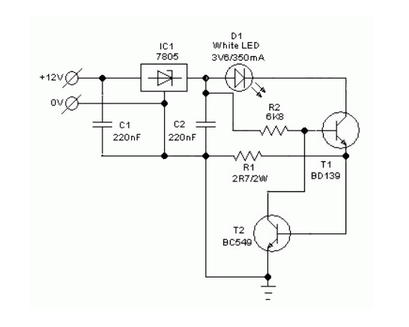
Automobile White LED Light
A simple and safe white LED driver circuit has been designed for use in 12V automobiles, allowing for the efficient operation of standard high-efficiency white LED modules powered by automotive battery systems. The circuit utilizes a fixed voltage regulator IC...

LM3445 Datasheet - Triac Dimmable Offline LED Driver
The LM3445 is an adaptive constant off-time AC/DC buck (step-down) constant current controller designed for compatibility with triac dimmers.
The LM3445 is a specialized integrated circuit that functions as a constant current controller in AC/DC applications, particularly suited for LED lighting...

PWM sound Tutorial
This document demonstrates the use of an Arduino PWM output pin to generate sound. The output pin can be toggled rapidly between LOW and HIGH states to create a square wave. If the frequency of this square wave is within...

Dimmer Switch
Dimmer Switch - Dimmer Switch Working, Installation, Circuits and Explanation.
A dimmer switch is a device that allows for the adjustment of the brightness of a light fixture. It operates by varying the voltage and current supplied to the light source,...
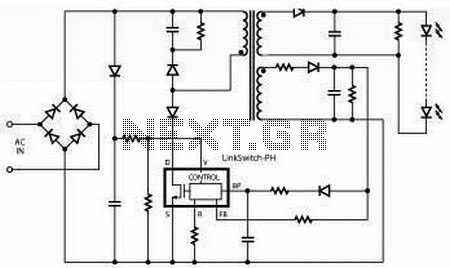
LinkSwitch-PH LED-Driver IC Family
Power Integrations announced a new reference design (DER-278) based on the company's single-stage LinkSwitch-PH LED-driver IC family. The new design..
Power Integrations has introduced reference design DER-278, which utilizes the LinkSwitch-PH family of LED driver integrated circuits (ICs). This design is...

Keep The Ramp right
If the ramp driving your PWM-based controller is not linear, monotonic, or is simply noisy, your DC/DC converter will not perform optimally. It is essential to understand how to achieve the best performance from your system. A typical DC/DC power...

Bluetoothß„? Front-end Ic T7024 Design Guide
The HV9911DB2 is an LED driver designed to drive up to twenty 100mA LEDs in series from an input voltage range of 9 to 16V DC. This demonstration board utilizes Supertex's HV9911 integrated circuit (IC) in a boost converter topology....

Keyer dimmer table lamp circuit
The keyer dimmer table lamp utilizes two touch buttons to adjust the light intensity. When one button is touched, the light dims from a strong brightness, while the other button increases the brightness from a dim state. The working principle...