


Knight Rider lights for model cars
#LEDs
#Knight Rider
#scanner mode
#7555 timer
#CMOS
#model cars
#light effects
#low power
#DIY electronics
#hobby projects

Description: This simple circuit drives six LEDs in a Knight Rider scanner mode. Power consumption primarily depends on the type of LEDs used, especially when utilizing a 7555 (555 CMOS version).
The Knight Rider scanner circuit is designed to create a visually appealing light sequence that mimics the iconic scanning effect seen in the television series "Knight Rider." This effect is achieved by sequentially illuminating a series of six LEDs, which can be arranged in a line or any desired configuration. The circuit utilizes a 7555 timer IC, which is a CMOS version of the classic 555 timer, known for its low power consumption and versatility in timing applications.
The operation of the circuit is based on the astable mode of the 7555 timer, generating a square wave output that controls the LEDs. The frequency of the blinking can be adjusted by selecting appropriate resistor and capacitor values connected to the timer. This configuration allows the user to customize the speed of the LED scanning effect.
The output from the 7555 timer is connected to a series of driver transistors, which amplify the current to drive the LEDs. Each LED is connected through a current-limiting resistor to ensure that it operates within its specified current ratings, preventing damage and ensuring longevity. The circuit can be powered by a standard DC power supply, with the voltage level determined by the specifications of the LEDs and the 7555 timer.
In summary, this Knight Rider scanner circuit not only provides an engaging visual display but also showcases the functionality of the 7555 timer in driving multiple outputs with efficient power management. Proper selection of components will enhance both the performance and reliability of the circuit.This simple circuit drives 6 LEDs in `Knight Rider scanner mode`. Power consumption depends mainly on the type of LEDs used if you use a 7555 (555 CMOS version).
The Knight Rider scanner circuit is designed to create a visually appealing light sequence that mimics the iconic scanning effect seen in the television series "Knight Rider." This effect is achieved by sequentially illuminating a series of six LEDs, which can be arranged in a line or any desired configuration. The circuit utilizes a 7555 timer IC, which is a CMOS version of the classic 555 timer, known for its low power consumption and versatility in timing applications.
The operation of the circuit is based on the astable mode of the 7555 timer, generating a square wave output that controls the LEDs. The frequency of the blinking can be adjusted by selecting appropriate resistor and capacitor values connected to the timer. This configuration allows the user to customize the speed of the LED scanning effect.
The output from the 7555 timer is connected to a series of driver transistors, which amplify the current to drive the LEDs. Each LED is connected through a current-limiting resistor to ensure that it operates within its specified current ratings, preventing damage and ensuring longevity. The circuit can be powered by a standard DC power supply, with the voltage level determined by the specifications of the LEDs and the 7555 timer.
In summary, this Knight Rider scanner circuit not only provides an engaging visual display but also showcases the functionality of the 7555 timer in driving multiple outputs with efficient power management. Proper selection of components will enhance both the performance and reliability of the circuit.This simple circuit drives 6 LEDs in `Knight Rider scanner mode`. Power consumption depends mainly on the type of LEDs used if you use a 7555 (555 CMOS version).

Dummy Alarm Project
This Dummy Alarm project causes an LED to flash briefly every 5 seconds, simulating the indicator light of a real alarm. The circuit is designed to consume minimal current to extend battery life, allowing it to remain powered continuously. An...

Cmos-short-pulse-generator
The pulse generator consists of two low-power CMOS chips that produce a precise pulse width ranging from 50 to 500 ns. IC1 is a dual monostable multivibrator (one shot) where each positive trigger pulse initiates simultaneous positive output pulses at...
Cmos-oscillator
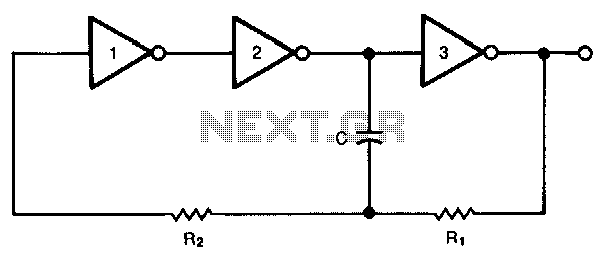
This circuit is guaranteed to oscillate at a frequency of approximately 2.2/(R1 x C) if R2 is greater than R1. Additionally, the number of gates can be reduced further by replacing gates 1 and 2 with a non-inverting gate.
The described...
Thrifty 2Hz Clock
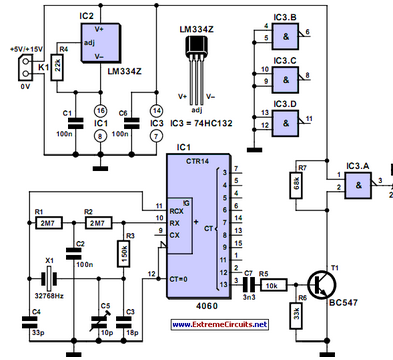
CMOS circuits are recognized for their low current consumption, which is especially significant for battery-powered applications. However, oscillators frequently face challenges related to...
CMOS (Complementary Metal-Oxide-Semiconductor) technology is widely utilized in the design of integrated circuits due to its advantageous characteristics,...
CD4047 CMOS OSCILLATOR
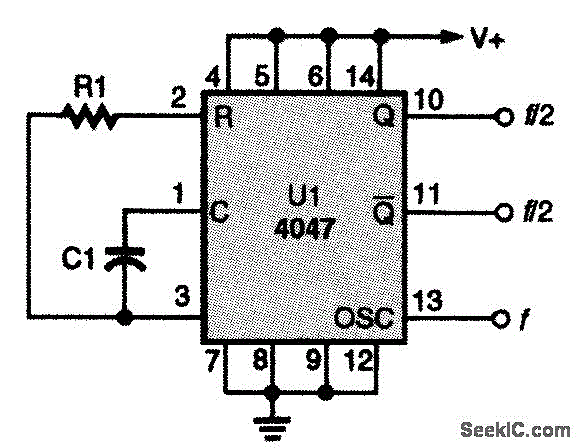
This CMOS square-wave oscillator utilizes the 4047 multivibrator circuit, suitable for both monostable (one-shot) and astable applications. In the provided configuration, the 4047 operates as an astable multivibrator. The circuit features three outputs from the 4047, with the first being...

Wilf Rigter`s SIMD1 V1
Normally the active high output from the inverter is used to enable the remainder of the CMOS gates which then perform some useful function. When the SIMD1 triggers at night, it snaps on and the output signal can be used...

CMOS Toggle Flip Flop Using Laser Pointer circuit
The IR photo transistor Q1 (Radio Shack 276-145A) or a similar component is connected to the set input (pin 6). It is essential to shield the photo transistor from direct light to ensure that the voltage at the set input...

Toggle Switch No.1 - Cmos 4013
This circuit energizes and de-energizes a relay with the push of a button. Any momentary push-to-make switch can be utilized. Pressing the button once energizes the relay, while pressing it a second time de-energizes the relay. The circuit is illustrated...

1.5V liquid crystal display circuit
The Motorola company's MC14440 CMOS integrated circuit is designed for timing and displaying calendar functions. It utilizes a 32.768 kHz NT cutting type quartz crystal along with fine-tune capacitance to generate time-based signals. The display circuit operates on a 1.5...