


Stepping CS6061A touch dimmer light circuit
#touch dimmer
#CS6061A
#step dimming
#light control
#integrated circuit
#switching
#dimmable lights
#home automation
#energy saving
#LED control

Description: The CS6061A integrated circuit is designed for touch-step dimming lights. It features a two-state female switching function and is reliable, capable of adapting to long cables and larger touch-sensitive pad loads (400pF). The collector circuit of the CS6061A utilizes a CMOS process, ensuring low power consumption and ease of use. It is primarily packaged in a standard DIP-8 configuration. The pin functions are as follows: OC (oscillation control), K (trimming resistor for correction of intermediate states), FL (luminance), VDJ (zero-crossing synchronization signal input), TI (touch signal input), CI (external vibration resistance terminal), CG (switch state control), and AT (trigger pulse output for direct thyristor driving). The CS6061A operates at a voltage of 5V.
The CS6061A integrated circuit provides a sophisticated solution for touch-sensitive lighting applications, enabling users to control light intensity through a simple touch interface. The two-state switching function allows for basic on/off control or dimming capabilities, making it versatile for various lighting environments. The capability to accommodate long cable runs and larger capacitive loads (up to 400pF) enhances its applicability in larger installations or where touch-sensitive pads are required to cover more extensive areas.
The CMOS technology employed in the CS6061A is notable for its low power consumption, which is critical in battery-operated devices or energy-efficient systems. The DIP-8 package format facilitates easy integration into existing circuits, allowing for straightforward prototyping and deployment in consumer electronics.
Each pin of the CS6061A plays a distinct role in its operation. The OC pin is utilized for oscillation control, allowing for fine-tuning of the circuit's performance. The K pin serves as a trimming resistor, which can be adjusted to correct the intermediate states of brightness. The FL pin provides luminance feedback, ensuring that the light output remains consistent with user input.
The VDJ pin is essential for synchronizing the circuit with the AC mains, utilizing a zero-crossing detection method to minimize electrical noise and flicker. The TI pin receives touch signals, enabling the user to control lighting with a simple touch. The CI pin allows for external resistance to be added, which can modify the sensitivity of the touch interface; increasing resistance enhances sensitivity, while decreasing it reduces sensitivity.
The CG pin controls the switch state, providing flexibility in operation modes. The AT pin outputs a trigger pulse, which can be used to drive external components such as thyristors, enabling the control of larger loads. This feature is particularly beneficial in applications requiring higher power management.
Overall, the CS6061A integrated circuit stands out as a reliable and efficient solution for modern touch-sensitive lighting control, suitable for both residential and commercial applications. Its combination of functionality, low power consumption, and ease of integration makes it a valuable component in contemporary electronic designs. CS6061A integrated circuit fabrication is the use of touch-step dimming lights, it has two state of the female state switching function, and J as reliable, able to adapt to lon g cable and a larger touch-sensitive pad load (400pF). CS6061A collector circuit using CMOS process with low power consumption, so easy to use and other characteristics, mainly for the package standard DIP-8 package. (, S6061A the pin function as follows pins. OC, K, the oscillation control system ends, trimming R; can be corrected intermediate state. Luminance pin Fl, zero-crossing synchronization signal input terminal pin VDJ, is. positive power input port. pin TI, a touch signal input. pin CI, the external vibration resistance, electrical terminal hole in a wall, increasing R (, value can increase the touch sensitivity, and vice versa reduced.
pin CG, the switch state control terminal, when a CG], two state; when C ( O, four-state pin V s, the negative terminal of the power supply pins AT, trigger pulse output terminal that can directly drive thyristor. CS6061A L as a voltage 5-c.sv.
The CS6061A integrated circuit provides a sophisticated solution for touch-sensitive lighting applications, enabling users to control light intensity through a simple touch interface. The two-state switching function allows for basic on/off control or dimming capabilities, making it versatile for various lighting environments. The capability to accommodate long cable runs and larger capacitive loads (up to 400pF) enhances its applicability in larger installations or where touch-sensitive pads are required to cover more extensive areas.
The CMOS technology employed in the CS6061A is notable for its low power consumption, which is critical in battery-operated devices or energy-efficient systems. The DIP-8 package format facilitates easy integration into existing circuits, allowing for straightforward prototyping and deployment in consumer electronics.
Each pin of the CS6061A plays a distinct role in its operation. The OC pin is utilized for oscillation control, allowing for fine-tuning of the circuit's performance. The K pin serves as a trimming resistor, which can be adjusted to correct the intermediate states of brightness. The FL pin provides luminance feedback, ensuring that the light output remains consistent with user input.
The VDJ pin is essential for synchronizing the circuit with the AC mains, utilizing a zero-crossing detection method to minimize electrical noise and flicker. The TI pin receives touch signals, enabling the user to control lighting with a simple touch. The CI pin allows for external resistance to be added, which can modify the sensitivity of the touch interface; increasing resistance enhances sensitivity, while decreasing it reduces sensitivity.
The CG pin controls the switch state, providing flexibility in operation modes. The AT pin outputs a trigger pulse, which can be used to drive external components such as thyristors, enabling the control of larger loads. This feature is particularly beneficial in applications requiring higher power management.
Overall, the CS6061A integrated circuit stands out as a reliable and efficient solution for modern touch-sensitive lighting control, suitable for both residential and commercial applications. Its combination of functionality, low power consumption, and ease of integration makes it a valuable component in contemporary electronic designs. CS6061A integrated circuit fabrication is the use of touch-step dimming lights, it has two state of the female state switching function, and J as reliable, able to adapt to lon g cable and a larger touch-sensitive pad load (400pF). CS6061A collector circuit using CMOS process with low power consumption, so easy to use and other characteristics, mainly for the package standard DIP-8 package. (, S6061A the pin function as follows pins. OC, K, the oscillation control system ends, trimming R; can be corrected intermediate state. Luminance pin Fl, zero-crossing synchronization signal input terminal pin VDJ, is. positive power input port. pin TI, a touch signal input. pin CI, the external vibration resistance, electrical terminal hole in a wall, increasing R (, value can increase the touch sensitivity, and vice versa reduced.
pin CG, the switch state control terminal, when a CG], two state; when C ( O, four-state pin V s, the negative terminal of the power supply pins AT, trigger pulse output terminal that can directly drive thyristor. CS6061A L as a voltage 5-c.sv.

PC SMPS PWM chip CG8010DX16
This document contains the datasheet and the circuit diagram of a PC Switching Power Supply utilizing the IC CG8010DX16.
The CG8010DX16 is a highly integrated switching power supply controller designed for use in personal computer power supplies. It features a range...

TT6061A and TT8486A sensitive touch light dimmer circuit with explanation
A simple dimmer circuit can be constructed using the CMOS ICs TT8486A and TT6061A, allowing control over the intensity of an incandescent lamp through a touch contact. This electronic touch dimmer can increase the brightness of incandescent lamps in three...

Automatic Mains Disconnect
Downloading and CD-burning programs often offer the option to automatically shut down the PC upon completion of their tasks. However, this energy-saving feature is ineffective if all peripheral equipment remains connected to the mains and continues to consume power even...

3-Way Light Control
This hookup is useful in certain house wiring situations where only two wires are available between switches, rather than the usual three-way setup that requires three wires. SI and S2 are standard three-way switches, while S3, a double-pole double-throw (DPDT)...

Switching Circuit
This switching circuit functions as a bank of interlocked mechanical switches. Activating one of the buttons latches its corresponding output while unlatching a previously selected output. A pair of inverters creates a latch for each output. For instance, pressing button...

Radio Buttons Using Push On Switch Latching Circuit
This is a switching circuit that provides a latching mechanism to create a set of radio buttons using push buttons. This circuit consists of an interlocking circuit.
The switching circuit operates on the principle of latching, allowing multiple push buttons to...
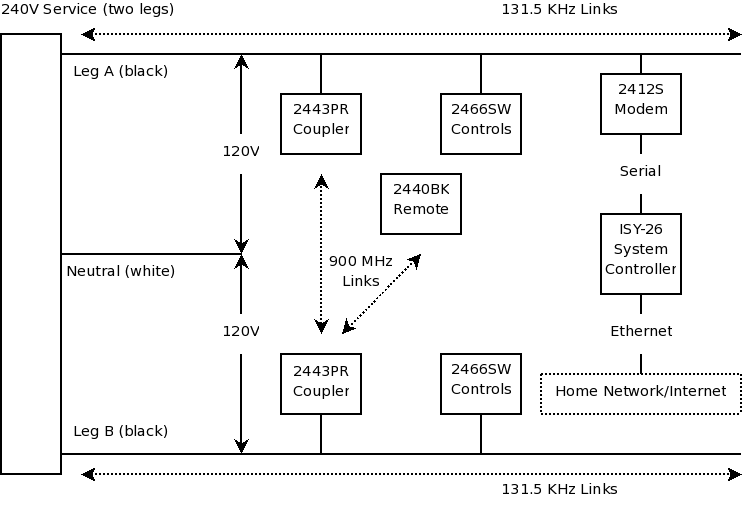
home automation Installation
First and foremost, if one is not skilled with tools and electrical systems, it is advisable to hire a qualified electrician rather than attempting to undertake this task independently. The electrician should review this page for specific cautions and advice....

Put That Light Out
If the light in a seldom-used room, such as a loft, is forgotten and left on, it can remain illuminated for extended periods, leading to significant electricity costs. To address this issue, electronics enthusiasts can design a simple circuit to...

automatic room light controller with
The objective of this project is to create a controller-based model that counts the number of individuals entering a specific room and activates the lighting accordingly. A sensor will be utilized to determine the current number of persons present. In...