


Timebase circuit sensing automatic light
#automatic light
#sensor
#NE55
#12V DC
#power supply
#light control
#circuit
#energy saving
#illumination

Description: The circuit utilizes a NE553 automatic light sensor composed of 55 groups, allowing lights to turn on when individuals are present and turn off when they leave. The power supply includes VD1, vS, and C, with a 12V DC input. The voltage is regulated by RP1 for the entire circuit and the VTP light control circuit. During the day, the phototransistor VTP is activated, and the output at pin 5 of the NE553 is less than 0.4V, which forces the reset circuit to output low, keeping the thyristor VTH off and the light E unlit. At night, the resistance of VTP increases, effectively turning it off, which elevates the output level and activates the base circuit. This turns on the lights, allowing the state regulator RP to control light sensitivity. The NE553 functions as a monostable device, remaining in a stable state with a low output at pin 5, keeping the lamp off. When a person approaches the sensing electrode, the time-based circuit generates a signal from the body to the sensor chip, producing an AC signal frequency. This signal is rectified by VI)2, triggering the NE555 flip-flop, which raises the output at VTH, energizing lamp E to emit light. After approximately 10 seconds, when the individual leaves, the time-based circuit stabilizes, and lamp E turns off. If a person remains within the sensor's effective detection range, lamp F remains steadily illuminated. To ensure adequate sensitivity, the sensor chip area should not be less than 10cm by 20cm, with thin copper sides and a slightly larger thin plexiglass plate (secured with 502 glue). The entire circuit should be installed behind the sensor chip, ensuring that the VTP is slightly extended to detect natural light while avoiding direct exposure, which may disrupt functionality. The effective sensing distance of this circuit is approximately 1-3 meters.
This automatic light sensor circuit is designed to enhance energy efficiency and user convenience by utilizing a combination of phototransistors and monostable multivibrator configurations. The NE553, a precision operational amplifier, is utilized for its low power consumption and excellent performance in light detection applications. The circuit operates by monitoring ambient light levels through the VTP phototransistor, which changes its resistance based on light exposure.
During daylight, the circuit remains inactive, keeping the thyristor in an off state to conserve energy. At dusk, the increased resistance of the VTP triggers the monostable multivibrator, which generates a pulse that activates the thyristor, allowing current to flow to the lamp. The integration of a timing circuit ensures that the lamp remains illuminated for a predetermined duration after the individual leaves the detection area, providing sufficient time for movement without frequent interruptions.
The design emphasizes the importance of sensor placement and orientation to maximize sensitivity and minimize false triggers. The use of a plexiglass cover not only protects the sensor but also allows for optimal light detection while preventing direct sunlight from affecting the sensor's performance. The circuit's effective range of 1-3 meters allows for versatile applications in residential or commercial settings, ensuring that lighting is automatically controlled based on occupancy, thus promoting energy savings and convenience.Using only a NE: automatic light sensor circuit composed of 55 groups, so that people can rice lights, people take the lights off. } N supply route VD1, vS, C. , (1 and R. composition, power and (1, both ends of the Sichuan Hl 12V input DC voltage of about .RP1 electricity for the whole composition and VTP light control circuit, daytime phototransistor VTP turned, NE5 55 feet of level is less than 0 4V, forced reset circuit, pin output low, the thyristor VTH off, light E does not shine. when night comes, VTP equivalent resistance becomes large, even completely turned off, feet elevated level , unblock base circuit when Sh , turn on the lights so as to create conditions for the state regulator RP festival circuit can control the light sensitivity.
NE553 composition monoflop device, usually in a stable state, pin is low, VTH off lamp does not light if the body close to the sensing electrode films, time-based circuit foot through the distribution of power between the body and the sensor chip to obtain T AC signal frequency content through VI) 2 rectifies the negative half cycle of the signal which can trigger flip NE555 set, feet high output .VTH opened, the lamp E energized to emit light. people left after about by JOs about that after the transient, time base circuit turn with steady, lamp E goes out.
If people feel should sheet to continue its activities within the effective detection range of ah, lamp F is a steady water quenching. in order to ensure an adequate trigger circuit sensitivity, the sensor chip area should not be less than iOcm 20crn see thin copper side.
mosaic and two village Section surface slightly larger than the thin plexiglass plate (with 502 glue). However, before it is embedded wall. the entire circuit just installed in the sensor chip back, pay attention to the opening in the sensor chip should make a little stretch VTP out to feel the irradiation of natural light, but X itself to avoid direct light, otherwise the electrical path not often stop working.
this circuit is effective sensing distance of about l-3m.
This automatic light sensor circuit is designed to enhance energy efficiency and user convenience by utilizing a combination of phototransistors and monostable multivibrator configurations. The NE553, a precision operational amplifier, is utilized for its low power consumption and excellent performance in light detection applications. The circuit operates by monitoring ambient light levels through the VTP phototransistor, which changes its resistance based on light exposure.
During daylight, the circuit remains inactive, keeping the thyristor in an off state to conserve energy. At dusk, the increased resistance of the VTP triggers the monostable multivibrator, which generates a pulse that activates the thyristor, allowing current to flow to the lamp. The integration of a timing circuit ensures that the lamp remains illuminated for a predetermined duration after the individual leaves the detection area, providing sufficient time for movement without frequent interruptions.
The design emphasizes the importance of sensor placement and orientation to maximize sensitivity and minimize false triggers. The use of a plexiglass cover not only protects the sensor but also allows for optimal light detection while preventing direct sunlight from affecting the sensor's performance. The circuit's effective range of 1-3 meters allows for versatile applications in residential or commercial settings, ensuring that lighting is automatically controlled based on occupancy, thus promoting energy savings and convenience.Using only a NE: automatic light sensor circuit composed of 55 groups, so that people can rice lights, people take the lights off. } N supply route VD1, vS, C. , (1 and R. composition, power and (1, both ends of the Sichuan Hl 12V input DC voltage of about .RP1 electricity for the whole composition and VTP light control circuit, daytime phototransistor VTP turned, NE5 55 feet of level is less than 0 4V, forced reset circuit, pin output low, the thyristor VTH off, light E does not shine. when night comes, VTP equivalent resistance becomes large, even completely turned off, feet elevated level , unblock base circuit when Sh , turn on the lights so as to create conditions for the state regulator RP festival circuit can control the light sensitivity.
NE553 composition monoflop device, usually in a stable state, pin is low, VTH off lamp does not light if the body close to the sensing electrode films, time-based circuit foot through the distribution of power between the body and the sensor chip to obtain T AC signal frequency content through VI) 2 rectifies the negative half cycle of the signal which can trigger flip NE555 set, feet high output .VTH opened, the lamp E energized to emit light. people left after about by JOs about that after the transient, time base circuit turn with steady, lamp E goes out.
If people feel should sheet to continue its activities within the effective detection range of ah, lamp F is a steady water quenching. in order to ensure an adequate trigger circuit sensitivity, the sensor chip area should not be less than iOcm 20crn see thin copper side.
mosaic and two village Section surface slightly larger than the thin plexiglass plate (with 502 glue). However, before it is embedded wall. the entire circuit just installed in the sensor chip back, pay attention to the opening in the sensor chip should make a little stretch VTP out to feel the irradiation of natural light, but X itself to avoid direct light, otherwise the electrical path not often stop working.
this circuit is effective sensing distance of about l-3m.

power How can I switch a high current with a low-rated switch
The project involves designing and constructing a breadboard power supply that draws power from an ATX-like switch-mode power supply (SMPS) using a 4-pin Molex connector. The design features a switch to select either a 12V or 5V output. However, the...

Power Supply Wiring Diagram For Nissan 300ZX
This circuit illustrates the power supply wiring diagram for the Nissan 300ZX, a sports car known as the Fairlady Z. Components include the lighting switch, ECCS, and fuse.
The power supply wiring diagram for the Nissan 300ZX is essential for understanding...

The electronic energy saving lamp maintenance circuit diagram
The saving lamp circuit features two main types: glass cover and exposed. The glass cover variants include three series: spherical, cylindrical, and processing types. The first two series consist of four variations: transparent, carved, engraved, and white. These lamps are...
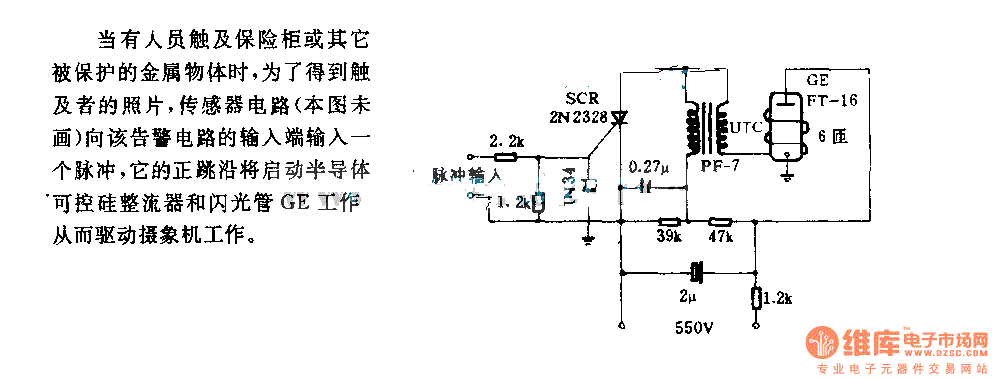
The alarm circuit diagram for safety box and other metal objects
When an individual touches the safety box or other protected metal objects, the sensor circuit generates a pulse to the alarm circuit. The positive edge of this pulse activates the semiconductor and thyristor flash GE, subsequently triggering the camera to...

car battery charger circuit
The circuit is designed to be powered directly by a power supply, which is why it does not include a transformer, rectifier, or filter capacitors in the schematic. However, these components can be added if desired. To operate the circuit,...

2 watt switching power supply
This compact switching power supply utilizes a Schmitt trigger oscillator to control a switching transistor, which provides current to a small inductor. When the transistor is activated, energy accumulates in the inductor, and this energy is subsequently released into the...

Flyback Power Supply Powers Subscriber Line Interface Circuit
Cable and xDSL modems are increasingly popular, leading to a need for designs that interface with existing telephones at subscriber locations. The subscriber line interface circuit (SLIC) within the modem must ring the phone and provide loop current during conversations....

Batteries charger & PSU - ideal for digital camerass
This circuit was designed for digital cameras, which are known to have significant power consumption. For instance, the Minolta E223 camera requires approximately 800 mA. In practice, this demand can be met using a mains power supply or high-capacity NiMH...

eliminate wasted phantom power
Most Apple and Windows PCs can enter "sleep" or "standby" mode when not in use instead of being completely shut down. This mode allows the operating system to restore all previous work sessions within seconds upon waking via keyboard or...