


8-direction Digital Compass Using Z8 Encore
#digital compass
#Z8 Encore
#DTMF
#transmitter
#receiver
#microprocessor
#call progress
#tone burst
#switched-capacitor
#DAC

Description: The M-8880 is a complete DTMF Transmitter/Receiver that features adjustable guard time, automatic tone burst mode, call progress mode, and a fully compatible 6500/6800 microprocessor interface. The receiver portion is based on the industry-standard M-8870 DTMF Receiver, while the transmitter utilizes a switched-capacitor digital-to-analog converter for low-distortion, highly accurate DTMF signaling. Tone bursts can be transmitted with precise timing by utilizing the automatic tone burst mode. To analyze call progress tones, a call progress filter can be selected by an external microprocessor from Clare, Inc.
The M-8880 device serves as a versatile solution for DTMF (Dual-Tone Multi-Frequency) signaling applications. It integrates both transmission and reception functionalities, making it suitable for various telecommunication systems. The adjustable guard time feature allows users to define the duration during which the system waits for a valid tone signal before processing, thus enhancing the reliability of tone detection.
The automatic tone burst mode is particularly beneficial for applications requiring the transmission of short bursts of DTMF tones with high precision. This mode ensures that the timing of the tone bursts is consistent, which is critical for effective communication in automated systems. The use of a switched-capacitor digital-to-analog converter in the transmitter section contributes to the low distortion and high accuracy of the transmitted DTMF signals, ensuring clear and reliable tone generation.
In addition to its transmission capabilities, the M-8880's receiver section leverages the well-established M-8870 DTMF receiver architecture, which is recognized for its robustness and efficiency in decoding DTMF signals. The device also includes a call progress mode, allowing it to detect and analyze various call progress tones, which can be essential for monitoring call status in telephony applications.
The integration of an external microprocessor interface compatible with the 6500/6800 series allows for enhanced functionality and flexibility. By selecting a call progress filter through the microprocessor, users can tailor the system's response to specific tone frequencies, thus optimizing performance for different operational requirements.
Overall, the M-8880 provides a comprehensive solution for DTMF signaling, combining advanced features and compatibility with existing microprocessor systems, making it a valuable component in modern telecommunications engineering.TheM-8880 is a completeDTMF Transmitter/Receiver that fea- tures adjustable guard time, Automatic Tone burst mode, call progressmode, and a fully compatible 6500/6800microproces- sor Interface The receiver portion is based on the industry stan- dard M-8870 DTMF Receiver, while the transmitter uses a switched-capacitor digital-to-analog converter f or low-distortion, highly accurateDTMF signaling. Tone bursts CAN be transmitted with precise Timing by making use of the auto- matic Tone burst mode. To analyze call progress Tones a call progress Filter CAN be selected by an external Microprocessor By Clare, Inc.
The M-8880 device serves as a versatile solution for DTMF (Dual-Tone Multi-Frequency) signaling applications. It integrates both transmission and reception functionalities, making it suitable for various telecommunication systems. The adjustable guard time feature allows users to define the duration during which the system waits for a valid tone signal before processing, thus enhancing the reliability of tone detection.
The automatic tone burst mode is particularly beneficial for applications requiring the transmission of short bursts of DTMF tones with high precision. This mode ensures that the timing of the tone bursts is consistent, which is critical for effective communication in automated systems. The use of a switched-capacitor digital-to-analog converter in the transmitter section contributes to the low distortion and high accuracy of the transmitted DTMF signals, ensuring clear and reliable tone generation.
In addition to its transmission capabilities, the M-8880's receiver section leverages the well-established M-8870 DTMF receiver architecture, which is recognized for its robustness and efficiency in decoding DTMF signals. The device also includes a call progress mode, allowing it to detect and analyze various call progress tones, which can be essential for monitoring call status in telephony applications.
The integration of an external microprocessor interface compatible with the 6500/6800 series allows for enhanced functionality and flexibility. By selecting a call progress filter through the microprocessor, users can tailor the system's response to specific tone frequencies, thus optimizing performance for different operational requirements.
Overall, the M-8880 provides a comprehensive solution for DTMF signaling, combining advanced features and compatibility with existing microprocessor systems, making it a valuable component in modern telecommunications engineering.TheM-8880 is a completeDTMF Transmitter/Receiver that fea- tures adjustable guard time, Automatic Tone burst mode, call progressmode, and a fully compatible 6500/6800microproces- sor Interface The receiver portion is based on the industry stan- dard M-8870 DTMF Receiver, while the transmitter uses a switched-capacitor digital-to-analog converter f or low-distortion, highly accurateDTMF signaling. Tone bursts CAN be transmitted with precise Timing by making use of the auto- matic Tone burst mode. To analyze call progress Tones a call progress Filter CAN be selected by an external Microprocessor By Clare, Inc.
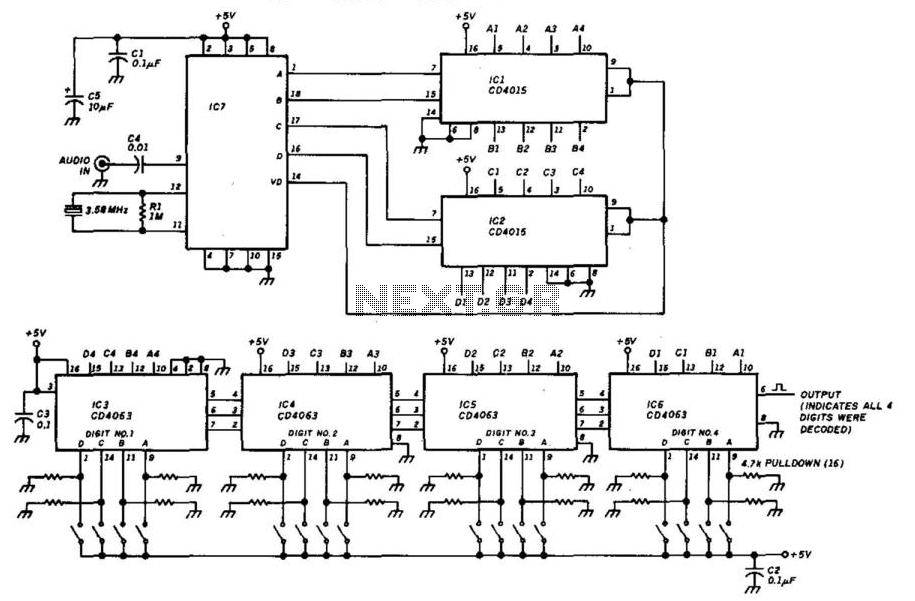
Low-Power Touch-Tone Decoder
This decoder will respond to a preselected 4-digit DTMF number. IC7 is a Radio Shack IC device (part #276-1303). The logic is all CMOS. The digits are selected by SW1 and SW2, a pair of 8-position DIP switches.
The described circuit...

telephone dtmf remote control
The circuit is a remotely operated DTMF telephone system capable of controlling up to nine devices using the keys 0 to 9 on a phone. The digit 0 is utilized to switch between the phone system remotely and alter the...

10x TDA1543 NOS DAC
In the supply section, a bridge rectifier and smoothing capacitor are utilized, followed by a common voltage regulator, the LM317, which is configured with resistors R1 and R2 to output approximately 8V. The supply line passes through an inductor to...

DTMF Multi-channel code decoding infrared remote control circuit
Figure (a) illustrates an infrared emission circuit composed of a 12-key keyboard and an S2559. Figure (b) displays a DTMF decoder circuit along with a channel control circuit utilizing the MT8870. Figure (c) presents a voltage amplifier circuit constructed with...

dtmf circuit
This article explains how to construct a general-purpose DTMF decoder using an affordable chip from MITEL. The circuit supports DTMF squelch based on a three-digit station ID (covering all 999 combinations). It can also decode four additional commands, which include...

ML7005 DTMF Transceiver ML7005DTMF Transceiver
The MLX90224 series consists of dual Hall effect latches. It features two Hall effect latch functions with typical thresholds of +/- 2.0 mT. Each latch utilizes a switched silicon Hall plate for magnetic flux detection. The BOP and BRP are...

MINI_ATV_TRANSMITTER
This low-power NTSC video and sound transmitter is suitable for amateur radio, video handheld transceivers, remote control applications, and surveillance purposes. It features a crystal oscillator-multiplier and a power amplifier. Video modulation is achieved through a three-transistor series modulator. The...

Radio Remote Control Using DTMF
This circuit diagram represents a remote control system utilizing DTMF (Dual Tone Multi-Frequency) signals. DTMF signals, generated by pressing numbers on a telephone keypad, serve as the control mechanism for the system. The DTMF tones are employed to modulate the...

Synchronizing Multiple High-Speed Multiplexed DACs for Transmit Applications
This application note provides insight into how to synchronize multiple high-speed DACs in transmitter applications.
This document outlines the techniques and methodologies for synchronizing multiple high-speed Digital-to-Analog Converters (DACs) in various transmitter applications. Synchronization is crucial in systems where multiple DACs...