


Control Single Chip Temperature Data Logger
#data logger
#temperature sensor
#single chip
#measurement
#recording
#embedded
#sensor interface
#monitoring
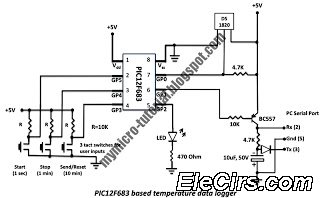
Description: A data logger is a device that records measurements over time. The measurements could be any physical variable like temperature, pressure, voltage, humidity, etc. This project describes how to build a mini logger that records surrounding temperature.
A data logger is an essential instrument utilized in various fields for monitoring and recording environmental parameters over specific intervals. The mini data logger described in this project focuses on capturing temperature data, which can be crucial for applications in climate studies, agriculture, and HVAC systems.
The circuit design for the mini data logger typically includes a microcontroller, a temperature sensor, an analog-to-digital converter (ADC), a memory module for data storage, and a power supply. The microcontroller serves as the central processing unit, coordinating the operation of the other components. Common choices for microcontrollers include the Arduino family or other low-power microcontrollers capable of handling the required input/output operations.
The temperature sensor, such as the LM35 or DS18B20, detects ambient temperature and converts it into an electrical signal. This signal is then processed by the ADC, which translates the analog voltage output of the temperature sensor into a digital value that the microcontroller can interpret. The data is then stored in a memory module, which could be an EEPROM or an SD card, depending on the required storage capacity and data retrieval needs.
For power supply, a battery or a USB power source can be used, ensuring that the logger operates efficiently over extended periods. Additionally, a real-time clock (RTC) module may be integrated to timestamp the recorded data, allowing for precise tracking of measurements over time.
The system can be programmed to log data at predetermined intervals, with the option to implement features such as data visualization or wireless data transmission, enabling remote monitoring. This mini data logger can be an invaluable tool for researchers and engineers looking to gather and analyze environmental data effectively.A data logger is a device that records measurements over time. The measurements could be any physical variable like temperature, pressure, voltage, humidity, etc. This project describes how to build a mini logger that records surrounding tem..
A data logger is an essential instrument utilized in various fields for monitoring and recording environmental parameters over specific intervals. The mini data logger described in this project focuses on capturing temperature data, which can be crucial for applications in climate studies, agriculture, and HVAC systems.
The circuit design for the mini data logger typically includes a microcontroller, a temperature sensor, an analog-to-digital converter (ADC), a memory module for data storage, and a power supply. The microcontroller serves as the central processing unit, coordinating the operation of the other components. Common choices for microcontrollers include the Arduino family or other low-power microcontrollers capable of handling the required input/output operations.
The temperature sensor, such as the LM35 or DS18B20, detects ambient temperature and converts it into an electrical signal. This signal is then processed by the ADC, which translates the analog voltage output of the temperature sensor into a digital value that the microcontroller can interpret. The data is then stored in a memory module, which could be an EEPROM or an SD card, depending on the required storage capacity and data retrieval needs.
For power supply, a battery or a USB power source can be used, ensuring that the logger operates efficiently over extended periods. Additionally, a real-time clock (RTC) module may be integrated to timestamp the recorded data, allowing for precise tracking of measurements over time.
The system can be programmed to log data at predetermined intervals, with the option to implement features such as data visualization or wireless data transmission, enabling remote monitoring. This mini data logger can be an invaluable tool for researchers and engineers looking to gather and analyze environmental data effectively.A data logger is a device that records measurements over time. The measurements could be any physical variable like temperature, pressure, voltage, humidity, etc. This project describes how to build a mini logger that records surrounding tem..

getting started with sn 6675
To measure temperature without using a thermometer, thermocouples are a viable option. However, thermocouples require a reference temperature, typically 0°C, to determine the temperature difference between the materials of the thermocouples, which can be inconvenient for users. To address this...

Digital Temperature Sensor Circuit using ADC0804 LM35 and LM317
A digital temperature sensor circuit is explained with a circuit diagram. ICs ADC 0804, LM35, and LM317 are used in this digital circuit project.
The digital temperature sensor circuit utilizes three primary integrated circuits (ICs): the ADC 0804, LM35, and LM317....
Temperature Controlled Relay Circuit
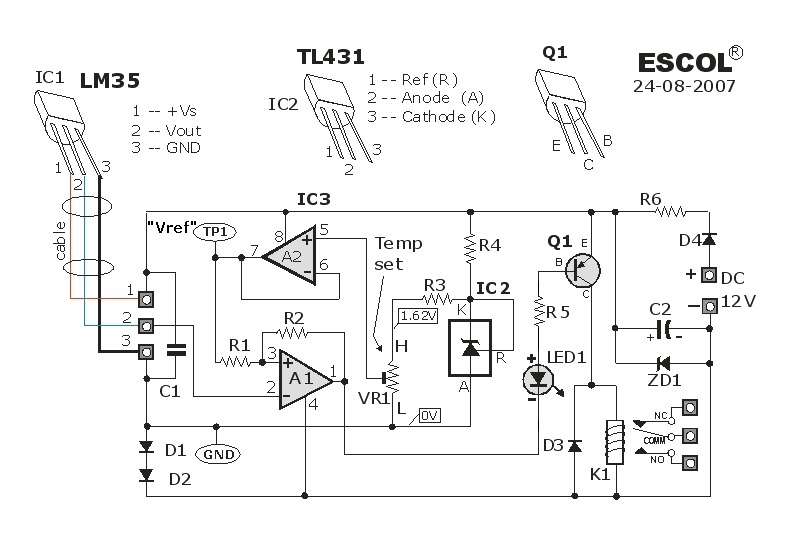
This temperature-controlled relay circuit is a simple yet highly accurate thermal control circuit that can be used in applications where automatic temperature regulation is required.
The temperature-controlled relay circuit operates by monitoring the ambient temperature using a temperature sensor, such as...

Intelligent thermostat temperature sensor LM75 circuit diagram consisting
The circuit features simple smart temperature sensors utilizing an I2C bus interface, designed as a thermostat controller circuit. It employs the LM75 temperature sensor connected to a 2N3904 transistor, which drives a relay coil. The relay operates based on the...

Digital Thermometer
A device designed for measuring time and temperature used in chemistry laboratory. The circuit employs a 89C4051, 20-pin CMOS Microcontroller with built-in 4kB code memory. Temperature was measured by LM35D, National Semiconductor Temperature sensor producing 10mV/°C. The CA3162, 3-digit DVM...

Pump Controller For Solar Hot Water System
This circuit optimizes the operation of a solar hot water system. When the water in the solar collector is hotter than the storage tank, the pump runs. The circuit comprises two LM335Z temperature sensors, a comparator, and a MOSFET. Sensor...

LED Thermometer
This LED thermometer is designed for home use, capable of reading temperatures between approximately 60 and 78 degrees Fahrenheit. It utilizes a precision temperature sensor IC, the LM34DZ, which requires no calibration and can measure temperatures ranging from -50°F to...

Remote thermometer
The low output impedance of a closed-loop operational amplifier (op amp) provides ideal immunity to line noise, while the offset voltage drift of the op amp serves as a temperature sensor. Utilizing the op amp in this manner requires no...

Simple Temperature Controller
This temperature controller utilizes an LM135/235/335 temperature sensor and is designed to maintain a small environment at a warm or hot temperature. A schematic diagram is provided.
The temperature controller circuit is centered around the LM135/235/335 series of temperature sensors, which...