


DIGITAL pH METER
#pH meter
#CMOS opamp
#high input impedance
#probe
#temperature correction
#analog reading
#gain adjustment
#voltage measurement

Description: The 3130 CMOS operational amplifier provides the necessary high input impedance for a pH probe at a low cost. The output of the probe varies from a positive generated DC voltage for low pH values to 0 V for a pH of 7, and negative voltages for high pH values. This output is amplified in a circuit that allows for gain adjustment to compensate for the temperature of the solution being measured. For analog readings, the output of the operational amplifier can be directly connected to a center-scale milliammeter through a 100K calibrating potentiometer. For a digital display that shows a reading of 7.00 for a 0 V output, the pH output is converted to a calibrated current that is summed with a stable offset current equal to 700 counts. This combined current is then fed to a current-to-frequency converter, which drives an appropriate digital display. Calibration is performed using standard pH buffer solutions.
The circuit employs a 3130 CMOS operational amplifier due to its high input impedance, which is critical for accurate pH measurements without loading the probe. The operational amplifier is configured in a non-inverting mode to amplify the voltage output from the pH probe. Gain adjustment is achieved through a feedback network that allows for fine-tuning based on the temperature of the solution, ensuring that the readings remain accurate across varying conditions.
The output from the operational amplifier is designed to cover a range of voltages corresponding to different pH levels, enabling a straightforward interpretation of the pH values. The analog output can be monitored using a milliammeter, which is calibrated with a 100K potentiometer, providing a visual indication of the pH level in real-time.
For digital readings, the circuit incorporates a current-to-frequency converter that translates the pH output into a frequency signal. This conversion facilitates the use of digital displays, which can provide precise numerical values corresponding to the pH levels. The offset current of 700 counts ensures that the digital display is calibrated to show a neutral pH of 7.00 at 0 V, allowing for easy interpretation of the results.
Calibration of the system is achieved using standard pH buffer solutions, which helps in maintaining the accuracy and reliability of the readings. The entire design is efficient and cost-effective, making it suitable for various applications where pH measurement is essential.3130 CMOS opamp gives required high input impedance for pH probe at low cost. Output of probe, ranging from positive generated DC voltage for low pH to 0 V for pH 7 and negative voltages for high pH values, is amplified in circuit that provides gain adjustment to correct for temperature of solution being measured. For analog reading, output of opa mp can be fed directly to center-scale milliammeter through 100K calibrating pot. For digital display giving reading of 7. 00 for 0-V output, pH output is converted to calibrated current for summing with stable offset current equal to 700 counts. This is fed to current-to-frequency converter driving suitable digital display. Standard pH buffer solutions are used for calibration. -D. Lancaster, "CMOS Cookbook, " Howard W. Sams, Indianapolis, IN, 1977, p 347-349.
The circuit employs a 3130 CMOS operational amplifier due to its high input impedance, which is critical for accurate pH measurements without loading the probe. The operational amplifier is configured in a non-inverting mode to amplify the voltage output from the pH probe. Gain adjustment is achieved through a feedback network that allows for fine-tuning based on the temperature of the solution, ensuring that the readings remain accurate across varying conditions.
The output from the operational amplifier is designed to cover a range of voltages corresponding to different pH levels, enabling a straightforward interpretation of the pH values. The analog output can be monitored using a milliammeter, which is calibrated with a 100K potentiometer, providing a visual indication of the pH level in real-time.
For digital readings, the circuit incorporates a current-to-frequency converter that translates the pH output into a frequency signal. This conversion facilitates the use of digital displays, which can provide precise numerical values corresponding to the pH levels. The offset current of 700 counts ensures that the digital display is calibrated to show a neutral pH of 7.00 at 0 V, allowing for easy interpretation of the results.
Calibration of the system is achieved using standard pH buffer solutions, which helps in maintaining the accuracy and reliability of the readings. The entire design is efficient and cost-effective, making it suitable for various applications where pH measurement is essential.3130 CMOS opamp gives required high input impedance for pH probe at low cost. Output of probe, ranging from positive generated DC voltage for low pH to 0 V for pH 7 and negative voltages for high pH values, is amplified in circuit that provides gain adjustment to correct for temperature of solution being measured. For analog reading, output of opa mp can be fed directly to center-scale milliammeter through 100K calibrating pot. For digital display giving reading of 7. 00 for 0-V output, pH output is converted to calibrated current for summing with stable offset current equal to 700 counts. This is fed to current-to-frequency converter driving suitable digital display. Standard pH buffer solutions are used for calibration. -D. Lancaster, "CMOS Cookbook, " Howard W. Sams, Indianapolis, IN, 1977, p 347-349.

Low cost ph meter
With a guaranteed 1 pA input bias, the ICL 8007A is ideal for use as a pH meter or for long-term sample and hold applications.
The ICL 8007A is a precision operational amplifier specifically designed for low-level signal processing, making it...
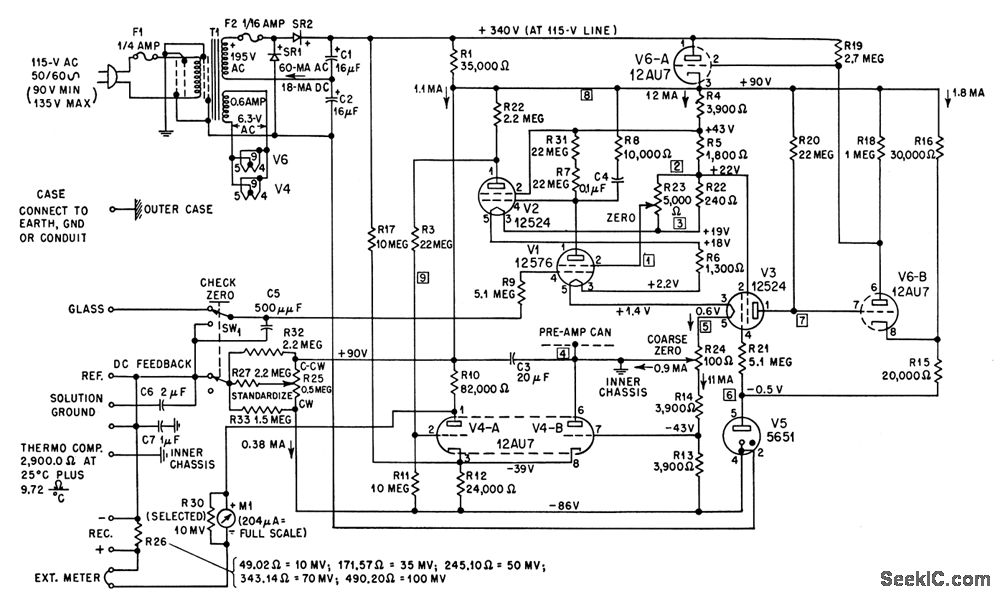
pH METER
The Beckman model W industrial-type pH meter is a direct current (DC) amplifier designed for measuring the potentials generated by pH-sensitive electrodes. The output is capable of driving most recorders. Resistor R32 is utilized exclusively with the 4 to 14...
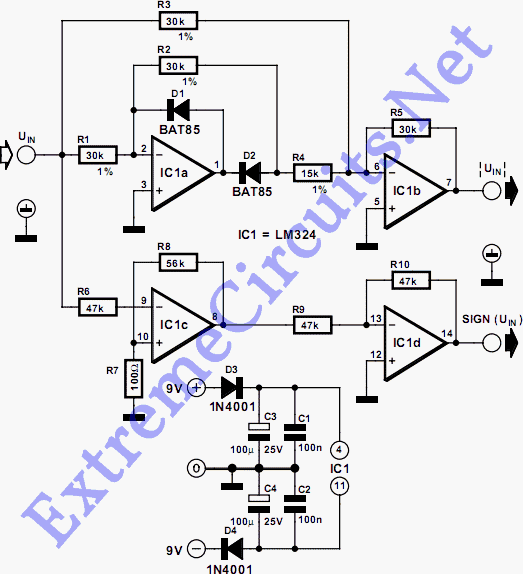
Absolute-Value Meter With Polarity Detector
This circuit separates an input voltage signal into its components: (1) the absolute value and (2) the polarity or 'sign' (+ or -). It is designed to handle direct current (DC) signals.
The circuit operates by utilizing operational amplifiers (op-amps) to...

Simple pH Meter Circuit A Low Cost Adapter for Your Digital Voltmeter
A pH meter is a precise voltmeter that measures the generated voltage of pH electrodes. The demand for such a meter is significant.
A pH meter operates by utilizing a combination of a glass electrode and a reference electrode. The glass...

Digital pH Meter Signal Conditioner with Pulse/Frequency Output
A signal conditioner for a pH meter probe requires high input impedance. The signal conditioning of the pH meter probe is achieved by incorporating a buffer.
The design of a signal conditioner for a pH meter probe is critical for accurate...

Coulomb meter
Another cause of voltage drift is the input current of IC1, which slowly charges capacitor C1. This effect is particularly noticeable when the output voltage is approximately 0 volts.
The circuit in question involves an integrated circuit (IC1) whose input current...

The Measurements for MIT 3DL1 Run
The chips that are classified as "working well" produce approximately 300 mV when exposed to a laser pointer and between 40 to 80 mV when illuminated by LED light. Voltages around 100 mV were recorded in a sunlit environment, while...

EIGHT CHANNEL COMPUTERIZED 3SUP1 SUP SUB2 SUB DIGIT_VM
Displays up to eight different DC voltages on a CRT terminal of a microprocessor under keyboard control, using BASIC commands and a BASIC routine provided in the article. Utilizes a modified Motorola MC14433 dual-lamp integrating analog-to-digital converter. An unknown voltage...

Circuit to Measure Power Supply Voltages
To obtain the power supply graphs on the previous page, the circuit is designed to independently monitor the power sources with the addition of a few resistors. Diode D3 allows the solar panel voltage to charge the batteries, while the...