


Electronic Scale Circuit
#electronic scale
#pressure transducer
#load cell
#A/D converter
#digital display
#calibration
#measurement
#instrumentation

Description: An electronic scale utilizes a pressure transducer (load cell) along with an analog-to-digital (A/D) converter to operate a digital display. The scale's range is determined by the specifications of the load cell, and the display is calibrated in suitable measurement units. The components are distributed across the main circuit board and the display board, while the external controls are located on the front panel and within the casing. The load cell in this scale is rated for a maximum capacity of 1 to 3 pounds (600 grams).
The electronic scale operates by converting the mechanical force exerted on the load cell into an electrical signal. The load cell, typically a strain gauge type, deforms under the weight applied to it, generating a change in resistance that is proportional to the load. This change is measured and converted into a digital signal by the A/D converter. The converter translates the analog voltage signal from the load cell into a digital format that can be processed by a microcontroller or microprocessor.
The microcontroller is programmed to interpret the digital signal and convert it into a readable value displayed on the digital screen. Calibration is essential to ensure accuracy; this involves adjusting the scale to display the correct weight corresponding to known weights. The display can be configured to show the weight in various units, such as pounds or kilograms, depending on user preference.
The main circuit board houses the load cell, A/D converter, and the microcontroller, while the display board contains the digital display elements, such as LED or LCD screens. The front panel includes user controls, such as buttons for zeroing the scale, switching between measurement units, and possibly a tare function to subtract the weight of containers. The design ensures that all components are securely mounted within the casing, providing durability and ease of use.
Overall, the electronic scale's design is focused on precision, reliability, and user-friendliness, making it suitable for various applications where weight measurement is required. An electronic scale using a pressure transducer (load cell) and an analog-digital (A/D) converter to drive a digital display is shown. The scale range depends on load cell. Display is calibrated in appropriate units. Components are on main circuit and display boards. The off-board controls are on the front panel and case. The cell in this scale is rated for 1.-3-pounds (600 grams).
The electronic scale operates by converting the mechanical force exerted on the load cell into an electrical signal. The load cell, typically a strain gauge type, deforms under the weight applied to it, generating a change in resistance that is proportional to the load. This change is measured and converted into a digital signal by the A/D converter. The converter translates the analog voltage signal from the load cell into a digital format that can be processed by a microcontroller or microprocessor.
The microcontroller is programmed to interpret the digital signal and convert it into a readable value displayed on the digital screen. Calibration is essential to ensure accuracy; this involves adjusting the scale to display the correct weight corresponding to known weights. The display can be configured to show the weight in various units, such as pounds or kilograms, depending on user preference.
The main circuit board houses the load cell, A/D converter, and the microcontroller, while the display board contains the digital display elements, such as LED or LCD screens. The front panel includes user controls, such as buttons for zeroing the scale, switching between measurement units, and possibly a tare function to subtract the weight of containers. The design ensures that all components are securely mounted within the casing, providing durability and ease of use.
Overall, the electronic scale's design is focused on precision, reliability, and user-friendliness, making it suitable for various applications where weight measurement is required. An electronic scale using a pressure transducer (load cell) and an analog-digital (A/D) converter to drive a digital display is shown. The scale range depends on load cell. Display is calibrated in appropriate units. Components are on main circuit and display boards. The off-board controls are on the front panel and case. The cell in this scale is rated for 1.-3-pounds (600 grams).

Digital-ProfiLab 4.0
Digital-ProfiLab was designed for measurement and control applications, combining features like circuit and logic simulation, front panel design, and hardware control to one powerful tool. Incoming signals from external devices may be processed and displayed. A circuit editor is used...

Digital display circuit configuration
The document presents two types of digital display circuits. The first type (a) utilizes a common anode circuit configuration, while the second type (b) employs a common cathode circuit structure.
The common anode display circuit configuration consists of multiple light-emitting diodes...

Advances in Measurement & Sensor Tech
This issue features articles on various measurement and sensor-related embedded design projects. Readers are encouraged to attempt similar projects and share their results. Starting on page 14, Petre Tzvetanov Petrov describes a multilevel audible logical probe design. Petrov notes that...

LF356 composed of AD converter
An A/D converter transforms an analog signal into a digital format. Various circuit configurations exist, as illustrated in Figures 21-24, which depict the structure of an A/D converter. One practical circuit configuration utilizes the integrated circuit LF356.
The A/D converter is...

Instrumentation circuit
The mechanical chassis prototype, as illustrated in the accompanying image, was constructed using two materials: foam and aluminum. Foam was selected for its ease of manipulation, while aluminum was chosen for its excellent strength-to-weight ratio. The prototype features a rotary...

ICL7106 1/2 Digit LCD/LED Display A/D Converters
The Intersil ICL7106 and ICL7107 are high-performance, low-power, 3½ digit analog-to-digital (A/D) converters. They include seven-segment decoders, display drivers, a reference, and a clock. The ICL7106 is designed to interface with a liquid crystal display (LCD) and features a multiplexed...

Digital DC Millivoltmeter
The DC millivoltmeter features a three-and-a-half digit display, offering high accuracy, performance, stability, and user-friendliness. Its measurement range extends from 0 to 1.999 mV, with a measurement accuracy of 1 mV.
The DC millivoltmeter is designed to provide precise voltage measurements...

high voltage ac calibrator circuit
This is an application circuit for calibration known as a high voltage AC calibrator circuit. A key aspect of sine wave oscillator design is the stable control of amplitude. In this circuit, the amplitude is stabilized through servo control, which...
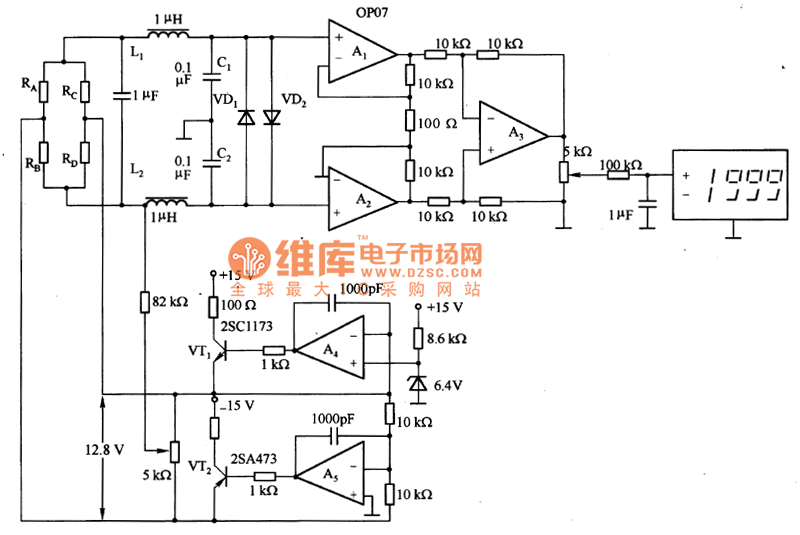
Digital display pressure measuring circuit diagram
The figure illustrates a digital display pressure measuring circuit diagram. The circuit operates with an additional voltage of approximately 12.8V and draws a current of 30mA. Under maximum gain conditions, the input voltage range is 0.8mV. The zero adjustment range...