


Lux meters attiny26-16 light measurement circuit

Description: Lux meter circuit using an Atmel ATtiny26-16 microcontroller, which displays lux values on an LED display. The circuit utilizes 2SK1061 MOSFETs for driving the LEDs.
The lux meter circuit operates by measuring ambient light levels and converting these measurements into a readable format displayed on an LED array. The Atmel ATtiny26-16 microcontroller serves as the central processing unit, executing the necessary algorithms to interpret the sensor input and control the output display.
In this design, light is detected using a suitable light sensor, which provides an analog voltage proportional to the illumination level. This voltage is fed into one of the analog-to-digital converter (ADC) channels of the ATtiny26-16. The microcontroller processes this analog signal, converting it into a digital value that corresponds to the lux level.
To drive the LED display, the circuit employs 2SK1061 MOSFETs. These MOSFETs are used to handle the current required by the LEDs without overloading the microcontroller's output pins. The microcontroller controls the gate of each MOSFET, allowing it to turn the LEDs on or off based on the computed lux values.
The LED display is configured to show the lux readings in a user-friendly format. This may involve using multiple LEDs to represent different ranges of light intensity, or a more complex arrangement to provide a more precise numerical display.
Additional components in the circuit may include resistors for current limiting, capacitors for filtering, and possibly a power supply circuit to ensure stable operation. The overall design emphasizes efficiency and accuracy in light measurement, making it suitable for various applications where light intensity monitoring is essential.Lux meter circuit atmel attiny26-16 microcontroller based on the value of the LED displays on the display lux with LEDs placed on 2sk1061 MOS.
The lux meter circuit operates by measuring ambient light levels and converting these measurements into a readable format displayed on an LED array. The Atmel ATtiny26-16 microcontroller serves as the central processing unit, executing the necessary algorithms to interpret the sensor input and control the output display.
In this design, light is detected using a suitable light sensor, which provides an analog voltage proportional to the illumination level. This voltage is fed into one of the analog-to-digital converter (ADC) channels of the ATtiny26-16. The microcontroller processes this analog signal, converting it into a digital value that corresponds to the lux level.
To drive the LED display, the circuit employs 2SK1061 MOSFETs. These MOSFETs are used to handle the current required by the LEDs without overloading the microcontroller's output pins. The microcontroller controls the gate of each MOSFET, allowing it to turn the LEDs on or off based on the computed lux values.
The LED display is configured to show the lux readings in a user-friendly format. This may involve using multiple LEDs to represent different ranges of light intensity, or a more complex arrangement to provide a more precise numerical display.
Additional components in the circuit may include resistors for current limiting, capacitors for filtering, and possibly a power supply circuit to ensure stable operation. The overall design emphasizes efficiency and accuracy in light measurement, making it suitable for various applications where light intensity monitoring is essential.Lux meter circuit atmel attiny26-16 microcontroller based on the value of the LED displays on the display lux with LEDs placed on 2sk1061 MOS.

Microcontroller Voltmeter / Ammeter with LCD
The rectifier bridge voltage is determined by the U2 element; refer to its datasheet for the maximum voltage specifications. The minimum voltage at this pin should not fall below approximately 9V, or 6.5V if low-dropout type U2 and U3 voltage...

IR On/Off Switch Using Microcontroller
Turning electrical devices ON or OFF using a remote control is a well-established concept, with numerous devices available that perform this function effectively. To create such a device, it is necessary to construct a receiver and a transmitter, as well...

LED dot display based Battery charge level indicator circuit diagram
In various situations, it is necessary to indicate the amount of battery charge using methods such as LED dot displays or LED bar displays. This circuit utilizes the LM3914 integrated circuit to serve as a battery charge indicator with an...
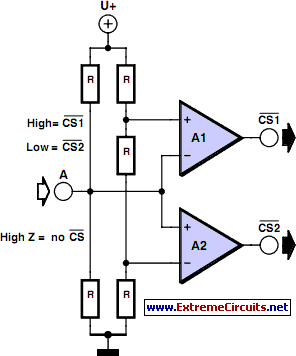
Multitasking Pins circuit
It is entirely logical that low-cost miniature microcontrollers have fewer pins than their larger counterparts, sometimes too few. Consideration has been given to how to economize on pins by making them perform the work of several. It was noted that...
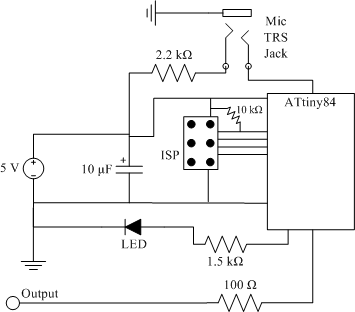
clap sensor construction
The clap sensor is a straightforward circuit that consists of a PC microphone, a microcontroller, and an output. The circuit design features the ATtiny84 microcontroller, chosen for familiarity with the AVR architecture and accessibility to necessary tools. The ATtiny84 is...

Interfacing seven segment to microcontroller
The Tutorial shows how to interface 7-segment display to a microcontroller. Also explains how do display more than one 7-segment on same data lines using scanning method. 7 Seg displays are are basically 7 LED's. It will be much easier...

Common-cathode-led-display
A Teledyne TSC7135 digital voltmeter (DVM) chip is utilized to control a multiplexed 5-digit display. To facilitate common cathode drive, a CD4513BE CMOS integrated circuit (IC) functions as a segment driver, with selection controlled by pins 17-20 of the DVM...

Talking Yoda head
The talking Yoda head consists of a Yoda mask and a microcontroller system to achieve the desired operation/effect. The basic operation of the project was specified as follows: The head was to be placed inside a closed box. Upon opening...

Wire Break Sensor Alarm Circuit Schematic
The circuit of a loop sensor-based simple security alarm is described here. The sensor loop consists of a short length of thin enamelled copper wire.
The loop sensor security alarm operates on the principle of detecting interruptions in the circuit formed...