


Mains Frequency Monitor circuit and explanation
#frequency counter
#mains supply
#TTL/CMOS logic
#ELM446
#crystal oscillator
#display driver
#240VAC
#400Hz
#1Hz gating

Description: This is a simple frequency counter designed to monitor the 240VAC mains supply. It has a frequency range of 0-999Hz, making it suitable for use with 400Hz equipment as well. Standard TTL/CMOS logic is utilized for the counters and display drivers, while an ELM446 (IC1) generates accurate 1Hz pulses for gating. The device employs a 3.579545MHz crystal for its timebase, which is commonly found in TV and video circuits, as well as in older PC motherboards.
The frequency counter circuit is structured to provide reliable frequency measurements of the 240VAC mains supply, which is crucial for various applications in electrical engineering and maintenance. The design incorporates a frequency range from 0Hz to 999Hz, allowing it to effectively measure the frequency of standard power supplies as well as specialized equipment operating at 400Hz.
The use of TTL (Transistor-Transistor Logic) and CMOS (Complementary Metal-Oxide-Semiconductor) technology ensures low power consumption and high-speed operation, making the device suitable for real-time monitoring. The ELM446 integrated circuit serves as the pulse generator, creating precise 1Hz pulses that act as a gating signal for the counting mechanism. This pulse generation is essential for accurate frequency measurement, as it enables the counter to tally the number of cycles within a given time frame.
The 3.579545MHz crystal oscillator provides a stable timebase, which is critical for maintaining accuracy in frequency counting. This frequency is widely utilized in consumer electronics, particularly in television and video applications, due to its historical significance and reliability. The design ensures that the frequency counter can effectively interface with various electronic devices, providing valuable diagnostic and operational data.
Overall, this frequency counter serves as an essential tool for engineers and technicians, facilitating the monitoring and analysis of electrical systems and ensuring optimal performance in a range of applications.Here is a simple frequency counter designed to monitor the 240VAC mains supply. It as a frequency range of 0-999Hz, so it could also be used with 400Hz equipment. Standard TTL/CMOS logic is employed for the counters and display drivers, while an ELM446 (IC1) generates accurate 1Hz pulses for gating. This device utilizes a 3. 579545MHz crystal for i ts timebase, as commonly found in TV and video circuits and even on old PC motherboards. Disclaimer All files are found using legitimate search engine techniques. This site does not and will not condone hacking into sites to create the links it list. We will and do assume that all links found on the search engines we use are obtained in a legal manner and the webmasters are aware of the links listed on the search engines. If you find a URL that belongs to you, and you did not realize that it was "open to the public", please use the report button to notify the blogmaster of your request to remove it or it will remove within 24 hours.
This is not an invitation for webblog haters to spam with requests to remove content they feel that is objectionable and or unacceptable. Proof of URL ownership is required. NOTICE: This Blog Has Already Been Reviewed And Accepted By Blogger. com
The frequency counter circuit is structured to provide reliable frequency measurements of the 240VAC mains supply, which is crucial for various applications in electrical engineering and maintenance. The design incorporates a frequency range from 0Hz to 999Hz, allowing it to effectively measure the frequency of standard power supplies as well as specialized equipment operating at 400Hz.
The use of TTL (Transistor-Transistor Logic) and CMOS (Complementary Metal-Oxide-Semiconductor) technology ensures low power consumption and high-speed operation, making the device suitable for real-time monitoring. The ELM446 integrated circuit serves as the pulse generator, creating precise 1Hz pulses that act as a gating signal for the counting mechanism. This pulse generation is essential for accurate frequency measurement, as it enables the counter to tally the number of cycles within a given time frame.
The 3.579545MHz crystal oscillator provides a stable timebase, which is critical for maintaining accuracy in frequency counting. This frequency is widely utilized in consumer electronics, particularly in television and video applications, due to its historical significance and reliability. The design ensures that the frequency counter can effectively interface with various electronic devices, providing valuable diagnostic and operational data.
Overall, this frequency counter serves as an essential tool for engineers and technicians, facilitating the monitoring and analysis of electrical systems and ensuring optimal performance in a range of applications.Here is a simple frequency counter designed to monitor the 240VAC mains supply. It as a frequency range of 0-999Hz, so it could also be used with 400Hz equipment. Standard TTL/CMOS logic is employed for the counters and display drivers, while an ELM446 (IC1) generates accurate 1Hz pulses for gating. This device utilizes a 3. 579545MHz crystal for i ts timebase, as commonly found in TV and video circuits and even on old PC motherboards. Disclaimer All files are found using legitimate search engine techniques. This site does not and will not condone hacking into sites to create the links it list. We will and do assume that all links found on the search engines we use are obtained in a legal manner and the webmasters are aware of the links listed on the search engines. If you find a URL that belongs to you, and you did not realize that it was "open to the public", please use the report button to notify the blogmaster of your request to remove it or it will remove within 24 hours.
This is not an invitation for webblog haters to spam with requests to remove content they feel that is objectionable and or unacceptable. Proof of URL ownership is required. NOTICE: This Blog Has Already Been Reviewed And Accepted By Blogger. com

Frequency Counter
Built around an Intersil 7216 frequency counter IC, this counter has a basic range of 10 MHz, a 100-MHz prescaler, and an extra frequency divider (IC3). This divider reduces the frequency by an additional factor, as indicated on S7 (refer...

frequency counter
The frequency counter is the most popular instrument in home-made instruments. The reason it is built widely is that it can be built easily because it is a digital circuit, it is a generic measurement, and many construction kits are...

Crystal oscillator using TTL
The circuit operates using binary signal statuses of "1" and "0". It also incorporates a frequency generator.
The circuit described utilizes a binary signaling system, which is fundamental in digital electronics. The binary states "1" and "0" represent the two possible...
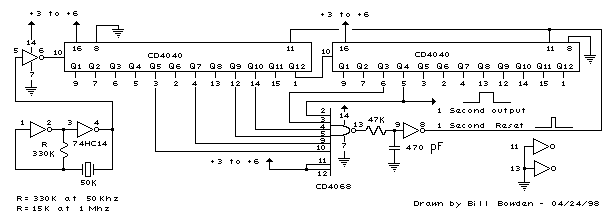
Crystal Oscillator counter
Using a 50 Khz crystal, a count of 50000 is detected when the appropriate counter bits that add up to 50000 are all high. This corresponds to bits 15 (32768) + 14 (16384) + 9 (512) + 8 (256) +...

UNIVERSAL TEST OSCILLATOR
The crystal is positioned in the feedback path of a Pierce oscillator, situated between the base and collector of transistor Q1, with a 2.5 mH RF choke replacing the tuned collector circuit. The oscillator operates within a frequency range of...

A Low-Frequency Crystal Controlled Oscillator
The RF engineer occasionally needs to find an instrument that can reliably and quickly test a low-frequency quartz crystal unit. This equipment is often challenging to locate, leading engineers to consult electronic circuits handbooks for schematics that can perform the...

Digital frequency counter
The frequency counter is designed to measure the number of cycles per second of an incoming signal. A counting device is necessary for this purpose, and in electronic circuits, counter integrated circuits (ICs) are available for counting input pulses. The...

Crystal Oscillator
A crystal oscillator, particularly a low-frequency variant, can be effectively constructed using an operational amplifier (op-amp) as the amplification component. Below is the schematic diagram of this circuit.
The crystal oscillator circuit utilizes the properties of a quartz crystal to generate...

10 Mhz universal counter
The ICM7216A can be utilized as a minimal component complete Universal Counter. This circuit is capable of handling input frequencies of up to 10 MHz at INPUT A and 2 MHz at INPUT B. In cases where the signal at...