


PEAK VOLTMETER FOR NARROW PULSES
#peak voltmeter
#narrow pulses
#amplifier
#voltage measurement
#linearity
#charging time constant
#dual-triode
#electronics
#response improvement

Description: The addition of a dual-triode amplifier (V2) to a conventional peak voltmeter reduces the charging time constant while increasing the available time for measuring peak values. Linearity is maintained up to 40 volts.
The integration of a dual-triode amplifier into a peak voltmeter circuit significantly enhances its performance by optimizing the measurement of transient signals. The dual-triode configuration allows for improved signal amplification, which is crucial for accurately capturing peak voltages in rapidly changing electrical signals.
In this setup, the dual-triode amplifier (V2) serves to minimize the charging time constant of the voltmeter. This reduction is critical because it allows the voltmeter to respond more quickly to changes in voltage, thereby providing a more accurate representation of peak values. The amplifier's design contributes to a high input impedance, which prevents loading effects that could distort the measurement.
The circuit operates effectively within a voltage range of up to 40 volts, maintaining good linearity throughout this range. This characteristic is essential for applications where precise voltage measurements are required, such as in audio electronics or signal processing. The dual-triode configuration ensures that the amplifier can handle variations in input signals without significant distortion, thus preserving the integrity of the measured peak values.
Overall, the enhancement of the peak voltmeter's response through the addition of a dual-triode amplifier exemplifies a practical application of amplifier technology in improving measurement accuracy and speed in electronic instrumentation.Addition of dual-triode amplifier V2 to conventional peak voltmeter reduces charging time constant while increasing available time for measuring peak value. Linearity is good up to 40 v. -M. Uno, Amplifier Improves Peak Voltmeter Response, Electronics, 37:14, p 73.
The integration of a dual-triode amplifier into a peak voltmeter circuit significantly enhances its performance by optimizing the measurement of transient signals. The dual-triode configuration allows for improved signal amplification, which is crucial for accurately capturing peak voltages in rapidly changing electrical signals.
In this setup, the dual-triode amplifier (V2) serves to minimize the charging time constant of the voltmeter. This reduction is critical because it allows the voltmeter to respond more quickly to changes in voltage, thereby providing a more accurate representation of peak values. The amplifier's design contributes to a high input impedance, which prevents loading effects that could distort the measurement.
The circuit operates effectively within a voltage range of up to 40 volts, maintaining good linearity throughout this range. This characteristic is essential for applications where precise voltage measurements are required, such as in audio electronics or signal processing. The dual-triode configuration ensures that the amplifier can handle variations in input signals without significant distortion, thus preserving the integrity of the measured peak values.
Overall, the enhancement of the peak voltmeter's response through the addition of a dual-triode amplifier exemplifies a practical application of amplifier technology in improving measurement accuracy and speed in electronic instrumentation.Addition of dual-triode amplifier V2 to conventional peak voltmeter reduces charging time constant while increasing available time for measuring peak value. Linearity is good up to 40 v. -M. Uno, Amplifier Improves Peak Voltmeter Response, Electronics, 37:14, p 73.
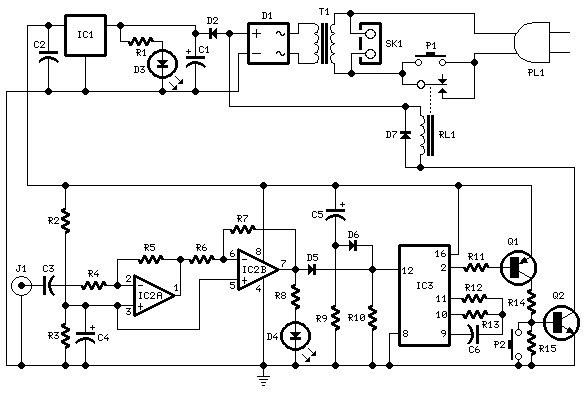
Amplifier Timer
Turns off your amplifier when idle for 15 minutes. Fed by amplifier tape-output. This circuit turns off an amplifier or any other device when a low-level audio signal fed to its input is absent for 15 minutes at least. Pushing...

Amplifier Circuit Output Relay Delay Audio
This is a simple circuit designed for an audio amplifier project to control the speaker output relay. The purpose of this circuit is to manage the relay that activates the speaker output in the audio amplifier. The circuit is designed...

amplifier delay output relay
This is a simple circuit which I built to one of my audio amplifier projects to control the speaker output relay. The purpose of this circuit is to control the relay which turns on the speaker output relay in the...

Amplifiers connecting Bridge
This is a circuit that ensures that you can connect two amplifiers together so you get more power. When called in bridge linking two amplifiers plus you can link the outputs of the amplifiers to the speaker. One of the...
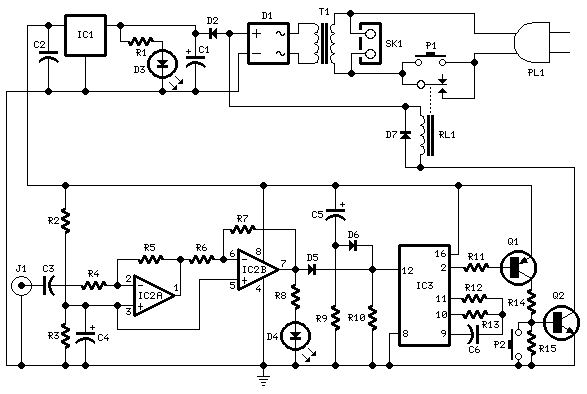
Amplifier Timer
This circuit turns off an amplifier or any other device when a low-level audio signal fed to its input is absent for 15 minutes at least. Pushing P1, the device is switched on, feeding any appliance connected to SK1. Input...

Self Oscillating Amplifier for Distortion Testing
The circuit is based on a simple inductor-capacitor filter circuit, and needs only a pot and a small light bulb to set and stabilise the oscillation. The frequency is fixed, and with a good inductor should be capable of very...
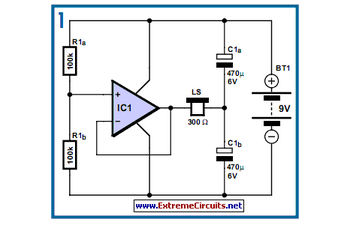
DC-Coupled Audio Amplifier
Designs for audio amplifiers with DC coupling to the load are not commonly seen today, despite their clear benefits. One advantage...
Audio amplifiers utilizing DC coupling to the load present several notable advantages in specific applications. DC coupling allows for a...

General-Purpose Output Amplifier Circuit
This general-purpose amplifier has a bandwidth of approximately 20 MHz and it uses an LM733/NE592 video amplifier integrated circuit. This circuit can be utilized as a line driver or as a LAN line driver.
The circuit employs the LM733/NE592 video amplifier...

EIGHT CHANNEL COMPUTERIZED 3SUP1 SUP SUB2 SUB DIGIT_VM
Displays up to eight different DC voltages on a CRT terminal of a microprocessor under keyboard control, using BASIC commands and a BASIC routine provided in the article. Utilizes a modified Motorola MC14433 dual-lamp integrating analog-to-digital converter. An unknown voltage...