


pic circuit
#PIC 16C84
#frequency meter
#auto-ranging
#50 MHz
#exponential format
#course project
#display
#microcontroller
#measurement
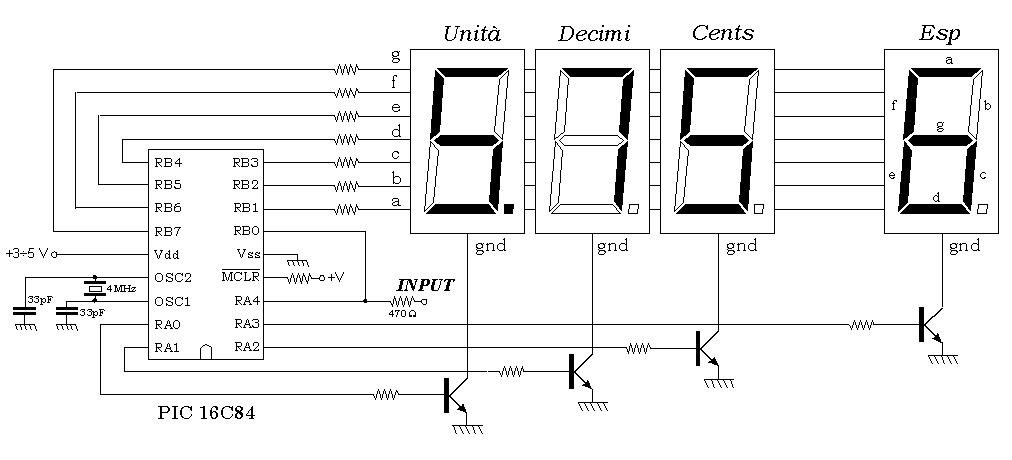
Description: This is a simple 50 MHz auto-ranging frequency meter developed as a course project by Simone Benvenuti and Andrea Geniola. It utilizes a single PIC 16C84 microcontroller and four displays to measure frequencies in the range of 0 Hz to 50 MHz. The output is presented in exponential format (XXX E) to maintain a sufficient number of significant digits. The PIC microcontroller enters a shutdown mode when the input is idle for a certain period and automatically powers on when a frequency signal is detected at the input. Source code and schematics are available. Additionally, there is a cable tester composed of two modules, designed to test network, phone, or other cables where the two ends are distanced from each other. This project was partly developed by Maurizio Fabbri and Fabio Raso. Complete schematics, source code, and documentation are provided. The sources should be assembled using Timo Rossi's picasm.
The 50 MHz auto-ranging frequency meter is designed to provide an efficient and user-friendly means of measuring frequency signals across a wide range. The core component, the PIC 16C84 microcontroller, is a versatile 8-bit device that enables precise frequency measurement and control of the display outputs. The system's architecture integrates four seven-segment displays, which are driven by the microcontroller to present frequency readings in an exponential format. This format is advantageous for displaying a wide range of values while ensuring that significant digits are preserved, enhancing the accuracy of readings.
The frequency meter operates by sampling the input signal and processing the frequency data using the microcontroller's internal algorithms. The shutdown feature is particularly useful for power conservation, allowing the device to remain inactive during periods of no signal input. Upon detecting a frequency input, the microcontroller is programmed to wake from its low-power state, ensuring quick responsiveness for real-time measurements.
In addition to the frequency meter, the cable tester module serves a distinct purpose by allowing users to verify the integrity of various types of cables over long distances. The design consists of two separate modules that communicate with each other, enabling the user to test cables such as network and telephone lines effectively. This module also incorporates a microcontroller and displays to provide feedback on the testing process.
Complete schematics for both the frequency meter and the cable tester are provided, along with the necessary source code for implementation. The assembly of the software is facilitated by Timo Rossi's picasm, which is a suitable assembler for the PIC microcontroller environment. The documentation accompanying these projects offers guidance on assembly, operation, and troubleshooting, making it accessible for educational purposes and practical applications in electronics testing.This is a simple 50 MHz auto-ranging Frequency meter, developed as a course project by Simone Benvenuti and Andrea Geniola. It uses a single PIC 16C84 and 4 displays to measure frequencies in the 0Hz. 50MHz range. Output is shown in exponential format (XXX E) in order to have enough significant digits. The PIC shuts down when the input is idle for some time, and turns on automatically when a frequency is applied to the input. Source code and schematics available. This is a cable tester made of two modules, useful to test network or phone or other cables where the two ends are far away from each other. Partly developed as a course project by Maurizio Fabbri, Fabio Raso. Schematics and full source and documentation. The sources should be assembled with Timo Rossi`s picasm.
The 50 MHz auto-ranging frequency meter is designed to provide an efficient and user-friendly means of measuring frequency signals across a wide range. The core component, the PIC 16C84 microcontroller, is a versatile 8-bit device that enables precise frequency measurement and control of the display outputs. The system's architecture integrates four seven-segment displays, which are driven by the microcontroller to present frequency readings in an exponential format. This format is advantageous for displaying a wide range of values while ensuring that significant digits are preserved, enhancing the accuracy of readings.
The frequency meter operates by sampling the input signal and processing the frequency data using the microcontroller's internal algorithms. The shutdown feature is particularly useful for power conservation, allowing the device to remain inactive during periods of no signal input. Upon detecting a frequency input, the microcontroller is programmed to wake from its low-power state, ensuring quick responsiveness for real-time measurements.
In addition to the frequency meter, the cable tester module serves a distinct purpose by allowing users to verify the integrity of various types of cables over long distances. The design consists of two separate modules that communicate with each other, enabling the user to test cables such as network and telephone lines effectively. This module also incorporates a microcontroller and displays to provide feedback on the testing process.
Complete schematics for both the frequency meter and the cable tester are provided, along with the necessary source code for implementation. The assembly of the software is facilitated by Timo Rossi's picasm, which is a suitable assembler for the PIC microcontroller environment. The documentation accompanying these projects offers guidance on assembly, operation, and troubleshooting, making it accessible for educational purposes and practical applications in electronics testing.This is a simple 50 MHz auto-ranging Frequency meter, developed as a course project by Simone Benvenuti and Andrea Geniola. It uses a single PIC 16C84 and 4 displays to measure frequencies in the 0Hz. 50MHz range. Output is shown in exponential format (XXX E) in order to have enough significant digits. The PIC shuts down when the input is idle for some time, and turns on automatically when a frequency is applied to the input. Source code and schematics available. This is a cable tester made of two modules, useful to test network or phone or other cables where the two ends are far away from each other. Partly developed as a course project by Maurizio Fabbri, Fabio Raso. Schematics and full source and documentation. The sources should be assembled with Timo Rossi`s picasm.

Water Level controller
The microcontroller-based water level controller and motor protector manages the on and off states of the motor based on the water level in the overhead tank (OHT). It regulates the tank's water level through a microcontroller, thereby providing automatic protection...

GSM Remote Control 2 IN and 2 OUT Part 2 Schematic
The control of the system is managed by a Microchip PIC18F46K20-I/PT microcontroller, which is programmed with firmware to oversee the activity of the GSM/GPRS module, monitor the logic conditions of two opto-isolated inputs, and send commands to two relays within...

Frequency meter with 10Hz to 2MHz
The 7208 seven-metric system counter is utilized as a frequency meter. It features a latch and multiplexing function and incorporates a direct drive circuit along with a display driver circuit. The 7207 IC divides the output frequency of a 6.5536...

Blanket internal measurement circuit disconnection
The internal disconnection circuit for a blanket operates on the principle of induction. It includes a wire approximately 2 cm in length that senses the proximity of a charged mains power source. When the sensing wire is close to the...

MICROCONTROLLER BASED AUTOMATIC ROOM LIGHT CONTROLLER
This project involves an automatic room light controller with a bidirectional visitor counter using a microcontroller. It is designed to manage room lighting and accurately count the number of individuals present. When a person enters the room, the counter increments...

1300 Mhz Frequency meter with prescaler
Having found a u664b prescaler chip (Telefunken) from an old TV tuner, I decided to build a valid frequency counter using PIC16F84. The prescaler I use is able to divide by 64 every frequency from 30 to 1300 MHz. The...
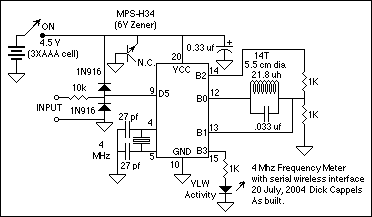
Wireless Coupled Frequency Meter
A 0 to 2 MHz frequency meter with a Minimum Mass Wireless Coupler, based on the ATMega8. Range to the Minimum Mass Base Unit is 10 to 15 cm. Since the frequency meter is battery operated, it can be floated...
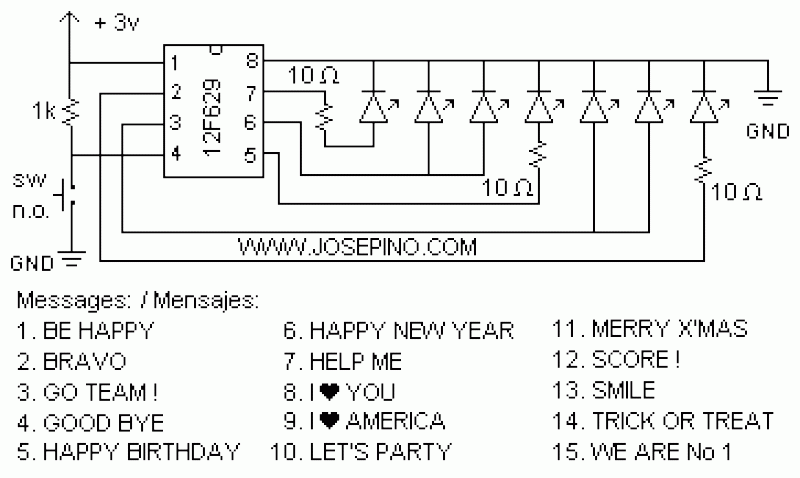
ON/OFF button using Microcontrollers
Using a switch to power up your microcontroller projects may not be a good idea if you need to "wake" the PIC during some events. For example: A metal detector sends a pulse indicating a car is ready to enter...

repair microcontroller circuit
The difference between these two ICs. A microcontroller is a specialized type of microprocessor designed to be self-sufficient and cost-effective, while a microprocessor is typically intended for general-purpose use, such as in personal computers (PCs). The microcontroller integrates several useful...