


Video speed 6-bit Flash A/D converter
#flash ADC
#analogue to digital converter
#high speed
#CA3306
#CMOS
#6-bit
#sampling rate
#measurement
#instrumentation

Description: This circuit utilizes the CA3306, a family of CMOS parallel (flash) analog-to-digital converters designed for low power and high-speed applications. The CA3306CE operates at sampling rates of up to 10 million samples per second, while the CA3306E can achieve rates of up to 15 million samples per second. This capability allows for the digitization of analog signals with bandwidths of up to 5 MHz or 7.5 MHz with 6-bit accuracy. Additionally, an overflow input enables the connection of two devices in parallel, effectively doubling the conversion speed.
The CA3306 series is particularly beneficial in applications where rapid data acquisition is essential, such as in instrumentation, communications, and digital signal processing. The architecture of the CA3306 employs a parallel conversion method, which significantly enhances the speed of the conversion process compared to traditional sequential converters.
The device's ability to handle high sampling rates makes it suitable for applications requiring real-time signal processing. The 6-bit resolution, although relatively low by modern standards, is adequate for many applications where precision is not the primary concern, allowing for efficient processing of signals in various electronic systems.
The overflow input feature is particularly noteworthy, as it allows for the cascading of multiple CA3306 devices. This configuration is advantageous for applications that demand higher throughput, as it effectively doubles the sampling rate without compromising the integrity of the data. When two devices are connected in parallel, the system can handle higher data rates, making it ideal for high-frequency signal applications.
The CA3306 family’s low power consumption is another critical aspect, making it suitable for battery-operated devices and portable applications. Its CMOS technology ensures minimal power draw while maintaining high performance, thus extending the operational lifespan of portable electronics.
In summary, the CA3306 series of analog-to-digital converters provides an effective solution for high-speed, low-power applications, with features that accommodate a range of operational needs in modern electronic design.This circuit use the CA3306 a family of CMOS parallel (flash) analogue to digital converters designed for low power, high speed applications. The CA3306CE operates at sampling rates up to 10 million samples per second and the CA3306E up to 15 million samples per second permitting analogue signals with bandwidths up to 5MHz or 7.5MHz to be fully digitised to 6-bit accuracy.
An overflow input allows two devices to be connected in parallel will permit conversion speed to be doubled.
The CA3306 series is particularly beneficial in applications where rapid data acquisition is essential, such as in instrumentation, communications, and digital signal processing. The architecture of the CA3306 employs a parallel conversion method, which significantly enhances the speed of the conversion process compared to traditional sequential converters.
The device's ability to handle high sampling rates makes it suitable for applications requiring real-time signal processing. The 6-bit resolution, although relatively low by modern standards, is adequate for many applications where precision is not the primary concern, allowing for efficient processing of signals in various electronic systems.
The overflow input feature is particularly noteworthy, as it allows for the cascading of multiple CA3306 devices. This configuration is advantageous for applications that demand higher throughput, as it effectively doubles the sampling rate without compromising the integrity of the data. When two devices are connected in parallel, the system can handle higher data rates, making it ideal for high-frequency signal applications.
The CA3306 family’s low power consumption is another critical aspect, making it suitable for battery-operated devices and portable applications. Its CMOS technology ensures minimal power draw while maintaining high performance, thus extending the operational lifespan of portable electronics.
In summary, the CA3306 series of analog-to-digital converters provides an effective solution for high-speed, low-power applications, with features that accommodate a range of operational needs in modern electronic design.This circuit use the CA3306 a family of CMOS parallel (flash) analogue to digital converters designed for low power, high speed applications. The CA3306CE operates at sampling rates up to 10 million samples per second and the CA3306E up to 15 million samples per second permitting analogue signals with bandwidths up to 5MHz or 7.5MHz to be fully digitised to 6-bit accuracy.
An overflow input allows two devices to be connected in parallel will permit conversion speed to be doubled.

ProfiLab-Expert 4.0
The ProfiLab-Expert software allows you to develop your own digital or analogue measuring technology projects. It doesn't matter if you want to create analogue measurements or digital controls - you can realize it all. And for all this you don't...

Simple circuit diagram repellent
A low-cost and straightforward repellent circuit can be utilized for deterring rats, mice, and other animals, as illustrated in the electronic figure below. The circuit employs a CMOS integrated circuit of type 4047, which functions as a relaxation oscillator. Its...

Cmos mixer
Four inputs can be mixed by duplicating the circuit to the left of C3 and using the fourth gate of ICI. Two gates are used in a touch-operated switching circuit that controls the voltage on the base of switching transistor...
Cmos-oscillator
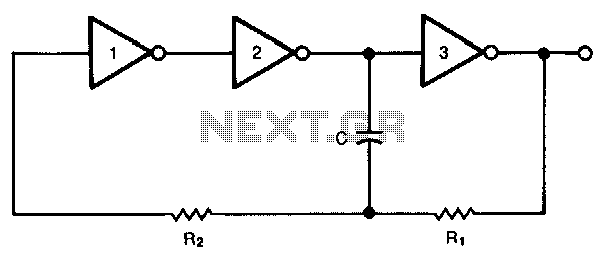
This circuit is guaranteed to oscillate at a frequency of approximately 2.2/(R1 x C) if R2 is greater than R1. Additionally, the number of gates can be reduced further by replacing gates 1 and 2 with a non-inverting gate.
The described...

Oscillator Buffers
CMOS buffers added to an operational amplifier oscillator enhance performance, primarily due to the asymmetry and variability of the operational amplifier's output saturation voltages.
The integration of CMOS buffers into an operational amplifier (op amp) oscillator circuit serves to significantly improve...

Cmos logic probe
The logic probe can indicate four input states, as follows: floating input - all LEDs off; logic 0 input - D2 switched on (D3 will briefly flash on); logic 1 input - D1 switched on; pulsing input - D3 switched...
Thrifty 2Hz Clock
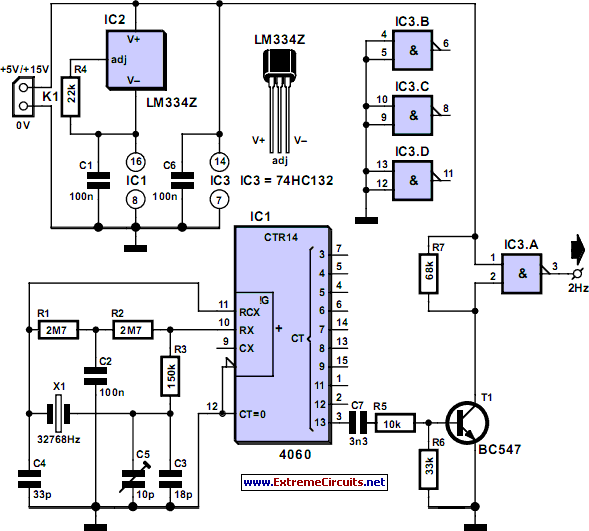
CMOS circuits are recognized for their low current consumption, which is particularly crucial for battery-powered applications. However, oscillators typically demand a significant amount of current. This proposed oscillator circuit achieves a very low current consumption of approximately 3 µA. It...

4-Bit Analogue to Digital Converter
The operation of the converter relies on the weighted addition and transfer of the analog input levels to the digital output levels. It comprises comparators and resistors. Although, theoretically, the number of bits is unlimited, each bit requires a comparator...

CMOS Pocketable Timekeeper
The CMOS Pocketable Timekeeper is a compact timekeeping circuit designed for portability. This circuit diagram illustrates the functionality of the CMOS Pocketable Timekeeper along with various advanced timer projects and electronic applications.
The CMOS Pocketable Timekeeper circuit utilizes complementary metal-oxide-semiconductor (CMOS)...