


Wide-range-rf-power-meter
#rf power meter
#Schottky diode
#chopper-stabilized op amp
#LM11
#detector
#amplifier
#de voltage
#ac conversion
#signal amplification

Description: The Hewlett-Packard HSCH-3486 zero-bias Schottky diode is utilized as the detector. To avoid employing a modulation detection method, a chopper-stabilized operational amplifier is implemented. The chopper operational amplifier effectively converts the input DC voltage to AC, amplifies it, and then converts it back to DC. The output from the detector is amplified 150 times using the chopper operational amplifier, raising the signal to a level manageable by simpler operational amplifiers, such as the LM11. Offset voltages in the amplifier are nullified using two potentiometers, one for the high range and another for the lower three ranges.
The Hewlett-Packard HSCH-3486 zero-bias Schottky diode serves as a crucial component in high-frequency detection applications due to its low forward voltage drop and fast switching capabilities. This diode functions effectively as a detector in RF applications, where rapid response times are essential for accurate signal processing.
The implementation of a chopper-stabilized operational amplifier in this configuration is significant. The chopper op-amp operates by periodically interrupting the input signal, converting it to an AC signal, and amplifying it. This method mitigates the effects of offset voltage and drift, which are common in traditional amplifiers. The AC signal is then demodulated back to a DC level, ensuring that the output is stable and suitable for further processing.
The amplification factor of 150 times is critical, as it elevates the weak signal from the Schottky diode to a range that can be effectively handled by subsequent stages of the circuit, particularly simpler op-amps like the LM11. The LM11, known for its low noise and high gain, can process the amplified signal without introducing significant distortion.
To ensure precision in signal processing, offset voltages within the amplifier are adjusted using two potentiometers. This dual-potentiometer configuration allows for fine-tuning across different ranges, accommodating variations in signal strength and ensuring that the output remains accurate across a broad spectrum of input conditions. The first potentiometer is designated for high-range adjustments, while the second is tailored for lower ranges, providing flexibility and precision in the overall circuit performance.
This design exemplifies the integration of advanced components to achieve reliable signal detection and amplification, making it suitable for various applications in electronic systems where high sensitivity and accuracy are required.The Hewlett-Packard HSCH-3486 zero-bias Schottky diode is used as the detector. To avoid using a modulation method of detection, a chopperstabilized op amp is used. The chopper op amp basically converts the input de voltage to ac, amplifies it, and converts it back to de. Amplifying the de output from the detector 150 times with a chopper op amp puts the signal at a level that simpler op amps, such as the LMll, can handle.
Offset voltages in the amplifier are nulled with two pots, one for the high range and one for the lower three ranges.
The Hewlett-Packard HSCH-3486 zero-bias Schottky diode serves as a crucial component in high-frequency detection applications due to its low forward voltage drop and fast switching capabilities. This diode functions effectively as a detector in RF applications, where rapid response times are essential for accurate signal processing.
The implementation of a chopper-stabilized operational amplifier in this configuration is significant. The chopper op-amp operates by periodically interrupting the input signal, converting it to an AC signal, and amplifying it. This method mitigates the effects of offset voltage and drift, which are common in traditional amplifiers. The AC signal is then demodulated back to a DC level, ensuring that the output is stable and suitable for further processing.
The amplification factor of 150 times is critical, as it elevates the weak signal from the Schottky diode to a range that can be effectively handled by subsequent stages of the circuit, particularly simpler op-amps like the LM11. The LM11, known for its low noise and high gain, can process the amplified signal without introducing significant distortion.
To ensure precision in signal processing, offset voltages within the amplifier are adjusted using two potentiometers. This dual-potentiometer configuration allows for fine-tuning across different ranges, accommodating variations in signal strength and ensuring that the output remains accurate across a broad spectrum of input conditions. The first potentiometer is designated for high-range adjustments, while the second is tailored for lower ranges, providing flexibility and precision in the overall circuit performance.
This design exemplifies the integration of advanced components to achieve reliable signal detection and amplification, making it suitable for various applications in electronic systems where high sensitivity and accuracy are required.The Hewlett-Packard HSCH-3486 zero-bias Schottky diode is used as the detector. To avoid using a modulation method of detection, a chopperstabilized op amp is used. The chopper op amp basically converts the input de voltage to ac, amplifies it, and converts it back to de. Amplifying the de output from the detector 150 times with a chopper op amp puts the signal at a level that simpler op amps, such as the LMll, can handle.
Offset voltages in the amplifier are nulled with two pots, one for the high range and one for the lower three ranges.
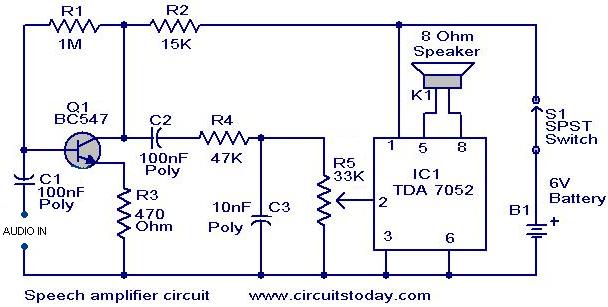
Speech amplifier circuit
This circuit can be housed within a box containing a speaker to create a convenient microphone amplifier. It is suitable for use by teachers, guides, lecturers, and others in crowded or noisy environments. The design is based on the audio...

Active-limiting-amplifier
The modified inverting amplifier employs an active clamp to precisely limit the output swing. Consideration must be given to the VBE of the transistors. The output swing is restricted by the base-emitter breakdown of the transistors. A straightforward circuit configuration...

Emitter negative feedback differential amplifier gain control circuit
A controllable gain amplifier functions as an automatic gain control circuit within the execution unit. The primary methods for controlling the amplifier's gain involve two approaches: one is by adjusting certain parameters of the amplifier itself, such as emitter current,...

Power Supply for Amlifiers [B]
Proposed power supply for amplifier 100W v-mosfet is what appears in the above form. It has separated supply for the various stages of supply, stage for power, stage for control, supply for preamplifier and for stage of protection. Whoever wants...

RF-AMP Documentation
The amplifier is suitable for various projects to buffer and amplify outputs from devices such as Direct Digital Synthesizer (DDS) chips. It was initially designed to amplify the output of the 9833 DDS chip and is also intended for Amateur...

Stereo audio power amplifier circuit using TDA2822
Circuit stereo TDA2822 audio power amplifier circuit schematics. In this series, the TDA2822M IC is utilized as the primary amplifier. Additionally, alternatives such as KA2209 and NJM2073 can also be employed.
The TDA2822 audio power amplifier circuit is designed to provide...

Band decoder circuit diagram
The circuit amplifier and attenuator control video detector consists of a composition for the synchronization channel. The synchronization interval is where the gain circuit is increased.
The described circuit involves an amplifier and an attenuator that work together to control a...

USB Powered Audio Power Amplifier
This circuit for multimedia speakers designed for PCs utilizes a single-chip architecture, operates on a low-voltage power supply, is compatible with USB power, facilitates easy heat dissipation, is cost-effective, offers high flexibility, and has a wide temperature tolerance. Central to...

Common intermediate frequency amplifier circuit having a circuit and on the radio
A common intermediate frequency amplifier circuit is presented, along with its components and parameters. The reference values for the components are as follows: 1) Transistors: VT1 to 3DG19, Vcc = 6V. 2) Resistance values: R1 = 50 kΩ, R2 =...